Huayan Robotics unveils integrated cobot joint modules in China
The Shanghai demonstration highlights a manufacturing shift combining motors, gearboxes and drive electronics into single rotary units.
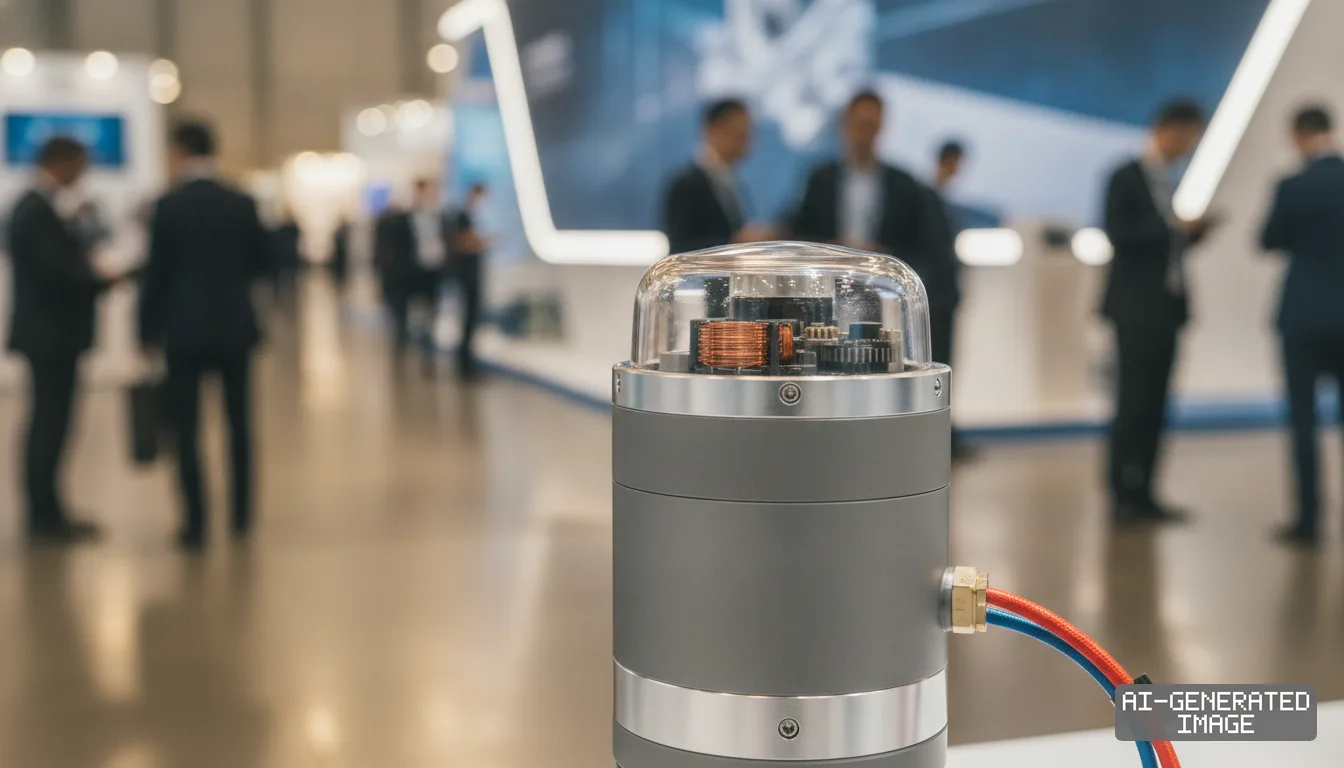
Huayan Robotics unveiled a mass-production joint actuator integrating five drive components for collaborative robots at the China International Industry Fair in Shanghai on Oct. 16, 2026.
The integrated package combines a frameless torque motor, harmonic gear reducer, 19-bit magnetic encoder, electromagnetic holding brake and field-oriented control driver into a sealed rotary housing.
By replacing discrete motor-gearbox setups, such packaged modules eliminate up to 70% of robotic arm integration time and remove separate external drive wiring, engineering data show.
South Korea's Ministry of Trade, Industry and Energy expanded its physical robotics component budget from 214.9 billion won to 402.2 billion won ($290 million) in 2026.
That 87% funding increase targets domestic commercialization of precision actuators, cycloidal gears and sensor arrays for industrial manipulators and humanoids, MOTIE budget documentation showed.
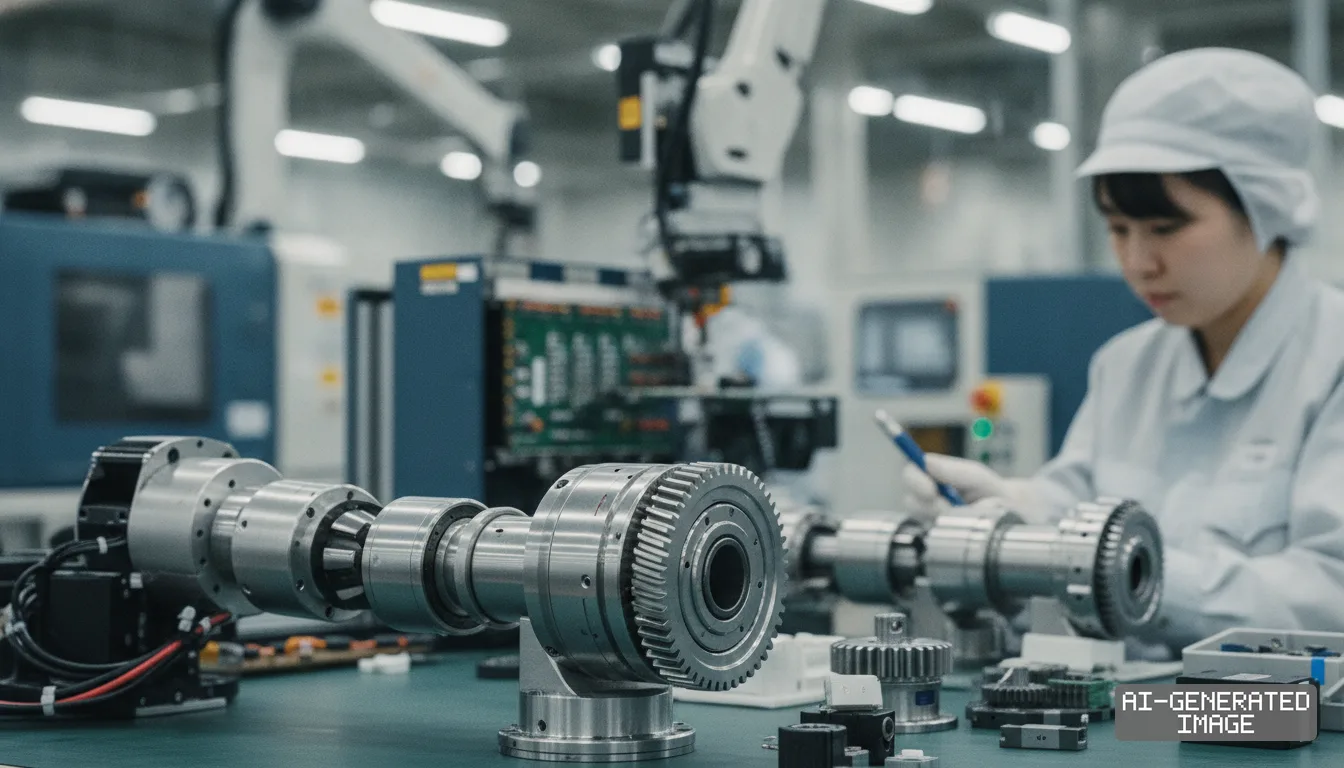
The module shift addresses a long-standing assembly bottleneck for industrial robotics builders, who previously sourced mechanical reducers, frameless stators, position sensors and servo inverters from separate component suppliers.
Systems integrators spent weeks shimming gear assemblies, tuning current loops and routing high-frequency harness cables through hollow robotic elbows to prevent mechanical snagging.
Kinco Automation documented the engineering transition in a technical paper on Sept. 22, detailing its iSMD integrated servo platform for automated machinery.
Kinco's units deliver 400 to 1,000 watts of continuous power at 24 to 60 volts of direct current, combining motor and drive to cut field failure rates.
Discrete component sourcing exposes robot builders to concentricity runout errors and thermal expansion mismatches between third-party reducers and motor stators, Kinco engineers said.
Integrating feedback sensors, electromagnetic brakes and power electronics into one factory-aligned shell transfers mechanical alignment precision from assembly halls to precision component specialists.
In South Korea, distributor Motor114 and actuator manufacturer EYOUBOT commercialized a family of harmonic joint actuators on June 11, after previewing prototypes on Feb. 24.
The EYOUBOT units integrate strain-wave gearheads, dual absolute encoders and FPGA motion controllers capable of executing field-oriented control loops at 20 kilohertz.
The strain-wave gearhead — a gear assembly using an elliptical plug to deform a thin steel cup against an outer ring — delivers high reduction ratios in tight spaces.
Dual absolute encoders allow the drive controller to measure rotor position and output-shaft deflection simultaneously, correcting for gear compliance in real time.
Central hollow bores measuring between 11 and 18 millimeters permit pneumatic tubing and industrial bus cabling to run internally through the rotating axis.
That internal routing eliminates external umbilical loops that snag on factory fixtures during tight articulated pick-and-place cycles, robot designers said.
The architecture also standardizes communication on real-time industrial Ethernet protocols, allowing controller cards to address each joint over EtherCAT or CANopen channels.
For collaborative arms handling payloads below 20 kilograms, strain-wave gears maintain zero backlash and positioning repeatability below 15 arcseconds, according to technical disclosures.
Zero backlash ensures the robotic arm does not wobble when changing directions under load, which is critical for precision electronics assembly and machine tending.
Embedded holding brakes lock the joints during sudden power interruptions, preventing multi-axis arms from dropping tooling onto factory workers or assembly conveyors.
Actuator makers report rated operational lifespans exceeding 8,000 hours under standard industrial duty cycles, reducing scheduled maintenance intervals for automated production cells.
South Korea is allocating 680 billion won in state backing under its 997.3 billion won K-On-Device AI Semiconductor project spanning 2026 through 2030.
The initiative subsidizes specialized microcontroller chips designed to run safety and torque-monitoring algorithms directly inside joint housing structures.
Embedding Safe Torque Off and Safe Brake Control directly into the joint inverter eliminates external safety relays and centralized cabinet space, automation engineers said.
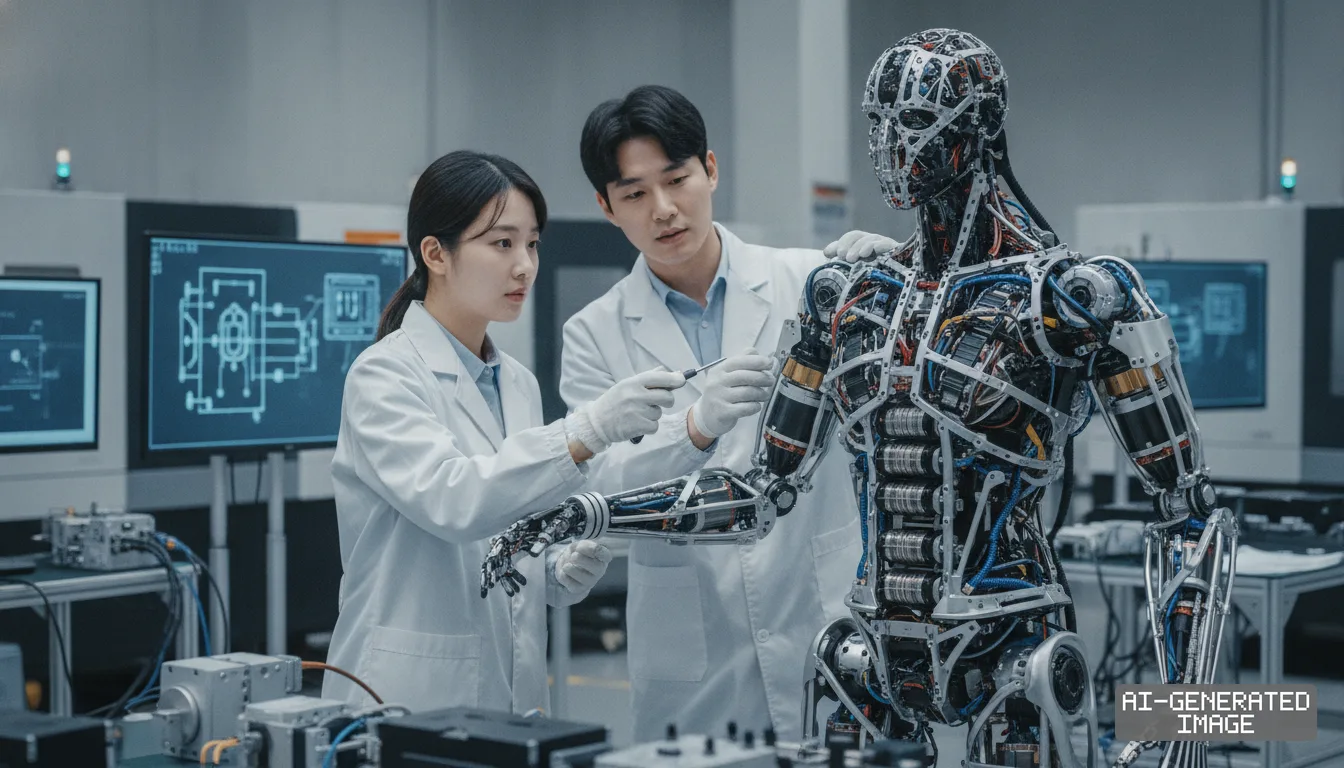
The approach allows small machine shops and specialized automation builders to assemble custom six-axis manipulators without maintaining dedicated precision mechanical machining facilities.
Component standardisation also reduces supply volatility by replacing multi-vendor procurement queues with single-part-number ordering for every degree of freedom.
Japanese precision component makers that historically supplied bare strain-wave reducers face rising demand to deliver integrated actuator assemblies rather than standalone mechanical gear sets.
Sourcing integrated modules shifts cost structures by moving precision assembly tolerances from the robotics factory floor into specialized component production lines.
The fair release did not disclose Huayan Robotics' commercial pricing per joint unit, and the company has not published its customer delivery timetable.
South Korea's trade ministry convenes its next robotics supply-chain review committee in Seoul on Nov. 25, 2026.
Impact map
How this development propagates across the region and out to global buyers.
| Event | Korea | China | Japan | Global impact |
|---|---|---|---|---|
| Cobot joint module integration | MOTIE commits 402.2 billion won to drive hardware while Motor114 rolls out 20kHz EtherCAT joints | Huayan and Kinco ramp all-in-one modules up to 1000W, shifting cobot SI procurement away from discrete parts | Precision reducer leaders face pressure to supply pre-tuned actuators instead of standalone strain-wave gears | Cobot integration lead times drop by up to 70% as 5-in-1 joint assemblies standardize motion bus wiring |
In this story
- Companies
- Huayan RoboticsKinco Automation
- Tickers
- 688160.SS
- Exposed
- Motor114EYOUBOT
- Policy
- Subsidies
- Impact
- Supply ChainCost Structure
Track every Subsidies development →
Related briefings
- Bruegel says EU-China trade deal fails to resolve subsidies in 2026 Also on Cost Structure, Subsidies
- Korean battery makers localize LFP cathodes under US rules Also on Cost Structure, Subsidies
- Korea Zinc Secures US Backing for $7.4B Tennessee Smelter Also on Cost Structure, Subsidies
- Hyundai adopts CATL safety tech for entry-level IONIQ V in China Also on Cost Structure, Subsidies
Sources
Primary documents
Reporting
Confidence: high — how we grade this
The documents behind this briefing are linked above. East Asia Brief produces its English text with AI assistance under human editorial review, and does not translate or republish other outlets' articles. See our methodology and AI policy. Spotted an error? Tell us.
The Morning Brief
What changed in Korean, Chinese and Japanese industry overnight — and what it means for your supply chain. One email, weekday mornings, US time. Free.
The Morning Brief is in preparation. Leave your address and we will write to you once — when the first issue is ready. Nothing before that.