FANUC UK restructures sales leadership to target aerospace and defense
The Japanese robotics maker's British unit named a dedicated account manager for aerospace on Sept. 3 as defense orders outpace automotive tooling.
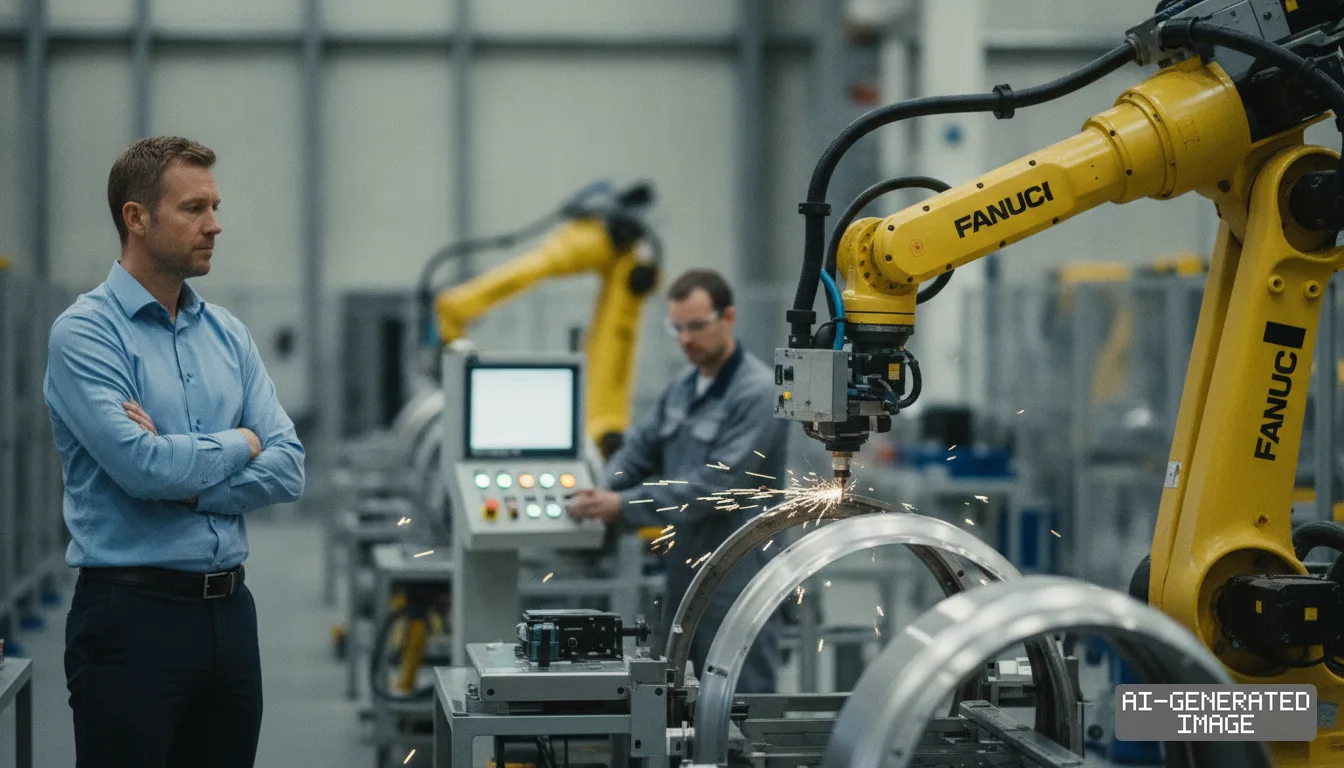
FANUC UK reorganized its commercial sales leadership on Sept. 3, appointing a dedicated executive to capture accelerating factory automation demand across aerospace and defense manufacturing programs.
The restructure took effect Sept. 1, moving former sales director Oliver Selby into the newly created role of strategic key account manager for aerospace and defense.
Dan Fisher succeeded Selby as head of sales for the unit, stepping up from business development duties across British manufacturing accounts.
The commercial changes reflect an effort to focus technical expertise on expanding industrial sectors, Managing Director Andy Armstrong said.
The British operating company is a commercial arm of Japan's FANUC Corporation, the world's largest supplier of computerized numerical control systems and industrial robots.
Parent company FANUC Corporation, headquartered in Yamanashi Prefecture, did not alter its corporate board structure, leaving the sales realignment focused on its British operations.
The parent company trades on the Tokyo Stock Exchange under ticker 6954 and published its regular monthly share repurchase notice on Sept. 3.
The subsidiary reorganization comes as global industrial robot makers reallocate commercial resources away from slowing automotive tooling programs toward high-value manufacturing niches.
Automotive assembly lines have historically absorbed the largest share of multi-axis articulated robots sold by Japanese manufacturers, including FANUC, Yaskawa Electric and Kawasaki Heavy Industries.
European automotive manufacturers have delayed capital expenditure on electric vehicle battery lines and body assembly facilities over the past 12 months.
Consumer electronics assemblers have also slowed machinery procurement following cyclical smartphone demand fluctuations and manufacturing capacity additions across East Asia.
Commercial aerospace prime contractors face opposite pressures, carrying multi-year aircraft order backlogs that require higher production rates across component supply networks.
Commercial aircraft manufacturers Airbus and Boeing hold order books extending past 2030, putting pressure on tier-one suppliers to expand monthly delivery rates for structural components.
Aerospace suppliers in Britain and Western Europe have struggled to expand shipments of fuselages, wing boxes and engine nacelles because skilled machining labor remains scarce.
Defense ministries across Europe have simultaneously expanded procurement budgets, pressing contractors to lift output for guided missiles, artillery munitions and tactical vehicle assemblies.
Aerospace and defense production lines long relied on manual labor and specialized static jigs because production runs were too small to justify automotive-style automation.
Rising delivery schedules and tighter machining tolerances are pushing aerospace contractors to adopt six-axis articulated arms and high-precision collaborative robots.
Modern robotic arms equipped with optical vision sensors and force feedback controls can switch between short-run production batches without extensive physical retooling.
Composite airframe structures require automated fiber placement, ply manipulation and ultrasonic non-destructive testing cells that maintain strict quality standards across large surface areas.
FANUC UK previously supplied heavy-payload industrial robots to British systems integrator Loop Technology to build automated preforming and carbon-fiber manipulation cells.
That automated tooling system uses robotic end-effectors for composite ply tacking and inspection, reducing cycle times for composite wing skin production.
The automation supplier also collaborated with aerospace tooling specialist Electroimpact and toolmaker Luebbering to build automated drilling systems for aircraft assembly.
Those robotic drilling units automate the process of drilling thousands of precision holes along airframe structures, replacing pneumatic hand drills used by manual operators.
Automating airframe drilling cuts production cycle times and eliminates repetitive-strain injuries that frequently cause labor shortages in structural assembly hangars.
Selby, who also chairs the robotics group at industry association Automate UK, will oversee accounts integrating automated manufacturing cells into defense and aerospace plants.
Assigning a dedicated sales director to aerospace accounts marks a departure from sales models that organized commercial coverage strictly by geographic territories.
Aerospace and defense installations require specialized supplier vetting, defense security compliance and strict data traceability that general industrial sales teams rarely manage.
Japanese robotics manufacturers face direct competition from Switzerland's ABB and Germany's KUKA in supplying automated assembly equipment to Western defense contractors.
Defense manufacturing facilities present specialized operating environments where industrial robots handle explosive materials, heavy steel munitions forgings and toxic anti-corrosion chemical coatings.
Military procurement authorities in Britain and allied nations are encouraging defense contractors to establish sovereign manufacturing facilities that can maintain production during supply shocks.
Aerospace demand extends beyond articulated robotic arms to computer numerical control equipment that directs multi-axis milling machines cutting titanium and nickel superalloys.
FANUC Corporation introduced integrated five-axis machining control software on Aug. 24, seeking to reduce setup times for precision machine tools handling complex airframe structures.
Automated machine tending cells that pair FANUC Robodrill machining centers with articulated robot arms allow defense machine shops to run unstaffed shifts overnight.
High-precision robotic cells also assist defense contractors in assembling guidance assemblies and unmanned aerial vehicle fuselages requiring strict positional repeatability.
The automation supplier said its newly structured commercial sales team began operating under the revised management reporting structure on Sept. 1.
Impact map
How this development propagates across the region and out to global buyers.
| Event | Korea | China | Japan | Global impact |
|---|---|---|---|---|
| Aerospace automation push | component machining demand | — | robotics export shift | defense production surge |
In this story
- Companies
- FANUC CorporationFANUC UK
- Tickers
- 6954.T
- Exposed
- AirbusBoeingLoop TechnologyElectroimpactABBKUKA
- Policy
- Economic Security
- Impact
- Order BookSupply ChainCapex
Track every Economic Security development →
Related briefings
- Bell Textron vets 17 Korean suppliers for helicopter supply chain Also on Airbus, Boeing, Order Book
- FANUC America links factory robots to Palladyne AI platform Also on KUKA, FANUC Corporation, ABB
- FANUC opens $18 million Michigan robotics training academy Also on KUKA, FANUC Corporation, ABB
- Estun Automation completes buyout of robotics unit Codroid Also on KUKA, ABB, Order Book
Sources
Reporting
Confidence: medium — how we grade this
The documents behind this briefing are linked above. East Asia Brief produces its English text with AI assistance under human editorial review, and does not translate or republish other outlets' articles. See our methodology and AI policy. Spotted an error? Tell us.
The Morning Brief
What changed in Korean, Chinese and Japanese industry overnight — and what it means for your supply chain. One email, weekday mornings, US time. Free.
The Morning Brief is in preparation. Leave your address and we will write to you once — when the first issue is ready. Nothing before that.