Japan vision makers deploy polarized image sensors for carbon fiber testing
High-speed CMOS polarization sensors with on-chip nanowire grids enable single-shot defect detection on automated aerospace and automotive composite assembly lines.
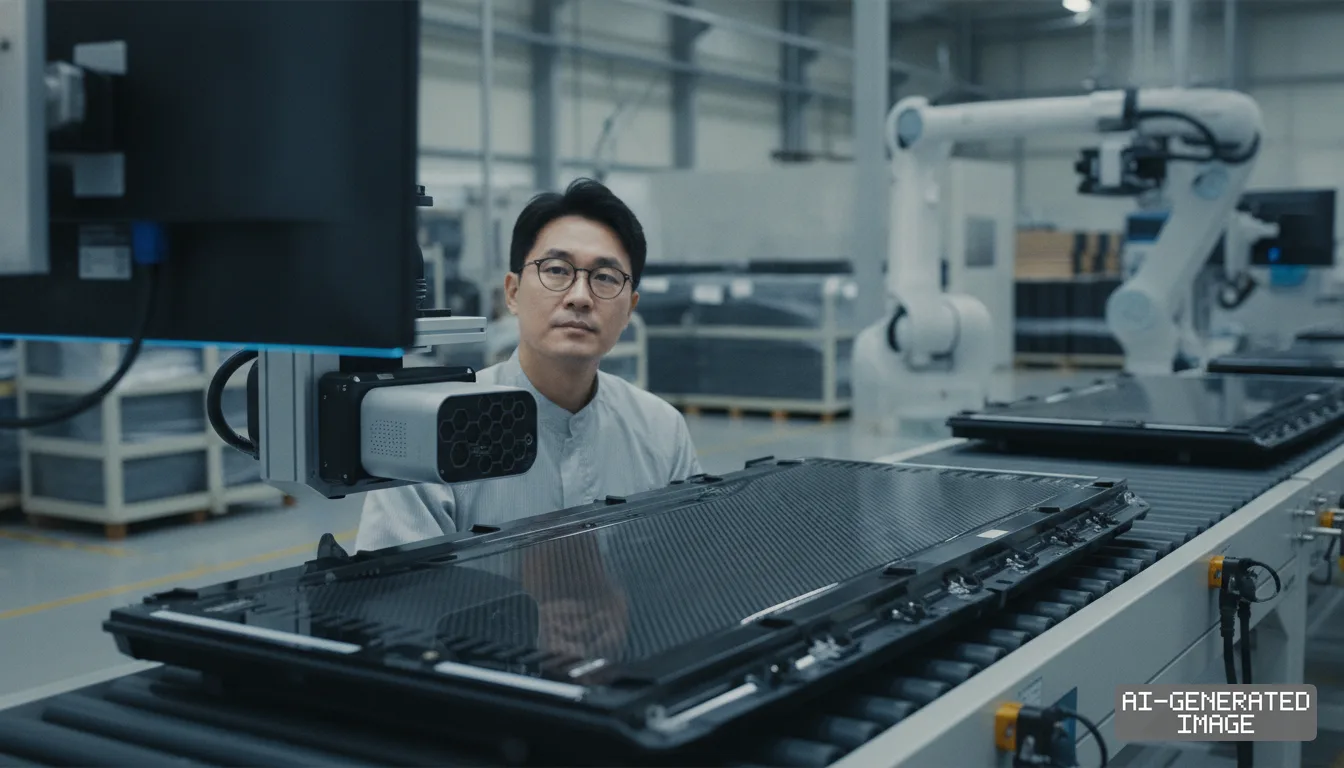
Japanese machine vision manufacturers and sensor developers are deploying high-speed polarization imaging hardware to automate non-destructive inspection of carbon fiber reinforced polymers across aerospace and automotive manufacturing lines. The rollout integrates on-chip polarizer arrays directly onto industrial image sensors, allowing automated production lines to detect fiber misalignments, subsurface weave distortions, and matrix stress concentrations in a single optical exposure without halting production conveyors.
Carbon fiber reinforced polymers, known as CFRP, serve as structural materials in modern commercial aircraft airframes and electric vehicle battery enclosures due to their high strength-to-weight ratio. Verifying the internal structural integrity of these composite laminates has historically formed a major manufacturing bottleneck, as conventional non-destructive evaluation relies on ultrasonic immersion tanks, laser shearography, and X-ray computed tomography systems that operate offline at low throughput rates.
The transition toward inline optical validation centers on specialized sensor architectures developed by Japanese component makers, led by Sony Semiconductor Solutions Corporation and high-speed imaging specialist Photron Ltd. Working alongside optical developer Photonic Lattice, Inc., these manufacturers have commercialized imaging arrays that capture multi-directional linear polarization parameters at frame rates exceeding 100 frames per second, matching the velocity requirements of automated fiber placement and automated tape laying machines.
At the hardware level, Sony Semiconductor Solutions built its Polarsens CMOS image sensor portfolio, including the IMX250MZR and IMX253MZR monochrome models and the IMX264MZR platform, around on-chip wire-grid polarizer technology. Rather than positioning mechanical rotating filters or liquid crystal modulators in front of the lens barrel, the sensor integrates four-directional aluminum nanowire polarizers oriented at 0, 45, 90, and 135 degrees directly over individual photodiodes in repeating two-by-two pixel matrices beneath the micro-lens array.
This architecture enables the sensor to calculate both the Angle of Linear Polarization and the Degree of Linear Polarization simultaneously for every four-pixel cluster in a single exposure. With pixel pitches of 3.45 micrometers and global shutter readout mechanisms capable of operating at up to 163.4 frames per second in eight-bit analog-to-digital conversion modes, the sensor eliminates motion blur and focal plane distortion on continuous production lines.
Photron and Photonic Lattice have targeted ultra-high-speed stress and birefringence analysis through the CRYSTA series of specialized polarization cameras. These devices employ photonic crystal micro-polarizer arrays fabricated through multi-layer sputter deposition on single quartz and silicon substrates, allowing systems like the CRYSTA PI-1P to record dynamic stress propagation, crack development, and thermal residual stress distributions in composite matrices under mechanical loading.
The physical operating principle underlying carbon fiber polarization vision relies on the intrinsic optical properties of synthetic carbon filaments. Individual carbon fibers possess cylindrical geometries and anisotropic reflective properties that strongly polarize reflected incident light parallel to the longitudinal direction of the filament axis. When illuminated by structured unpolarized or circularly polarized light sources, the reflected beam conveys the exact spatial orientation of the outermost fiber plies directly to the polarization sensor array.
Machine vision algorithms process the resulting Stokes parameter arrays to measure fiber orientation angles across dry fabric preforms and resin-impregnated prepregs with angular measurement accuracy ranging between 0.1 and 0.2 degrees. This angular resolution allows automated inspection software to spot tow deviations, fiber gaps, overlaps, bridging defects, and out-of-plane fiber undulations that remain undetectable under standard monochromatic or color machine vision illumination.
For aerospace aerostructure suppliers, including Japan-based primary contractors Mitsubishi Heavy Industries, Kawasaki Heavy Industries, and Subaru Corporation producing wing boxes and fuselage sections for commercial jetliners, automating composite ply verification directly inside automated tape placement cells removes the risk of laminating flawed plies into structural autoclaves. Detecting a fiber gap or tow twist during tape placement prevents defective parts from completing curing cycles, eliminating material scrap costs that reach tens of thousands of dollars per composite panel.
In the automotive sector, where composite use expands into structural electric vehicle battery enclosures, hydrogen pressure vessels, and chassis crossmembers, polarization vision systems allow tier-one suppliers to replace sample-based destructive testing with inline surface and subsurface verification. High-speed cameras verify the fiber orientation of non-crimp fabrics and chopped fiber compression moldings before high-pressure resin transfer molding presses close, securing uniform mechanical stiffness across structural vehicle safety components.
Equipment integrators installing polarization machine vision heads report cycle time reductions compared to acoustic and X-ray modalities. While ultrasonic scanning requires several hours to map a large composite skin component, single-shot polarization cameras mounted on six-axis inspection robots scan composite surfaces at line speeds of several meters per minute, delivering real-time pass-fail coordinates directly to factory manufacturing execution systems.
Industrial camera makers are standardizing polarization data transport protocols across GigE Vision and CoaXPress camera interfaces, enabling vision software platforms to ingest raw four-channel polarization intensity matrices directly without proprietary software decoders. Production facilities across Japan, Europe, and North America are validating these polarized inspection cells to meet aerospace quality compliance standards under AS9100 quality management frameworks.
Impact map
How this development propagates across the region and out to global buyers.
| Event | Korea | China | Japan | Global impact |
|---|---|---|---|---|
| Inline CFRP polarization inspection | battery enclosure QA | drone composite validation | vision sensor hardware | aerospace cycle time reduction |
In this story
- Companies
- Sony Semiconductor SolutionsPhotronPhotonic Lattice
- Tickers
- 6758.T
- Exposed
- Mitsubishi Heavy Industries
- Policy
- Economic Security
- Impact
- Supply ChainOrder BookCost Structure
Track every Economic Security development →
Related briefings
- Japanese shipbuilders standardize electric coastal feeder designs to cut renewal costs Also on Mitsubishi Heavy Industries, Cost Structure, Order Book
- Pentagon ends Chinese mineral waivers before 2027 deadline Also on Mitsubishi Heavy Industries, Cost Structure
- China bars dual-use exports to Japan citing military end-use Also on Mitsubishi Heavy Industries, Cost Structure
- Mitsubishi Heavy buys shipyard land in Shimonoseki buildout Also on Mitsubishi Heavy Industries, Order Book
Sources
Primary documents
Reporting
Confidence: high — how we grade this
The documents behind this briefing are linked above. East Asia Brief produces its English text with AI assistance under human editorial review, and does not translate or republish other outlets' articles. See our methodology and AI policy. Spotted an error? Tell us.
The Morning Brief
What changed in Korean, Chinese and Japanese industry overnight — and what it means for your supply chain. One email, weekday mornings, US time. Free.
The Morning Brief is in preparation. Leave your address and we will write to you once — when the first issue is ready. Nothing before that.