FANUC spends $18 million on Michigan robotics training center
The 132,000-square-foot Auburn Hills academy doubles classrooms to 28, targeting factory labor shortages across North American supply chains.
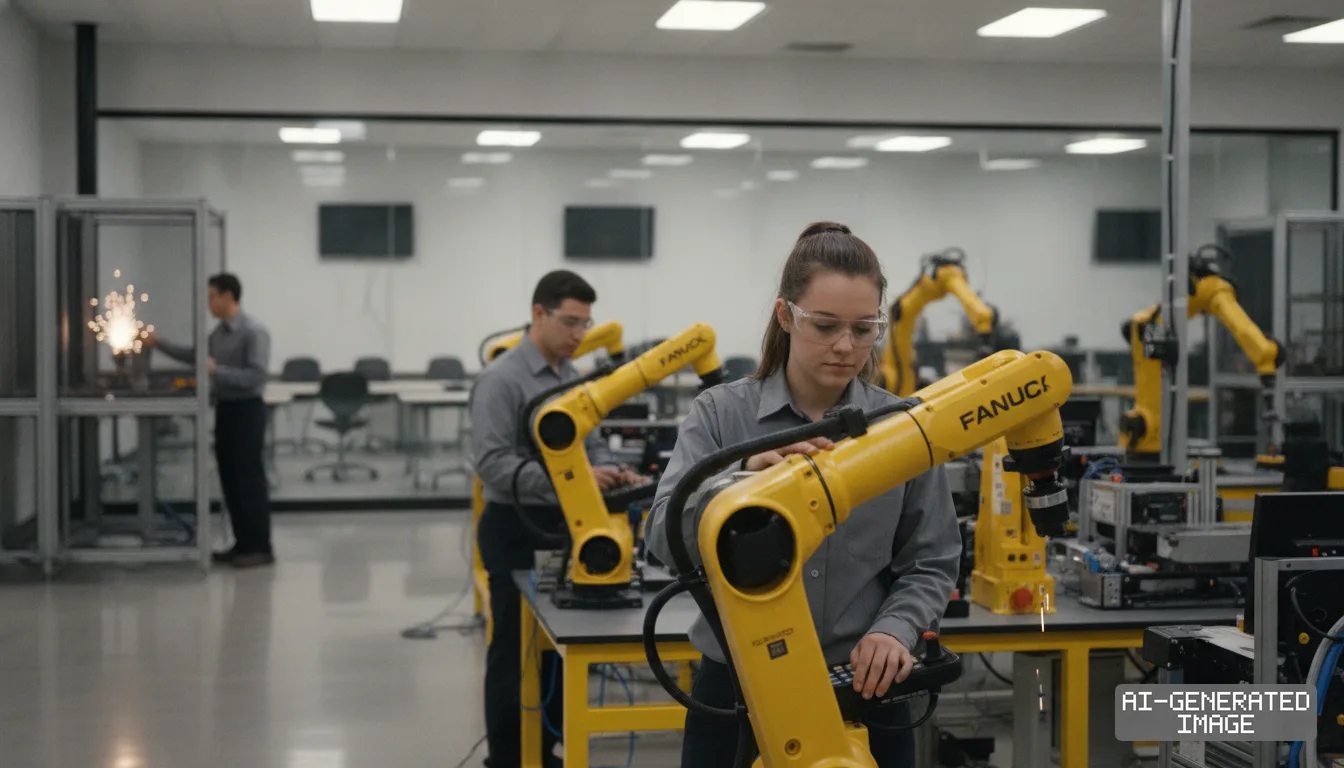
FANUC America deployed on Nov. 14 its full training program at a new $18 million robotics academy in Auburn Hills, Michigan, expanding instruction to resolve skilled labor shortages across North American manufacturing plants.
The $18 million facility covers 132,000 square feet, allocating 56,300 square feet specifically to training bays and classrooms. The project represents roughly 17% of the company's $108 million Michigan capital expenditure program this year.
The site replaces an older training center at the company headquarters in Rochester Hills, Michigan. Classroom count rises from 13 to 28, more than doubling instructional capacity in a single move.
Across its Auburn Hills hub and eight regional satellite facilities, the company can now train approximately 17,500 participants annually. The network operates more than 160 industrial robots and over 40 computerized numerical control simulators.
Industrial robot shipments have accelerated across the United States as domestic manufacturers reshore component production. Factory operators, however, repeatedly encounter an acute shortage of technicians capable of programming, maintaining and troubleshooting automated machinery.
System downtime often costs high-volume assembly lines tens of thousands of dollars per minute. Without qualified in-house technicians, plant managers hesitate to deploy complex multi-robot workcells, dampening automation capital deployment.
North America serves as the primary growth engine for parent company FANUC Corporation. The Japanese automation builder generates roughly 68% of its regional revenue in the Americas from its robot division.
Robotics sales across the group rose 12.6% year-on-year to ¥194.3 billion ($1.29 billion) during the six months ended Sept. 30, 2026. Global demand was driven by sustained factory retooling in the Americas and China.
The robot business accounted for 44.1% of FANUC Corporation's consolidated net sales in the fiscal year ended March 31, 2026. Defending that market share requires anchoring the technical workforce that programs its distinctive yellow arms.
Training operators creates a structural switching barrier in automated manufacturing. Technicians trained on proprietary teach pendants — the handheld control terminals used to program robotic motion paths — tend to recommend identical robotic hardware for subsequent assembly lines, securing long-term recurring orders.
Rival automation vendors, including Switzerland-headquartered ABB and Japanese competitor Yaskawa Electric, are also expanding service networks in North America. Retaining engineer loyalty through early institutional training insulates equipment suppliers from competitive hardware displacement.
The company works with more than 1,700 educational institutions across North America through its Certified Education Training program. That curriculum reaches approximately 60,000 high school and community college students each year.
Instruction at the Auburn Hills academy covers entry-level mechatronics, advanced motion trajectory planning and vision-guided part sorting. Attendees include tier-one automotive component suppliers, independent system integrators and vocational instructors.
Automotive manufacturers in Michigan, Ohio and Indiana form the initial user base for the expanded academy. Retooling assembly lines for hybrid and electric vehicle components requires plant personnel to master multi-axis robotic spot welding and adhesive dispensing.
General industrial customers outside automotive fabrication are also increasing automated cell installations. Warehousing logistics, consumer packaging plants and aerospace machining shops represent an increasing share of newly trained personnel in Auburn Hills.
The academy buildout complements a separate $90 million manufacturing facility that the company announced in March. That site was designed to provide production-ready capacity for potential domestic robotic assembly operations in Michigan.
Combined with prior developments, FANUC America now occupies nearly two million square feet of operational floorspace across Oakland County, Michigan. The infrastructure footprint concentrates engineering support within driving distance of major automotive design centers.
Modern automated cells increasingly incorporate physical artificial intelligence and machine vision sensors that inspect parts in real time. Deploying such advanced vision systems requires plant technicians to interpret diagnostic algorithmic data rather than rely solely on mechanical maintenance.
The presence of 40 CNC simulators highlights the operational convergence between metal-cutting machine tools and robotic handling arms. Machine-tending cells that load rough castings require synchronized programming between the numerical controller and the robotic arm.
The three-story building was completed using a Michigan-based contractor network led by Frank Rewold & Sons. In addition to instructional halls, the building contains 200 parking stalls and specialized demonstration areas.
Federal and state authorities have encouraged private investments in advanced manufacturing education. The United States Department of Labor has supported corporate apprenticeship initiatives designed to align technical community college curricula with factory automation standards.
Manufacturers that enroll workers in hands-on equipment labs report faster commissioning schedules for newly delivered production lines. Minimizing programming errors during initial trial runs prevents costly delays during automotive model changeovers.
A dedicated customer support call center situated within the Auburn Hills complex is scheduled for completion in 2027, the company said.
The company has not disclosed the tuition revenue generated by the academy, nor has it published the exact pass rate requirements for commercial integrator certification.
Impact map
How this development propagates across the region and out to global buyers.
| Event | Korea | China | Japan | Global impact |
|---|---|---|---|---|
| FANUC training academy deployment | domestic robot arm manufacturers face steeper software switching barriers in US automotive supply chains | industrial automation suppliers encounter entrenched Japanese hardware service footprints across North America | FANUC Corporation expands high-margin servicing and operator lock-in across North American manufacturing hubs | automotive and aerospace plants accelerate automation commissioning as technician throughput reaches 17,500 annually |
| FANUC training academy deployment | domestic robot arm manufacturers face steeper software switching barriers in US automotive supply chains | industrial automation suppliers encounter entrenched Japanese hardware service footprints across North America | FANUC Corporation expands high-margin servicing and operator lock-in across North American manufacturing hubs | automotive and aerospace plants accelerate automation commissioning as technician throughput reaches 17,500 annually |
In this story
- Companies
- FANUC CorporationFANUC America
- Tickers
- 6954.T
- Impact
- CapexSupply ChainOrder Book
Related briefings
- FANUC opens $18 million Michigan robotics training academy Also on FANUC America, FANUC Corporation
- FANUC America unveils packaging robotics for PACK EXPO 2026 Also on FANUC America, FANUC Corporation
- FANUC debuts welding and painting robots for FABTECH 2026 Also on FANUC America, FANUC CORPORATION, Order Book
- FANUC America taps Palladyne AI for factory robot autonomy Also on FANUC America, Order Book
Sources
Reporting
Confidence: medium — how we grade this
The documents behind this briefing are linked above. East Asia Brief produces its English text with AI assistance under human editorial review, and does not translate or republish other outlets' articles. See our methodology and AI policy. Spotted an error? Tell us.
The Morning Brief
What changed in Korean, Chinese and Japanese industry overnight — and what it means for your supply chain. One email, weekday mornings, US time. Free.
The Morning Brief is in preparation. Leave your address and we will write to you once — when the first issue is ready. Nothing before that.