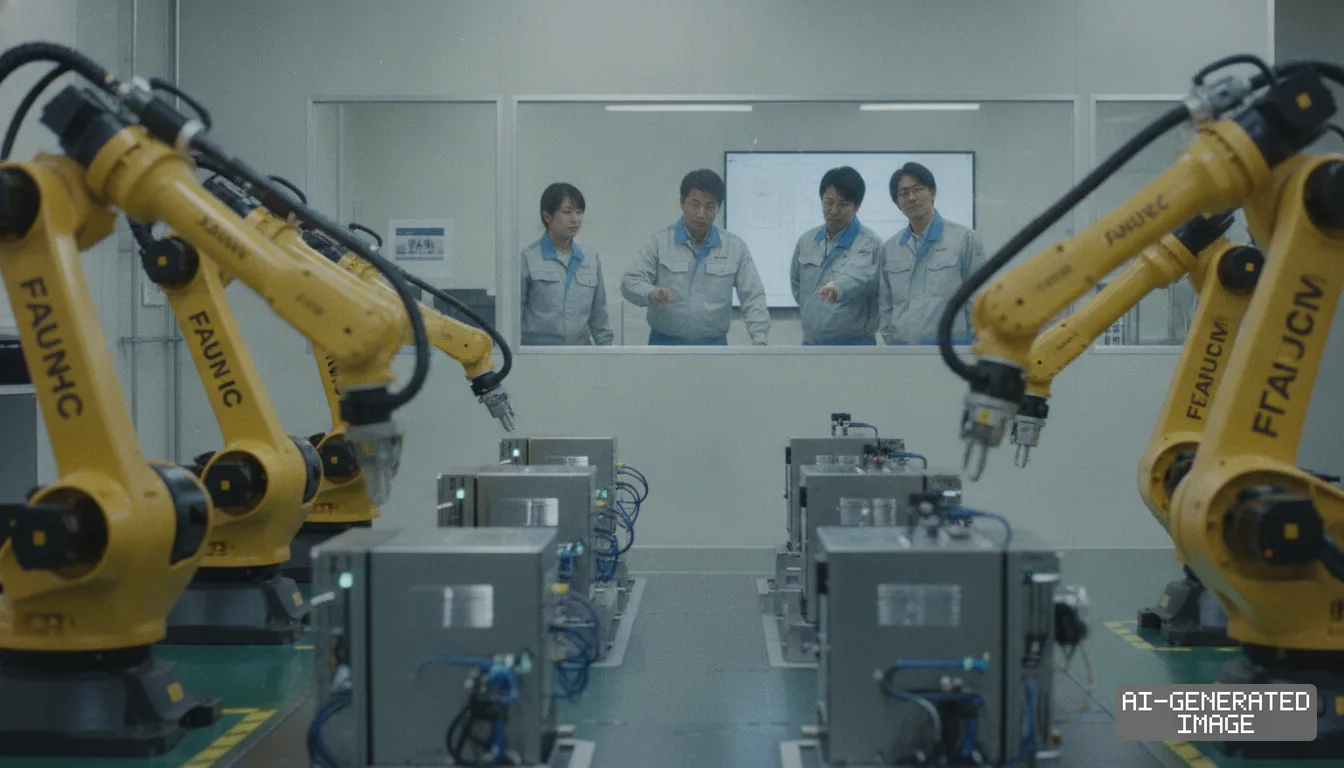
FANUC debuts welding and painting robots for FABTECH 2026
The lineup introduces an 11-kilogram collaborative welding arm alongside multi-robot coordinated systems designed to ease structural metal fabrication and industrial finishing.
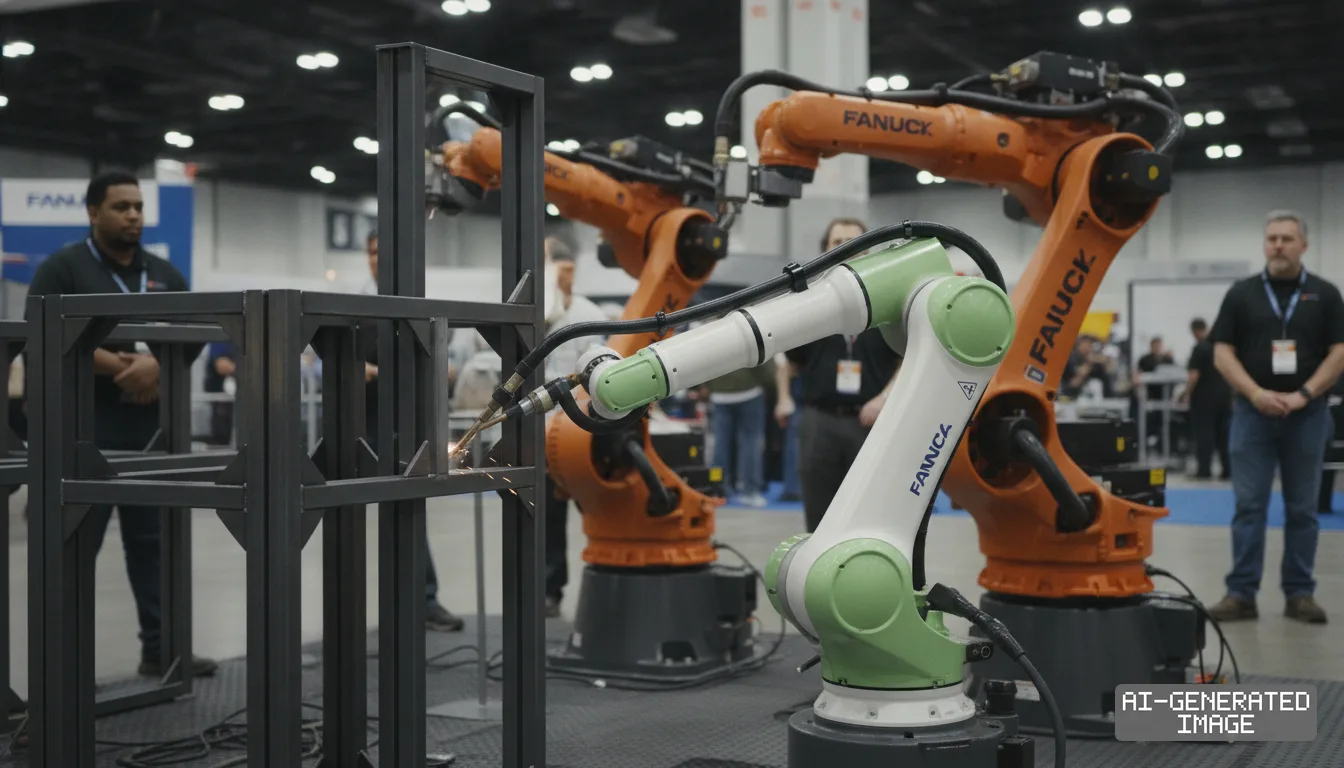
FANUC America announced Oct. 5, 2026, that it will demonstrate specialized welding and painting robotic systems designed for confined structural assembly at the FABTECH 2026 trade show in Las Vegas.
The showcase marks the North American exhibition debut of the CRX-3iA collaborative robot. The unit weighs 11 kilograms and supports a three-kilogram payload across a 692-millimeter reach.
With a repeatability tolerance of ±0.02 millimeters, the lightweight arm represents the smallest collaborative manipulator built by the Japanese automation company. It carries both a welding torch and seam sensors.
The robotic arm uses an integrated magnetic base that anchors directly onto heavy ferrous plate. Built-in sensors automatically determine the installation orientation after workers reposition the tool inside structural steel enclosures.
Integrated wire touch sensing locates joint seams and calculates path corrections without manual reprogramming. That capability allows the system to conduct vertical-up welding — moving the weld puddle upward along a joint.
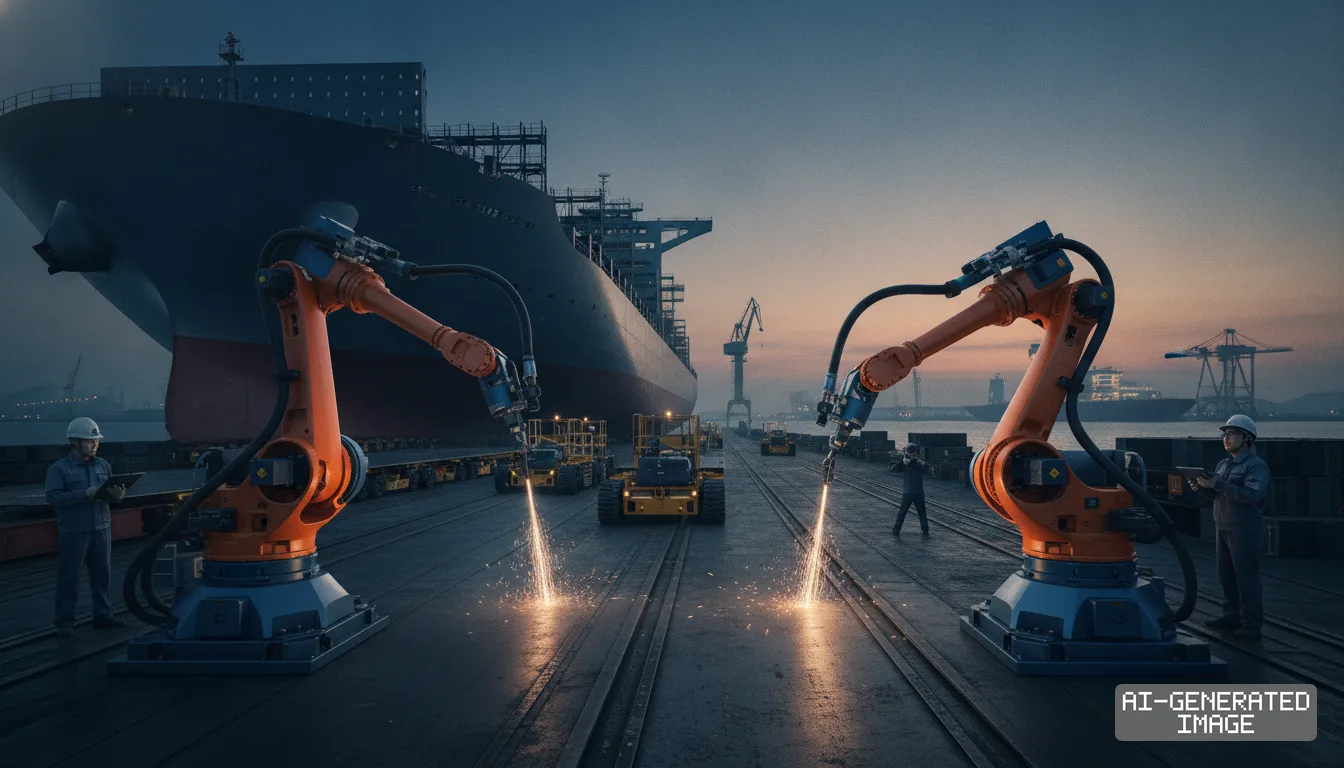
Confined fabrication compartments in shipyards and bridge construction have long relied on manual labor. Workers struggle to access narrow double-hull compartments where conventional 500-kilogram articulated robots cannot fit.
Aging workforces and certified welder deficits across North America and East Asia have intensified pressure on industrial yards. Portable cobots allow a single technician to supervise multiple automatic welding torches simultaneously.
FANUC America will also introduce the P-55/15-21A painting robot in Paint Booth #S11008 at the convention. The unit targets high-precision coating across irregular automotive and industrial machinery components.
The painting arm is engineered to deliver uniform film thickness while adjusting dynamically to varying part geometries. It operates alongside industrial coating lines to reduce overspray and hazardous solvent emissions.
In Main Booth #S40006, the company plans to demonstrate a high-capacity multi-arm welding cell. The setup pairs a heavy-payload M-950/500F-28A robot with two articulated ARC Mate welding manipulators.
The three machines execute synchronized coordinated motion, allowing the primary arm to position bulky structural assemblies while the two secondary arms weld critical joints. This layout eliminates intermediate part re-clamping.
FANUC will also display a CRX-10iA/L collaborative robot mounted on an integrated seventh-axis rail. The linear transfer mechanism expands the arm's reach across long workpieces without requiring stationary repositioning.
The rail-mounted system performs continuous arc passes along extended beams and agricultural frames. Operators program torch paths through hand-guided teaching or tablet interfaces using graphic software icons.
A separate cell features the LR-10iA/10 robot executing both automated laser welding and part marking within a single workstation. Consolidating the two processes removes material handling steps between production stations.
The compact laser cell targets precision sheet-metal enclosures and battery hardware assemblies. It relies on enclosed beam optics and integrated suction to maintain clean operating conditions on shop floors.
The hardware configurations run on FANUC's R-50iA and R-30iB Plus controller architectures. These platforms incorporate embedded machine vision tools and force sensors that monitor torch contact pressure during fabrication.
Parent company FANUC CORPORATION builds the mechanical manipulators and digital CNC drives at its primary manufacturing facilities in Yamanashi Prefecture, Japan. The group distributes automated cells globally.
"At FABTECH 2026, FANUC is demonstrating how automation is expanding into applications that were once difficult to automate," Eric Potter, vice president of product management and application engineering at FANUC America, said.
These technologies help fabricators address labor constraints while broadening the range of automated welding and thermal cutting, Potter said. The systems emphasize portable deployment over rigid safety fencing.
FANUC began initial mass production of the CRX-3iA platform in Japan in January 2026. The company completed commercial certification for North American structural and industrial steel fabricators later this year.
FANUC America has not published unit list pricing or commercial delivery lead times for the CRX-3iA or the P-55/15-21A. Equipment availability will depend on integration options selected by regional fabricators.
The machinery will make its public operating debut when FABTECH 2026 opens Oct. 21, running through Oct. 23 at the Las Vegas Convention Center.
Impact map
How this development propagates across the region and out to global buyers.
| Event | Korea | China | Japan | Global impact |
|---|---|---|---|---|
| Portable welding robot debut | Shipyards test portable cobots against domestic Rainbow Robotics units in double hulls | Heavy industrial shops rely on gantry robots as Japanese compact arms lead high-precision niches | FANUC ramps domestic Yamanashi production of compact harmonic drives and lightweight arms | Steel fabricators deploy magnetic-mount cobots to counter skilled welder shortages |
In this story
- Companies
- FANUC CORPORATIONFANUC America
- Tickers
- 6954.T
- Impact
- Order BookCost Structure
Related briefings
- FANUC America taps Palladyne AI for factory robot autonomy Also on FANUC America, Cost Structure, Order Book
- IndexBox projects delta robot market will double by 2035 Also on Fanuc Corporation, Cost Structure
- FANUC America links factory robots to Palladyne AI platform Also on FANUC Corporation, Cost Structure
- Fanuc and Yaskawa Expand China Motion Control Plants to Meet Local Content Rules Also on Fanuc Corporation, Cost Structure
Sources
Reporting
Confidence: medium — how we grade this
The documents behind this briefing are linked above. East Asia Brief produces its English text with AI assistance under human editorial review, and does not translate or republish other outlets' articles. See our methodology and AI policy. Spotted an error? Tell us.
The Morning Brief
What changed in Korean, Chinese and Japanese industry overnight — and what it means for your supply chain. One email, weekday mornings, US time. Free.
The Morning Brief is in preparation. Leave your address and we will write to you once — when the first issue is ready. Nothing before that.