China RV reducer makers expand heavy-duty robot market share as national testing standards take hold
Chinese gear manufacturers push domestic substitution in 6-axis articulated robot joints past 80% using unified precision cycloidal standards and local CR certification rules. [175자]
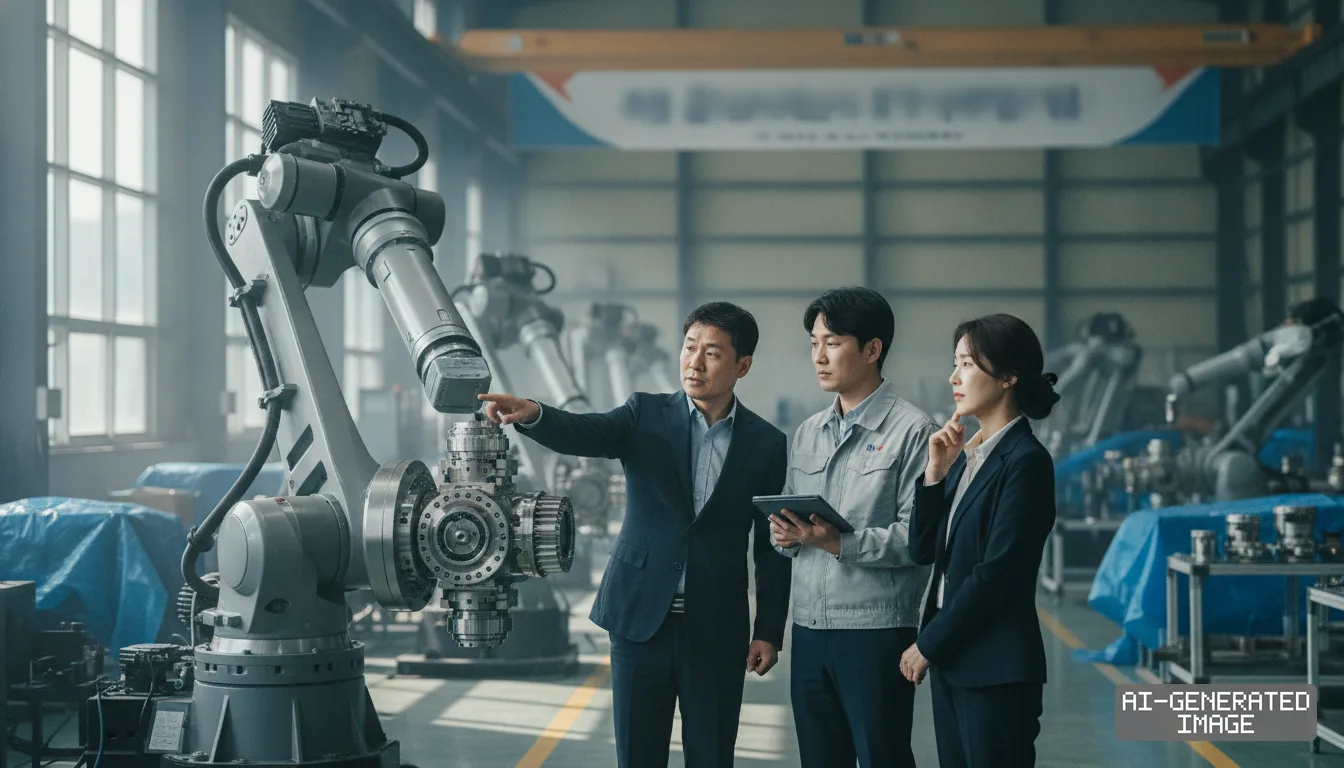
Zhejiang Shuanghuan Driveline and domestic precision transmission builders expanded commercial delivery of rotary vector cycloidal reducers on Aug. 28, 2026, advancing standardized component integration across heavy-duty industrial robotic arms.
The expansion targets six-axis articulated robots, which rely on rotary vector reducers — high-rigidity gearboxes that convert high-speed motor rotation into low-speed, high-torque joint movement — across their heavy-payload base, shoulder and elbow joints.
Japanese manufacturers Nabtesco Corporation and Sumitomo Heavy Industries historically supplied over 70% of these heavy-payload motion units across Asian assembly plants.
Chinese automation equipment builders have now raised the domestic sourcing share for mid-to-heavy industrial robot speed reducers past 80% across domestic vehicle assembly and clean-energy manufacturing lines.
Reducers represent 15% to 25% of an industrial robot's total bill of materials, making component procurement costs and supply stability critical for factory builders.
The nationwide manufacturing push rests on standard GB/T 37718-2019, which the State Administration for Market Regulation and the Standardization Administration of China enacted on Jan. 1, 2020.
The document set technical requirements and dimensional benchmarks for precision planetary cycloidal reducers used in robotic articulated joints.
That technical baseline built upon national standard GB/T 35089-2018, enacted on Dec. 1, 2018, which defined standardized testing methods for transmission error, backlash, torsional rigidity and operational fatigue life.
Regulators reinforced the precision drivetrain framework with national standard GB/T 37165-2018, establishing uniform structural definitions for precision cycloidal-pin-wheel reducers.
Formal product qualification shifted through the National Robot Testing and Assessment Center in Guangzhou, which enacted official CR Certification implementation rules for robot precision reducers on Dec. 1, 2019.
Joint venture supplier Shanghai Nabtesco Motion Equipment secured the initial CR certificate for its RV-110E cycloidal reducer model in Jan. 2023.
Domestic manufacturer Greatoo Intelligent followed on May 11, 2023, filing a disclosure confirming that its JLRV40E precision cycloidal model received formal CR certification dated May 9, 2023.
Standardization expanded further when the China Association of Machinery Automation approved group standard T/CAMETA for accelerated life testing of robot planetary cycloidal reducers on Oct. 11, 2024.
The standardized testing rules allow component builders to simulate extreme joint wear under high-torque loading, validating internal cycloid tooth profile modifications without altering underlying failure mechanics.
Standardized mass production allows domestic suppliers to quote delivery lead times of four to six weeks, compared with 16 to 24 weeks from overseas precision gear suppliers during peak capital spending cycles.
Domestic component makers use multi-tooth pin-wheel meshing configurations to keep transmission backlash below one arcminute — an angular measurement equal to one-sixtieth of a degree — during continuous factory operations.
Low angular backlash prevents cumulative positioning drift when multi-joint articulated robots execute spot-welding and high-speed palletizing sequences under payloads exceeding 200 kilograms.
Cost reductions from localized RV reducers have enabled Chinese robotics assemblers to lower total system pricing across automotive welding lines and battery cell facilities.
Procurement planners at lithium-ion battery gigafactories and photovoltaic panel plants have qualified domestic cycloidal units for robotic transport arms operating in continuous shift patterns.
Despite gains in domestic production volume, Japanese component makers retain strong positions in specialized robot cells requiring operational lifespans exceeding 20,000 continuous operating hours under elevated thermal stress.
National regulatory authorities maintain GB/T 37718-2019 as a recommended national standard rather than a mandatory technical regulation.
No formal bilateral mutual recognition agreement currently links Chinese GB/T reducer certifications with European Union machinery directives or Japanese Industrial Standards.
Precision machine tool builders and automation planners in the Asia-Pacific region continue monitoring long-term wear metrics, thermal expansion rates and torque consistency across multi-axis assembly systems.
Impact map
How this development propagates across the region and out to global buyers.
| Event | Korea | China | Japan | Global impact |
|---|---|---|---|---|
| RV reducer localization | system integrator options | gearbox makers gain share | export volume pressure | automation equipment costs |
In this story
- Companies
- Zhejiang Shuanghuan DrivelineGreatoo IntelligentNabtesco Corporation
- Tickers
- 002472.SZ002031.SZ6268.T
- Exposed
- Sumitomo Heavy IndustriesEstun Automation
- Policy
- Economic SecuritySubsidies
- Impact
- Supply ChainCost StructurePricing
Track every Economic Security development → Track every Subsidies development →
Related briefings
- Nabtesco adapts cycloidal gearboxes for heavy logistics robots Also on Nabtesco Corporation, Sumitomo Heavy Industries, Cost Structure
- Chinese precision reducer makers push into Southeast Asia to supply electronics assembly lines Also on Zhejiang Shuanghuan Driveline, Pricing, Cost Structure
- Imabari Shipbuilding wins two Aframax tankers from Carlova by 2030 Also on Sumitomo Heavy Industries
- Fanuc and Yaskawa Expand China Motion Control Plants to Meet Local Content Rules Also on Estun Automation, Pricing, Cost Structure
Sources
Primary documents
Reporting
Confidence: high — how we grade this
The documents behind this briefing are linked above. East Asia Brief produces its English text with AI assistance under human editorial review, and does not translate or republish other outlets' articles. See our methodology and AI policy. Spotted an error? Tell us.
The Morning Brief
What changed in Korean, Chinese and Japanese industry overnight — and what it means for your supply chain. One email, weekday mornings, US time. Free.
The Morning Brief is in preparation. Leave your address and we will write to you once — when the first issue is ready. Nothing before that.