Traders book US copper cargoes as China spot premium hits $500
Xiamen Xindeco and Mercuria booked American warehouse stocks after Shanghai delivery surcharges jumped 39% in a single day amid severe metal shortages.
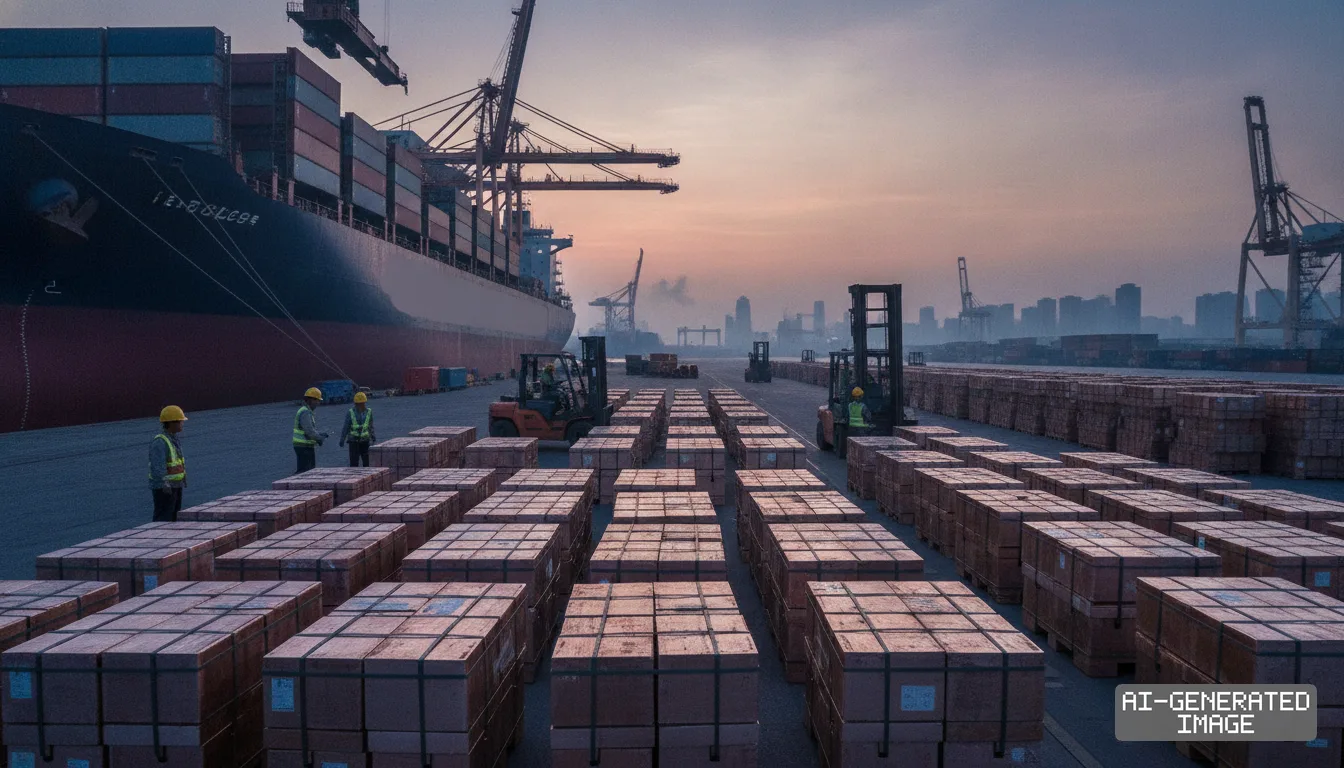
Commodity merchants Xiamen Xindeco and Mercuria booked export shipments of refined copper from United States warehouses on Nov. 19, 2026, redirecting idle American inventory to relieve an acute physical shortage in China.
The trade bookings reverse traditional Pacific flow patterns. Chinese manufacturing facilities face sudden metal deficits following sharp domestic stockpile drawdowns and smelting run curtailments.
The Yangshan copper premium jumped 39% day-on-day to a record $500 per metric ton on Nov. 19, according to Shanghai Metals Market and Platts pricing records. The surcharge tracks what Chinese importers pay above London Metal Exchange cash contracts to secure prompt physical cathode.
Domestic spot metal inside China traded at a record premium of 7,250 yuan ($1,088) per metric ton over active Shanghai Futures Exchange contracts. That cash spread widened transpacific delivery arbitrage margins to record territory.
Shanghai Futures Exchange warehouse stockpiles dropped 18.3% during the week ended Nov. 13 to 27,642 metric tons, exchange inventory disclosures showed. That drawdown pulled visible exchange inventories to their lowest level since December 2023.
The rapid depletion left domestic copper tube manufacturers and electrical wire fabricators unable to secure prompt cathode. Several processing operations reduced plant runtimes as physical raw material surcharges escalated.
The Chinese supply squeeze stands in stark contrast to record metal accumulation across North America. Warehouse warrant filings indicate roughly 85% of globally registered exchange copper currently sits inside depots in the United States.
American commercial and exchange storage facilities hold an estimated 1.4 million to 2.0 million metric tons of refined cathode. Trading houses built those holdings over a two-year hoarding cycle ahead of expected tariff shifts.
The United States government scheduled a provisional 15% import tariff on foreign refined copper to take effect in January 2027. International commodity traders responded by shipping massive volumes of cathode into American ports throughout 2025 and 2026.
That pre-tariff accumulation locked vast quantities of physical metal away from international trade routes. The concentration drained commercial reserves across Asian logistics hubs and left fabricators vulnerable to unexpected industrial demand spikes.
China consumes more than half of global refined copper, relying heavily on steady raw material imports to feed power grid expansion and clean energy equipment manufacturing. Processing operations require continuous cathode feeds to sustain production lines.
Domestic smelting margins collapsed earlier this year when copper concentrate spot treatment and refining charges plunged into negative territory. Chinese refiners consequently throttled back output expansion programs because imported ore feedstock remained restricted.
Refined cathode import volumes also contracted over prior months after major global mining companies pushed for elevated annual sales premiums. Chilean state producer Codelco had set its baseline 2026 China sales surcharge at a record $350 per metric ton.
Chinese buyers rejected those elevated contract terms, causing imports of Chilean cathode to fall 38% year-on-year during the first nine months of 2026. Domestic mills exhausted buffer stocks rather than booking expensive contracted volumes.
The combination of subdued domestic smelting growth and deferred import commitments stripped China of surplus cathode. Spot contracts on the Shanghai exchange entered steep backwardation — a market state where immediate delivery costs more than future delivery dates.
The resulting price dislocation made transpacific shipments profitable despite transoceanic container freight expenses. Trading desks moved quickly to withdraw unregistered cathode from commercial warehouses located along the Pacific coast of the United States.
Logistics booking manifests confirm that container line CMA CGM allocated cargo space aboard the container ship CMA CGM Cassiopeia at the Port of Los Angeles. Terminal crews initiated loading procedures on Nov. 19 for initial departure runs.
Merchants offered early cathode parcels of roughly 1,000 metric tons from American facilities to Chinese buyers at landed surcharges near $300 per metric ton. Similar export consignments are now assembling across regional California storage depots.
State-backed trading firm Xiamen Xindeco contracted multiple container lots to replenish internal processing supply chains in eastern China. Independent trading house Mercuria arranged complementary export parcels out of bonded warehouses in the same corridor.
The maritime schedule indicates that CMA CGM Cassiopeia will arrive at Chinese container terminals in January 2027. Follow-on container parcels dispatched by competing maritime carriers will discharge across Asian receiving ports through February 2027.
The physical outflow of American cathode coincides with annual supply negotiations for 2027 delivery terms. Major overseas producers are retreating from earlier aggressive pricing postures to avoid losing contracted market positions across China.
Codelco reduced its indicative 2027 Asian cathode premium to between $250 and $280 per metric ton during contract discussions in Shanghai. Rival miner Freeport Indonesia offered cathode output from its Manyar smelter at an annual premium of $158 per metric ton.
The private trading response demonstrates how physical metal flows circumvent geopolitical policy measures when regional price gaps widen. Commercial participants opted to monetize surplus stockpiles rather than holding metal for domestic American tariff protection.
Customs registries and commercial trading houses have not published the total contract volume or aggregate financial value across all pending reverse-flow shipments.
The provisional 15% United States tariff on refined copper takes effect on Jan. 1, 2027, setting the outer calendar limit for tax-free warehouse inventory repositioning.
Impact map
How this development propagates across the region and out to global buyers.
| Event | Korea | China | Japan | Global impact |
|---|---|---|---|---|
| Transpacific copper reverse arbitrage | LS MnM maintains steady domestic cathode supply under long-term contract quotas | Xiamen Xindeco and local fabricators import US cathode to cover immediate spot deficits | JX Advanced Metals monitors regional Asian premiums as spot competition expands | US COMEX stockpiles of up to 2.0 million tons bleed metal to relieve Chinese shortages |
In this story
- Companies
- Xiamen XindecoMercuriaCMA CGMCodelco
- Tickers
- 000700.SZ
- Exposed
- Freeport Indonesia
- Policy
- Tariffs
- Impact
- Supply ChainPricingCost Structure
Track every Tariffs development →
Related briefings
- Mineral stockpiling strategies split across US, EU and East Asia Also on Mercuria, Cost Structure
- HD Hyundai delivers world’s first lashing-free boxship to CMA CGM Also on CMA CGM, Cost Structure
- HD Hyundai delivers lashing-free container ship to CMA CGM Also on CMA CGM, Cost Structure
- CSSC Reallocates Yard Drydocks to Accelerate Large Containership Output Also on CMA CGM
Sources
Reporting
Confidence: medium — how we grade this
The documents behind this briefing are linked above. East Asia Brief produces its English text with AI assistance under human editorial review, and does not translate or republish other outlets' articles. See our methodology and AI policy. Spotted an error? Tell us.
The Morning Brief
What changed in Korean, Chinese and Japanese industry overnight — and what it means for your supply chain. One email, weekday mornings, US time. Free.
The Morning Brief is in preparation. Leave your address and we will write to you once — when the first issue is ready. Nothing before that.