Korea speeds HVDC power corridor to supply Yongin semiconductor cluster
State utility KEPCO fast-tracks 500-kilovolt transmission lines to deliver coastal nuclear and renewable electricity to advanced memory and foundry fabs in Gyeonggi Province.
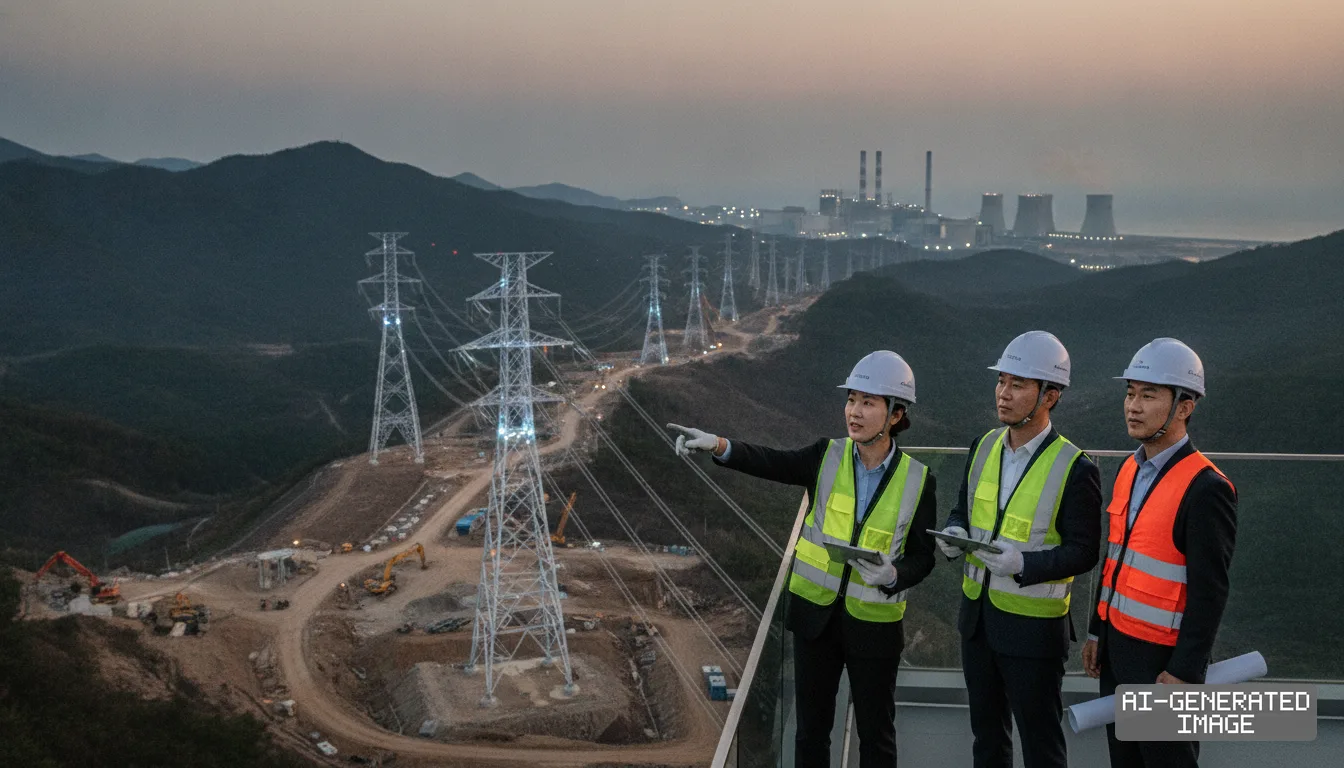
South Korea has formally accelerated construction timelines and procurement procedures for its long-distance high-voltage direct current power transmission corridors, establishing dedicated trunk lines to channel coastal generation to the planned semiconductor mega-cluster in Yongin. The state-run utility Korea Electric Power Corporation (KEPCO) has structured the capital allocation program to bridge the widening geographic divide between generation assets in the eastern and southwestern coastal zones and high-density industrial load centers in Gyeonggi Province. The infrastructure blueprint establishes high-voltage direct current (HVDC) technology as the primary backbone to overcome right-of-way constraints, minimize line loss across mountainous terrain, and circumvent local permitting bottlenecks that have historically stalled alternating-current transmission links.
The policy directive addresses an unprecedented concentration of industrial electric demand. The Yongin semiconductor mega-cluster, which integrates advanced memory fabrication facilities from SK hynix and logic foundry lines from Samsung Electronics, is projected to require more than 10 gigawatts of steady baseload power upon full commercial deployment. South Korea's existing inland alternating-current grid networks operating at 345 kilovolts and 765 kilovolts have reached functional saturation across key inter-regional junctions, preventing surplus baseload power generated by nuclear reactors in Uljin and Yeonggwang from reaching industrial consumers in the Seoul Metropolitan Area. By deploying 500-kilovolt point-to-point HVDC links, the Ministry of Trade, Industry and Energy intends to establish dedicated power corridors that bypass intermediate regional grid congestion entirely.
Under the accelerated transmission investment schedule, KEPCO has prioritized two central corridors: the East Coast-to-Capital Area 500-kilovolt HVDC link and the West Coast undersea HVDC trunk line. The East Coast project spans approximately 230 kilometers from Uljin across the Taebaek Mountain Range to the eastern edge of Gyeonggi Province, divided into an 8-gigawatt bipolar configuration. KEPCO has restructured site acquisition workflows and equipment staging for the high-voltage converter stations located at the coastal generation hub and inland receiving substations. The utility is transitioning procurement schedules for thyristor and voltage source converter valves, smoothing reactors, and high-power gas-insulated switchgear to align grid energization directly with the commissioning schedules of cleanrooms in the Yongin cluster.
The parallel West Coast undersea HVDC corridor is designed to aggregate generation from coastal nuclear facilities and planned offshore wind farms along the southwestern littoral zone, channeling up to 8 gigawatts of power directly into the western and southern flanks of the Gyeonggi industrial belt through subsea cabling. By routing heavy-load transmission through marine routes and direct underground landing points, the Ministry of Trade, Industry and Energy aims to compress the land acquisition phase and reduce administrative exposure to municipal zoning disputes. This subsea and underground corridor provides direct redundancy for the semiconductor manufacturing corridor, mitigating single-point grid failure risks for ultra-clean industrial operations where voltage fluctuations measured in milliseconds can disrupt photolithography and wafer-etch processing.
Capital deployment for the HVDC corridors represents a major financial realignment for KEPCO, which operates under structural balance-sheet pressures following years of tariff distortions and fuel-cost volatility. To underwrite the multi-trillion-won transmission capex, the South Korean government has enacted statutory mechanisms under the National Grid Expansion Special Act to establish sovereign financing guarantees, direct budget co-funding, and fast-track environmental clearance protocols. The legislative framework grants the Ministry of Trade, Industry and Energy the authority to designate transmission corridors of national strategic importance, compressing administrative review periods for right-of-way permits from an average of four years down to under eighteen months.
For semiconductor manufacturers, the pace of transmission infrastructure delivery directly governs capital expenditure execution and production ramp-up schedules. Advanced extreme ultraviolet (EUV) lithography systems and wafer transport automation operate with continuous base power profiles, precluding reliance on localized, intermittent generation sources. Samsung Electronics and SK hynix have structured their long-term facility schedules around confirmed grid interconnection milestones, coordinating fab shell completion with the commissioning dates of dedicated on-site substations. The provision of heavy HVDC trunk capacity allows fab operators to reduce planned on-site liquefied natural gas generation, limiting operational greenhouse gas exposure while securing high-reliability baseload inputs.
The execution timeline of the HVDC initiative also alters procurement requirements across the domestic and regional power equipment supply chain. Industrial suppliers of converter transformers, DC circuit breakers, control protection systems, and high-voltage subsea cables face firm volume requirements through the end of the decade. KEPCO has initiated joint technology verification programs with domestic equipment fabricators and international consortiums to ensure that voltage source converter systems meet stringent stability criteria under fluctuating industrial load swings. The commercialization of 500-kilovolt voltage source converter technology domestically is designed to provide dual-directional power flow control, facilitating the dynamic balancing of renewable variability alongside base-load nuclear outputs.
The grid expansion plan established under the 11th Basic Plan for Long-term Electricity Supply and Demand assigns total transmission and substation investment a binding delivery schedule running through 2038. The Ministry of Trade, Industry and Energy has scheduled quarterly inter-agency progress reviews with KEPCO, the Korea Power Exchange, local municipal authorities, and the semiconductor cluster developers to verify engineering milestones and substation civil works along each corridor segment.
Impact map
How this development propagates across the region and out to global buyers.
| Event | Korea | China | Japan | Global impact |
|---|---|---|---|---|
| HVDC corridor acceleration | KEPCO capex mobilization | grid tech comparison | heavy equipment competition | fab power security standards |
In this story
- Companies
- Korea Electric Power CorporationSamsung ElectronicsSK hynix
- Tickers
- 015760.KS005930.KS000660.KS
- Policy
- Economic SecuritySubsidiesIndustrial Infrastructure
- Impact
- CapexSupply ChainOrder Book
Track every Economic Security development → Track every Subsidies development →
Related briefings
- KEPCO seeks $18 billion advance power bill payment from Samsung and SK hynix Also on Korea Electric Power Corporation, SK hynix, Samsung Electronics
- South Korea confirms $120 billion civil nuclear pact with US Also on Korea Electric Power Corporation, Order Book
- Cameco backs $120B US-Korea nuclear pact for eight reactors Also on Korea Electric Power Corporation, Order Book
- Pacifico Energy commits $1 billion to South Korea offshore wind projects Also on Korea Electric Power Corporation, Order Book
Sources
This briefing carries no sources block. It was written from our desks’ working knowledge of the sector rather than from documents retrieved for this piece. Read it as orientation and check any figure you intend to act on — how we source briefings.
This briefing carries no linked sources: it was written from our desks' working knowledge of the sector rather than from documents retrieved for this piece. East Asia Brief publishes no citation it cannot link. Our English text is produced with AI assistance under human editorial review. See our methodology and AI policy. Spotted an error? Tell us.
The Morning Brief
What changed in Korean, Chinese and Japanese industry overnight — and what it means for your supply chain. One email, weekday mornings, US time. Free.
The Morning Brief is in preparation. Leave your address and we will write to you once — when the first issue is ready. Nothing before that.