JBIC, QatarEnergy sign energy finance pact to safeguard LNG
The Tokyo agreement establishes a framework for gas infrastructure and third-country investment as Japan seeks to protect fuel procurement against Middle East supply disruptions.
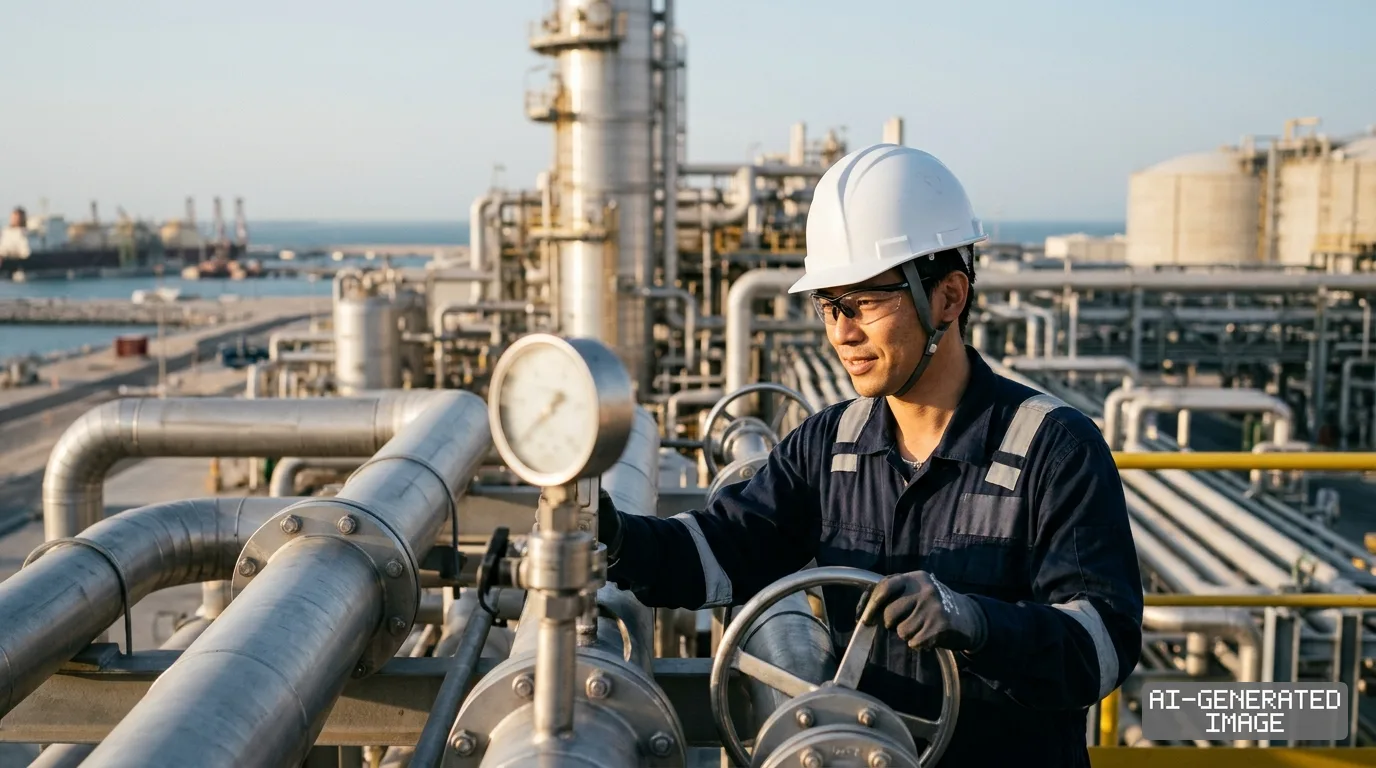
QatarEnergy and the Japan Bank for International Cooperation signed an agreement on Nov. 25 to expand project financing across liquefied natural gas extraction, power grids and overseas energy infrastructure.
The memorandum of understanding establishes an operating framework aligned with Japan's Partnership on Wide Energy and Resources Resilience initiative. The program coordinates official financial backing for critical fuel supply lines across Asia.
Qatar supplied 5.3% of Japan's liquefied natural gas imports in 2025, according to trade data. Asian buyers purchased 82.5% of Qatar's overall fuel exports that same year.
Saad Sherida Al-Kaabi, Qatar's Minister of State for Energy Affairs and chief executive of QatarEnergy, signed the document in Tokyo. Kazuhiko Amakawa, the governor of the state-owned policy bank, represented the Japanese lender.
The agreement spans seven commercial areas, including natural gas extraction, transmission infrastructure, carbon capture and storage, and water desalination. It also creates financing channels for joint ventures involving Japanese companies in third countries.
Japan has been a longstanding energy partner for the country, Al-Kaabi said. The arrangement establishes an expanded base for capital deployment across each stage of production, he said.
Japan imports almost all of its fossil fuel consumption. Middle Eastern producers supplied more than 90% of the nation's crude oil purchases last year, ministry figures show.
The bilateral pact formalizes Japanese policy credit support for Qatari energy projects. Japanese officials want to preserve access to Middle Eastern gas volumes while domestic utilities manage prolonged delays in nuclear reactor restarts.
The state lender has directed balance sheet capacity toward Gulf energy infrastructure throughout 2026. The bank committed $990 million in project finance on Jan. 15 for Qatar's Facility E utility complex.
That installation requires $2.97 billion in total co-financing from commercial banks and export credit agencies. The asset pairs a 2,400-megawatt gas-fired generation plant with an 110 million imperial gallon daily desalination plant.
Sumitomo Corporation leads the commercial consortium holding an equity interest in Facility E. Mitsubishi Power secured the manufacturing order to deliver the project's gas turbines.
South Korea's Samsung C&T holds the $2.8 billion engineering and construction contract for the Ras Abu Fontas plant. Output from the site will supply Qatar General Electricity and Water Corporation under a 25-year purchase contract.
Japanese commercial power utilities are securing long-term Qatari fuel volumes directly. Power producer JERA signed a 27-year sales contract with QatarEnergy in February to receive 3 million tonnes of liquefied natural gas annually.
Deliveries under that agreement begin in 2028 as Qatar expands production trains at Ras Laffan. The contracted volume equals roughly 5% of JERA's baseline annual fuel procurement requirement.
Competition from Chinese state-owned buyers has pushed Japanese lenders to offer direct balance sheet backing. China Petrochemical Corporation and PetroChina previously finalized 27-year purchase contracts for output from Qatar's North Field expansion projects.
The Japanese policy bank operates the Japan Strategic Investment Facility to absorb risks that private commercial syndicates reject. The institution previously extended $601 million in credit through two green loans to Abu Dhabi National Oil Company.
The Tokyo framework also covers potential joint investments between Japanese trading houses and QatarEnergy in Southeast Asia. The lender plans to back reception terminals, gas storage facilities and regional pipeline networks through those partnerships.
Prime Minister Sanae Takaichi launched the Partnership on Wide Energy and Resources Resilience on April 15. The strategy deploys Japanese state financing to stabilize energy procurement networks across Asia.
Project terms under the new bilateral agreement will require separate loan contracts. The lender did not assign binding loan quotas, dedicated credit lines or interest rate terms to the memorandum.
The notice does not state whether the lender will guarantee equity investments in Qatari liquefaction trains, and neither party published financial commitments for upcoming projects.
JERA begins receiving its contracted 3 million tonnes of Qatari fuel in 2028. Sumitomo Corporation expects first commercial output from the Facility E complex in the first half of 2028.
Impact map
How this development propagates across the region and out to global buyers.
| Event | Korea | China | Japan | Global impact |
|---|---|---|---|---|
| JBIC-Qatar energy cooperation | Samsung C&T holds $2.8 billion Facility E EPC contract in Qatar | Sinopec and PetroChina hold 27-year Qatar offtake contracts without Japanese state finance | JERA secures 3 million tonnes annually of Qatari LNG starting in 2028 | Asian utilities absorb 82.5% of Qatari LNG exports amid tightening long-term contract availability |
In this story
- Companies
- QatarEnergyJapan Bank for International CooperationSumitomo CorporationJERA
- Tickers
- 8053.T
- Exposed
- Mitsubishi PowerSamsung C&T
- Impact
- Supply ChainCapexCompliance
Related briefings
- METI expands Western rare earth alliances as China chokes yttrium Also on Sumitomo Corporation
- Korea Nuclear Association mobilizes 70 suppliers for export Also on Samsung C&T
- Japan and ASEAN launch $10B supply chain pact for critical minerals Also on Japan Bank for International Cooperation, Compliance
- Japan, Uzbekistan agree to refine critical minerals locally for export Also on Japan Bank for International Cooperation, Compliance
Sources
Primary documents
Reporting
Confidence: high — how we grade this
The documents behind this briefing are linked above. East Asia Brief produces its English text with AI assistance under human editorial review, and does not translate or republish other outlets' articles. See our methodology and AI policy. Spotted an error? Tell us.
The Morning Brief
What changed in Korean, Chinese and Japanese industry overnight — and what it means for your supply chain. One email, weekday mornings, US time. Free.
The Morning Brief is in preparation. Leave your address and we will write to you once — when the first issue is ready. Nothing before that.