India awards $870M in rare earth magnet grants to 4 consortia
The Heavy Industries Ministry granted initial awards for 4,800 tonnes of processing capacity to curb a 90% import reliance on Chinese magnets.
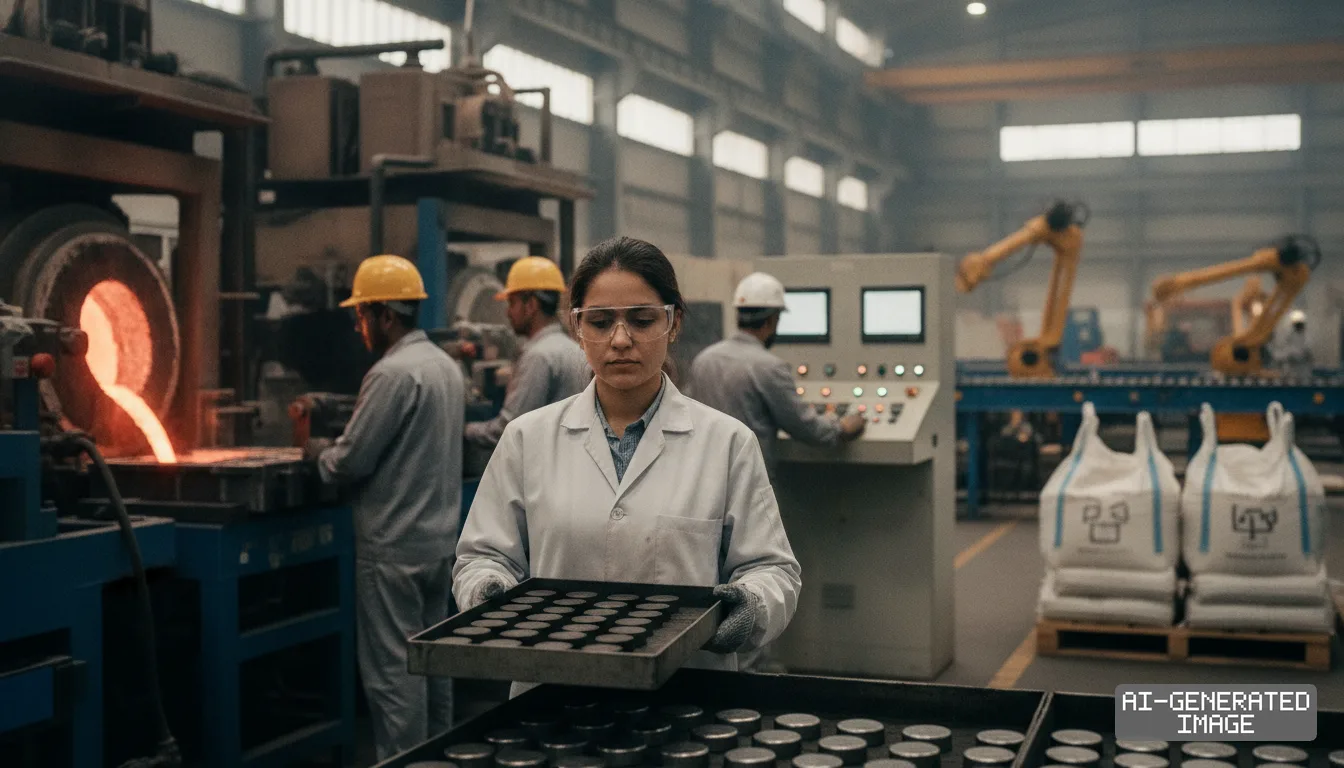
India's Ministry of Heavy Industries advanced its 72.80 billion rupee ($870 million) rare earth permanent magnet program on Nov. 25, 2026, delivering initial award letters to build 4,800 metric tonnes of annual processing capacity.
The awards implement a federal incentive scheme approved in November 2025 to establish domestic refining and fabrication capacity. India currently imports roughly 90% of its sintered neodymium-iron-boron magnets from China.
The program allocates 7.50 billion rupees ($90 million) in capital subsidies alongside 64.50 billion rupees in sales incentives over five years. The targeted total capacity of 6,000 metric tonnes per annum represents roughly half of India's projected industrial magnet consumption.
Four manufacturing groups received letters of intent, each securing allocations of up to 1,200 metric tonnes per annum of finished sintered magnets. The recipients include Coal India, Midwest Energy, ReNew and Prozeal Green Energy.
Coal India leads a consortium with the Non-Ferrous Materials Technology Development Centre, an autonomous technical laboratory. The state-owned coal miner was selected as the second-lowest bidder and sought zero sales incentives under the funding formula.
The state miner will build its 1,200-tonne facility through a special purpose vehicle, Coal India said in a regulatory filing to the BSE. The company did not disclose the proposed manufacturing site or equity split.
Midwest Energy received approval for a 1,200-tonne facility at a quoted incentive rate of 505.05 rupees ($6.04) per kilogram of magnet sales. The company must submit a 400 million rupee ($4.8 million) performance guarantee within 90 days to finalize the contract.
The company currently operates a 2.50 billion rupee ($30 million) magnet plant in Hyderabad. That plant is commissioning an initial 500-tonne line and aims to reach 1,500 tonnes of annual processing capacity by late 2027.
ReNew Private Limited and Prozeal Green Energy Limited each secured 1,200-tonne production quotas. Their bids requested sales incentives ranging between 243 rupees and 505 rupees per kilogram of finished sintered magnets, according to ministry tender records.
Selected manufacturers will receive feedstock support through state-owned mining enterprise IREL (India) Limited. Under tender terms, IREL will prioritize supplying neodymium-praseodymium oxide from its refining plants in Odisha and Aluva to the three lowest incentive bidders.
Neodymium-iron-boron magnets supply the magnetic torque in electric vehicle traction motors, wind turbines and precision defense navigation systems. Sintering — the heating and compression of alloy powder in magnetic fields — produces the dense magnets required for automotive powertrains.
China controls roughly 92% of global sintered magnet production and nearly all commercial heavy rare earth separation. That concentration exposes Indian component builders to export licensing delays and quota restrictions enforced by Beijing.
India holds roughly 6% of global rare earth reserves, mostly in coastal monazite beach sands, but lacks downstream commercial metallization plants. Domestic electric motor producers have historically shipped domestic ores abroad or purchased finished Chinese subassemblies.
The manufacturing program aligns with supply diversification goals pursued by the Quadrilateral Security Dialogue, which includes India, the United States, Japan and Australia. Quad working groups have prioritized alternative critical mineral supply lines to prevent bilateral export restrictions from halting auto assembly lines.
Japan's state resource agency JOGMEC and Australian miner Lynas Rare Earths established independent light rare earth supply chains over the past decade. India is attempting a similar transition by subsidizing the capital-intensive conversion of refined oxides into finished motor magnets.
The Indian incentive scheme enforces a seven-year operating timetable. Consortiums have a two-year gestation period to construct chemical separation, melting and machining lines, followed by five years of volume-linked cash disbursements.
Participating companies must convert rare earth oxides into metals, cast intermediate alloys and machine finished sintered blocks to qualify for payments. Assembling imported semi-finished magnet blocks does not meet the program's local value addition thresholds.
Industrial suppliers face commercial barriers in scaling output, particularly in securing dysprosium and terbium additives that prevent motor magnets from demagnetizing at high operating temperatures. India possesses minimal domestic reserves of heavy rare earth elements.
Winning consortiums must lodge bank guarantees before mid-February 2027 to convert letters of intent into binding contracts, setting initial factory commissioning for late 2028.
The Ministry of Heavy Industries has not published the outcome of the fifth 1,200-tonne tender allocation, and official filings do not confirm whether Quad partners will provide direct joint financing for the planned factories.
Impact map
How this development propagates across the region and out to global buyers.
| Event | Korea | China | Japan | Global impact |
|---|---|---|---|---|
| Rare earth permanent magnet scheme awards | Hyundai Motor and local motor tier-1 suppliers secure alternate non-China magnet sourcing channel by 2028 | Retains dominance over heavy rare earths but loses captive supply share for Indian EV motor demand | JOGMEC and Japanese magnet alloy makers gain potential South Asian processing partner | Global sintered NdFeB non-China processing capacity expands by up to 6,000 MTPA by 2028 |
In this story
- Companies
- Coal IndiaMidwest EnergyReNewProzeal Green Energy
- Tickers
- COALINDIA.NS
- Exposed
- IREL (India) Limited
- Policy
- Subsidies
- Impact
- Supply ChainCapexOrder Book
Track every Subsidies development →
Related briefings
- India pushes rare earth magnet output to counter China curbs Also on Coal India, IREL (India) Limited, Subsidies
- Japan seeks rare earth supply pact with India's Andhra Pradesh Also on IREL (India) Limited
- POSCO Future M backs $403M in debt guarantees for Ultium CAM Also on Subsidies, Order Book
- Westinghouse qualifies new nuclear suppliers amid forging crunch Also on Subsidies, Order Book
Sources
Reporting
Confidence: high — how we grade this
The documents behind this briefing are linked above. East Asia Brief produces its English text with AI assistance under human editorial review, and does not translate or republish other outlets' articles. See our methodology and AI policy. Spotted an error? Tell us.
The Morning Brief
What changed in Korean, Chinese and Japanese industry overnight — and what it means for your supply chain. One email, weekday mornings, US time. Free.
The Morning Brief is in preparation. Leave your address and we will write to you once — when the first issue is ready. Nothing before that.