COOEC takes $800M QatarEnergy offshore contract for subsea lines
The 66-month turnkey award for Maydan Mahzam pushes the Chinese offshore contractor's three-year Middle East order total past 50 billion yuan.
Offshore Oil Engineering Co., a listed engineering unit of China National Offshore Oil Corp., booked an $800 million offshore infrastructure contract with state-owned QatarEnergy on Nov. 22.
The turnkey award covers engineering, procurement, construction and installation duties for package two of the Maydan Mahzam offshore field redevelopment. The field sits about 110 kilometers northeast of the Qatari coast.
The contract carries a value of roughly 2.9 billion Qatari riyals ($800 million). That figure lifts COOEC's cumulative order intake in the Middle East over the past three years above 50 billion yuan ($7.48 billion).
Work under the MM-EPIC2 package requires laying more than 100 kilometers of subsea pipelines, power cables and umbilicals. Umbilicals are bundled conduit lines that feed electrical power, fluid controls and monitoring signals from surface platforms to seabed equipment.
The project runs across a 66-month execution timetable, the contractor said in a regulatory filing to the Shanghai Stock Exchange. Milestone disbursements will be paid in monthly installments based on verified physical installation progress.
The filing does not state that CNOOC or COOEC acquired an equity stake in Maydan Mahzam, and QatarEnergy has not allocated any concession barrels or equity ownership to the Chinese contractor.
The transaction represents a commercial engineering contract rather than an upstream asset acquisition. Financial revenue will flow directly into COOEC's international contracting accounts without providing equity crude lifting rights to Chinese state refineries.
Maydan Mahzam is one of Qatar's oldest offshore production assets. Discovered in 1963, the complex entered commercial production in November 1965 and pipes crude and associated gas to dedicated offshore processing platforms.
QatarEnergy is carrying out an extensive field life-extension program to stabilize crude output. The redevelopment plan involves drilling 45 new wells targeting the Arab reservoir formations alongside replacement jackets and upgraded subsea fluid gathering infrastructure.
The package follows two major Qatari engineering wins previously secured by the Chinese contractor. COOEC signed a $4 billion contract with QatarEnergy for the Bul Hanine offshore redevelopment, alongside a compression package for the North Field.
The $4 billion Bul Hanine contract entails fabricating more than 130,000 tons of structural steel. That project, which began fabrication work in September, established COOEC's logistics and installation footprint within Qatari waters.
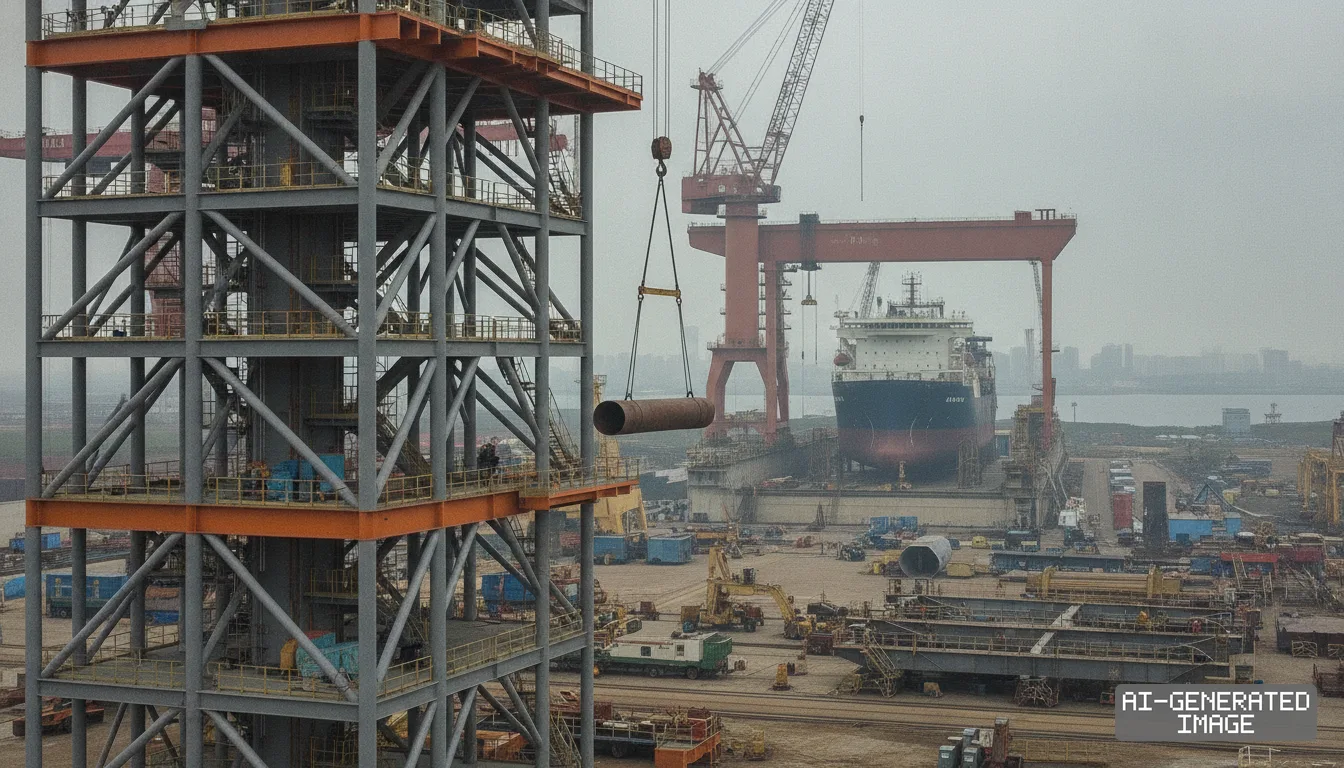
Chinese offshore engineering yards have increased regional bidding competitiveness through domestic modular fabrication. COOEC utilizes fabrication yards in Qingdao and Tianjin to assemble complex offshore components before shipping them to the Persian Gulf.
The integrated fabrication model limits high offshore labor expenses by completing structural assembly in China. Pipelay barges and heavy-transport vessels then move the equipment directly to offshore installation corridors in the Middle East.
The contract intensifies competition for Asian and European offshore construction groups seeking Middle Eastern tenders. South Korean shipbuilders including HD Hyundai Heavy Industries have pivoted away from conventional subsea pipelaying toward higher-margin floating production units.
Japanese offshore engineering groups such as JGC Holdings face similar contractor realignment in Gulf waters. Shallow-water pipeline laying and cable installation have increasingly shifted toward Chinese yards maintaining dedicated installation vessel fleets.
China has strengthened bilateral commercial energy transactions with Qatar across the past five years. State energy firms Sinopec and parent group CNOOC previously signed long-term liquefied natural gas supply contracts linked to Qatar's North Field expansion projects.
COOEC said the Maydan Mahzam project reinforces its overseas market share under international corporate planning goals. The engineering contractor aims to source a wider share of annual revenue from Middle Eastern national oil producers.
Execution begins under commercial terms signed by both companies, according to the stock exchange disclosure. The 66-month project schedule sets completion in mid-2032, with detailed engineering work starting before specialized pipelaying vessels deploy to the Gulf.
Impact map
How this development propagates across the region and out to global buyers.
| Event | Korea | China | Japan | Global impact |
|---|---|---|---|---|
| Maydan Mahzam EPIC2 contract award | HD Hyundai Heavy Industries faces tighter bidding competition for Gulf subsea work | COOEC lifts three-year Middle East contract intake past 50 billion yuan ($7.48 billion) | JGC Holdings confronts lower Chinese cost structures on Middle Eastern marine tenders | Subsea cable and pipeline installation margins compress across Persian Gulf field overhauls |
In this story
- Companies
- Offshore Oil Engineering Co.QatarEnergy
- Tickers
- 600583.SS
- Exposed
- CNOOCHD Hyundai Heavy IndustriesJGC Holdings
- Impact
- Order BookSupply Chain
Related briefings
- HD Hyundai Heavy Industries faces delivery risks after wage rejection Also on QatarEnergy, HD Hyundai Heavy Industries, Order Book
- HD Hyundai wins DNV approval on 271,000 cbm LNG hull design Also on QatarEnergy, HD Hyundai Heavy Industries, Order Book
- HD Hyundai Heavy ratifies wage pact, clearing delivery risks Also on QatarEnergy, HD Hyundai Heavy Industries, Order Book
- Samsung Heavy names 174,000 cbm LNG carrier for MISC in Korea Also on QatarEnergy, Order Book
Sources
Reporting
Confidence: medium — how we grade this
The documents behind this briefing are linked above. East Asia Brief produces its English text with AI assistance under human editorial review, and does not translate or republish other outlets' articles. See our methodology and AI policy. Spotted an error? Tell us.
The Morning Brief
What changed in Korean, Chinese and Japanese industry overnight — and what it means for your supply chain. One email, weekday mornings, US time. Free.
The Morning Brief is in preparation. Leave your address and we will write to you once — when the first issue is ready. Nothing before that.