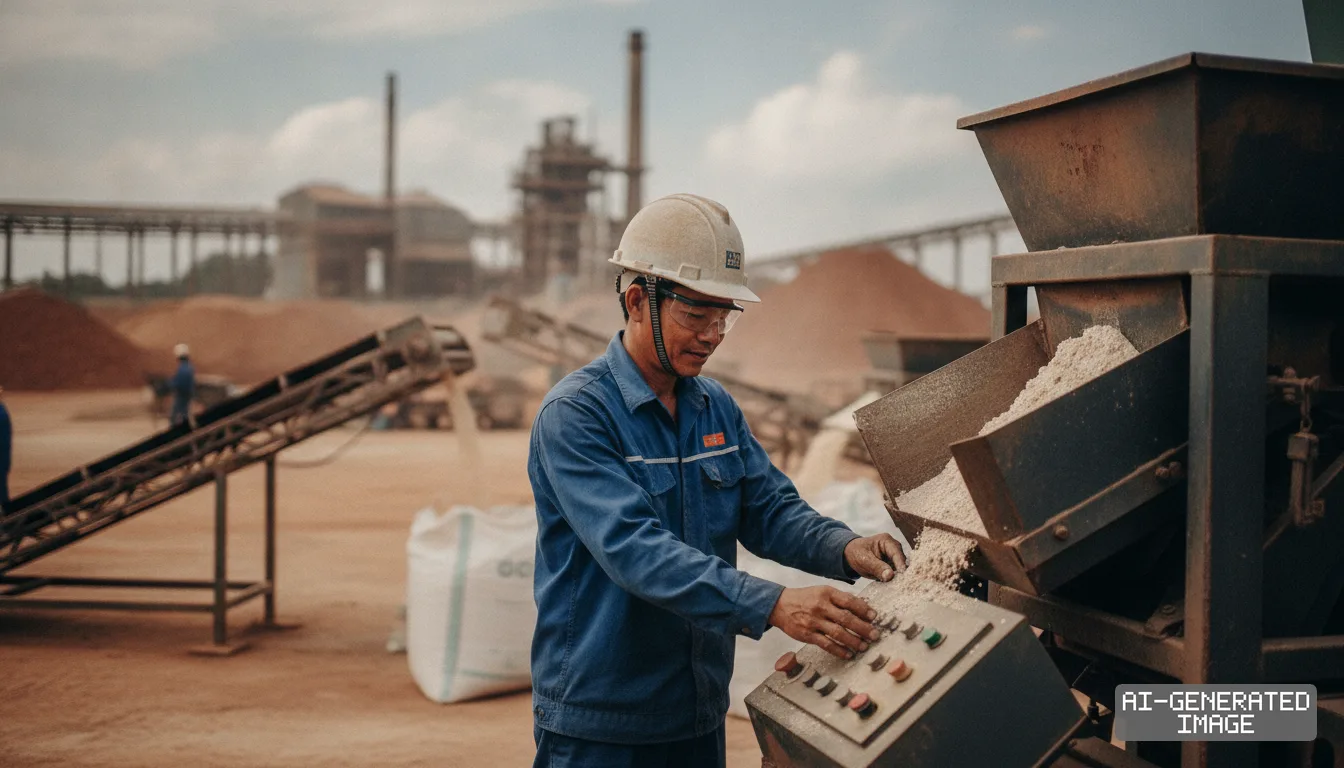
China delays rare earth and mineral export controls until Jan. 10
The waiver delays restrictions across six mineral categories and processing gear through Jan. 10, 2027, temporarily steadying supply chains fed by Chinese refiners.
China's Ministry of Commerce said Nov. 9 it extended the suspension of six export-control measures covering rare earths, battery materials and processing equipment through Jan. 10, 2027.
The joint announcement with the General Administration of Customs delays restrictions originally scheduled to resume Nov. 10. The action prolongs a temporary waiver first instituted in late 2025.
China accounts for about 70% of global rare-earth mine production and more than 90% of refined capacity for high-performance magnets. The controls threaten essential manufacturing supply chains worldwide.
The delayed rules cover six formal announcements issued on Oct. 9, 2025. They restrict overseas shipments of heavy rare earths, centrifugal extraction hardware, recycling technologies and lithium battery materials.
The export framework targets specific strategic elements including samarium, holmium and related alloys. These specialized materials serve as vital inputs for precision defense guidance systems and specialized sensor hardware.
Under Announcement 61, foreign manufacturers using Chinese rare-earth content above 0.1% of total product value must secure export licences from Beijing. The threshold applies to advanced items produced outside China.
The regulation asserts extraterritorial reach over products made overseas using Chinese extraction, smelting, magnetic material fabrication and recycling technologies. Overseas businesses must file licence applications in the Chinese language.
The ministry requires case-by-case reviews for materials tied to logic chips below 14 nanometers or memory chips with 256 layers or more. That specific vetting provision remains suspended during the two-month extension.
Equipment used in rare-earth production also falls under the delayed restrictions. The rules cover centrifugal extraction units and automated precipitation equipment capable of treating at least 5,000 cubic meters of leaching liquid daily.
Parallel to the mineral waiver, the State Council Customs Tariff Commission postponed additional duties on US goods. The commission delayed a 24% reciprocal tariff from Nov. 10 until Jan. 10, 2027.
A baseline 10% tariff on covered American goods remains in effect, the commission said. The decision maintains current tariff rates on cross-border industrial shipments while bilateral trade discussions continue between Beijing and Washington.
South Korean shipbuilder Hanwha Ocean received direct regulatory relief under a separate ministerial order published Nov. 9. China suspended retaliatory countermeasures against five US subsidiaries of Hanwha Ocean through Jan. 10, 2027.
The shipyard operator acquired Philly Shipyard in Philadelphia for $100 million in 2024 to expand its American maritime footprint. The waiver covers Hanwha Shipping LLC, Hanwha Philly Shipyard Inc. and three affiliated investment holdings.
Chinese authorities originally imposed penalties against the five Hanwha Ocean subsidiaries in October 2025 under Order No. 6. Beijing claimed the units supported US trade investigations into Chinese maritime, logistics and shipbuilding practices.
The penalty suspension allows domestic Chinese organizations and individuals to conduct commercial transactions with the five American entities. The pause protects contracted commercial maritime operations across the shipyard's supply network.
Downstream manufacturers in East Asia face immediate procurement decisions during the 60-day grace period. South Korean automotive and electronics firms depend on China for about 80% of their critical raw mineral imports.
Permanent neodymium magnets — key components that convert electrical energy into motion in electric vehicles and wind turbines — remain heavily reliant on Chinese feedstock. Processing facilities outside China cannot quickly replace this volume.
South Korean magnet and battery component suppliers have sought to diversify mineral sourcing away from Chinese processors. Alternative extraction projects in Australia and North America remain insufficient to meet total domestic manufacturing demand.
Japanese industrial suppliers face comparable exposure in precision motor manufacturing and factory robotics. Japan imports roughly 60% of its heavy rare-earth compounds from Chinese refiners for specialized magnets and automation equipment.
Automakers across North America and Europe have spent the past year building buffer stockpiles of dysprosium and terbium. These heavy rare earths prevent electric motor magnets from demagnetizing under high operating temperatures.
The temporary reprieve allows procurement managers to clear existing purchase orders through Chinese customs checkpoints. Border agents will process shipments under regular licensing procedures rather than the expanded extraterritorial vetting system.
Refiners in China process more than two-thirds of the world's battery-grade lithium and spherical graphite. Global battery cell producers rely on Chinese upstream processing for high-nickel cathode materials and synthetic anode formulations.
The regulatory pause coincides with ongoing bilateral negotiations between trade officials from Washington and Beijing. Both sides seek to manage commercial friction before scheduled bilateral meetings at multilateral economic summits.
The notice does not state whether Beijing plans to grant general export licences after Jan. 10, 2027, or enforce individual transaction reviews. Officials gave no guidance on post-deadline processing criteria.
Existing export-control waivers expire at midnight on Jan. 10, 2027, when customs authorities will either implement the six restricted orders or announce another negotiated extension.
Impact map
How this development propagates across the region and out to global buyers.
| Event | Korea | China | Japan | Global impact |
|---|---|---|---|---|
| Rare earth export control suspension | Hanwha Ocean avoids sanctions on Philly Shipyard, buyers gain 60-day buffer for 80% China-reliant mineral inputs | MOFCOM maintains trade negotiating leverage while refiners clear order backlogs | Magnet makers importing 60% of heavy rare earths gain two months to manage inventory | Automakers and wind turbine builders avert immediate dysprosium and terbium supply shock |
In this story
- Companies
- Hanwha Ocean
- Tickers
- 042660.KS
- Policy
- Export ControlsTariffs
- Impact
- Supply ChainCompliance
Track every Export Controls development → Track every Tariffs development →
Related briefings
- Hanwha Ocean US units gain two-month reprieve from Chinese sanctions Also on Hanwha Ocean, Tariffs, Compliance
- Pentagon ends Chinese mineral waivers before 2027 deadline Also on Hanwha Ocean, Export Controls, Compliance
- Hanwha Ocean faces $1.0 billion arbitration over Arctic LNG Also on Hanwha Ocean, Export Controls, Compliance
- Chinese shipbuilders surpass South Korea in October LNG orders Also on Hanwha Ocean, Tariffs
Sources
Primary documents
Reporting
Confidence: high — how we grade this
The documents behind this briefing are linked above. East Asia Brief produces its English text with AI assistance under human editorial review, and does not translate or republish other outlets' articles. See our methodology and AI policy. Spotted an error? Tell us.
The Morning Brief
What changed in Korean, Chinese and Japanese industry overnight — and what it means for your supply chain. One email, weekday mornings, US time. Free.
The Morning Brief is in preparation. Leave your address and we will write to you once — when the first issue is ready. Nothing before that.