Tesla accelerates Cybercab plans and squeezes hardware suppliers
A planned €3 billion Berlin expansion and internal 4680 battery lines support a platform that removes steering columns, pedal boxes and side mirrors.
Tesla advanced commercial deployment schedules for its autonomous Cybercab on Nov. 20, 2026, intensifying margin pressure on automotive component vendors and battery cell manufacturers across its global supply chain.
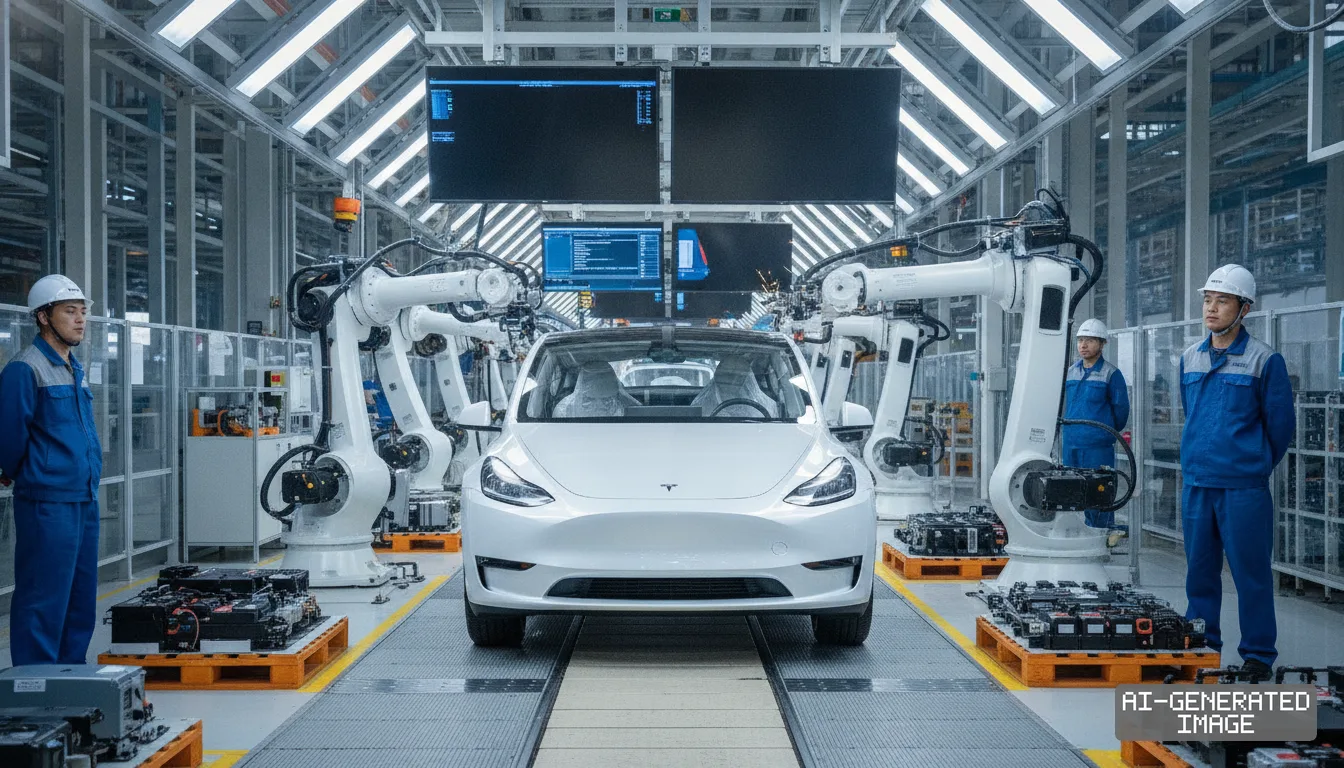
The Austin-based carmaker is redirecting manufacturing capital toward purpose-built driverless vehicles that eliminate manual controls entirely. The platform removes mechanical steering columns, pedal boxes and exterior mirrors, stripping high-value hardware that tier-one suppliers depend on for revenue.
Tesla confirmed a €3 billion ($3.31 billion) investment to construct a dedicated Cybercab manufacturing hall at its Grünheide facility near Berlin. The expansion adds capacity for up to 1 million units annually, representing roughly 72% of the German site's projected 1.38 million-vehicle total footprint.
Groundbreaking at the German site is scheduled for the first half of 2027, André Thierig, Tesla's senior director of manufacturing at Giga Berlin, said. Volume manufacturing is scheduled to begin in 2029, following building permit applications due before the end of 2026, Thierig said.
The European expansion builds on installed Cybercab capacity of over 125,000 units annually at Gigafactory Texas, according to Tesla's third-quarter regulatory filing. Commercial robotaxi service began carrying paying passengers in Austin in September 2026.
Tesla began inviting selected US customers to place orders on Nov. 14, setting a purchase price of $29,990. Customers must pay a $1,000 nonrefundable deposit and agree to a mandatory $299 monthly full self-driving subscription to operate the vehicle.
To support robotaxi manufacturing, Tesla will wind down Cybertruck production in Austin by mid-2027, Chief Executive Elon Musk said. Engineering resources and factory footprint previously allocated to the pickup are shifting directly to Cybercab assembly lines, Musk said.
Cost discipline on the platform extends beyond eliminating cabin controls. Tesla began installing a stripped-down power inverter, originally engineered for the Cybercab, into production Model 3 sedans on Nov. 1, drivetrain engineers said.
The redesigned inverter significantly reduces printed circuit board components and allows interchangeability between multiple silicon carbide chip suppliers. Deploying the hardware across passenger models ahead of robotaxi mass production helps Tesla secure volume scale while pushing component costs down, engineers said.
The mechanical architecture directly bypasses traditional automotive tier-one suppliers. Systems that typically generate $1,200 to $1,800 in content per vehicle—such as electronic power steering racks, brake pedal linkages and dashboard instrument clusters—are completely omitted from the two-seat cabin.
Battery procurement presents even steeper volume and pricing adjustments for cell manufacturers. The Cybercab relies on a compact 47.6 kilowatt-hour pack operating at 326 volts, roughly 40% smaller than the 75 to 82 kilowatt-hour packs standard in Tesla's passenger lineup.
Tesla is powering initial Austin Cybercab builds with its own 4680 cylindrical cells containing in-house cathode material, the company said in September. Austin cathode operations reached an early run rate of 10 gigawatt-hours annually, feeding active material directly into cell lines to bypass merchant suppliers.
The combination of smaller pack capacity and vertical integration threatens volume demand for primary cell partners. Panasonic Holdings and LG Energy Solution, which supply 2170 cylindrical cells for Tesla's high-volume passenger vehicles, face reduced pack requirements as fleet production shifts toward internal chemistries.
The 47.6 kilowatt-hour pack reduces cell demand per vehicle by roughly 40% compared to long-range models, directly trimming unit shipments for external battery partners. Smaller packs also limit the dollar value of cathode and anode raw materials purchased per finished unit.
Tesla designed the Cybercab pack using four separate, individually serviceable modules rather than a fully glued structural pack, vehicle engineering executives said. The housing includes reserved empty volume designed to accommodate lower-cost lithium iron phosphate (LFP) cells as production scales, engineering director Robert Sumpf said.
A future transition to LFP chemistry would allow Tesla to shrink pack capacity to 40 kilowatt-hours through vehicle efficiency gains, Musk said. Such a reduction would cut cell volume by an additional 16%, further lowering procurement spending per vehicle.
The pricing structure shifts vehicle profit from hardware delivery to recurring software monetization. At a $29,990 sticker price, vehicle hardware margins will remain compressed, requiring the $299 monthly autonomous driving subscription to generate operating returns.
Commercializing driverless fleets in Europe faces immediate regulatory hurdles that could delay volume delivery. European Union small-series vehicle regulations currently cap registration of vehicles without driver controls at 1,500 units per type each year, limiting near-term fleet operations.
Tesla has not published formal price-reduction requests for existing merchant suppliers, and filings do not confirm whether the company will outsource 4680 cell production or LFP modules for the European facility.
Tesla plans to submit formal environmental and construction filings for the Grünheide Cybercab hall before Dec. 31, 2026, ahead of scheduled groundbreaking in early 2027.
Impact map
How this development propagates across the region and out to global buyers.
| Event | Korea | China | Japan | Global impact |
|---|---|---|---|---|
| Cybercab commercialization ramp | LG Energy Solution faces reduced cell volume as Tesla prioritizes internal 4680 packs | CATL and local LFP suppliers position for potential 40 kWh modular pack chemistry switch | Panasonic Holdings sees cylindrical cell growth dilute as Austin cathode lines ramp | Tier-one automotive suppliers lose up to |
| Cybercab commercialization ramp | LG Energy Solution faces reduced cell volume as Tesla prioritizes internal 4680 packs | CATL and local LFP suppliers position for potential 40 kWh modular pack chemistry switch | Panasonic Holdings sees cylindrical cell growth dilute as Austin cathode lines ramp | Tier-one automotive suppliers lose up to $1,800 per vehicle in steering and pedal assemblies |
In this story
- Companies
- TeslaPanasonic HoldingsLG Energy Solution
- Tickers
- TSLA6752.T373220.KS
- Impact
- PricingSupply ChainCapex
Related briefings
- Panasonic Energy opens Osaka battery hub for advanced cells Also on Panasonic Holdings, Tesla, LG Energy Solution
- Panasonic Energy unveils 150 C solid-state prismatic battery Also on Panasonic Holdings, Tesla, LG Energy Solution
- Sumitomo Metal Mining books $270M hit on Philippine nickel refinery Also on Panasonic Holdings, Tesla
- Sumitomo Metal Mining keeps 60,000-ton nickel cathode output steady Also on Panasonic Holdings, Tesla
Sources
Primary documents
Reporting
Confidence: high — how we grade this
The documents behind this briefing are linked above. East Asia Brief produces its English text with AI assistance under human editorial review, and does not translate or republish other outlets' articles. See our methodology and AI policy. Spotted an error? Tell us.
The Morning Brief
What changed in Korean, Chinese and Japanese industry overnight — and what it means for your supply chain. One email, weekday mornings, US time. Free.
The Morning Brief is in preparation. Leave your address and we will write to you once — when the first issue is ready. Nothing before that.