SK On bids for 25-year Jeju storage tender to offset idle lines
The proposal targets 260 megawatt-hours of utility capacity on the island after the battery maker ran factories at 53% of capacity during the first half.
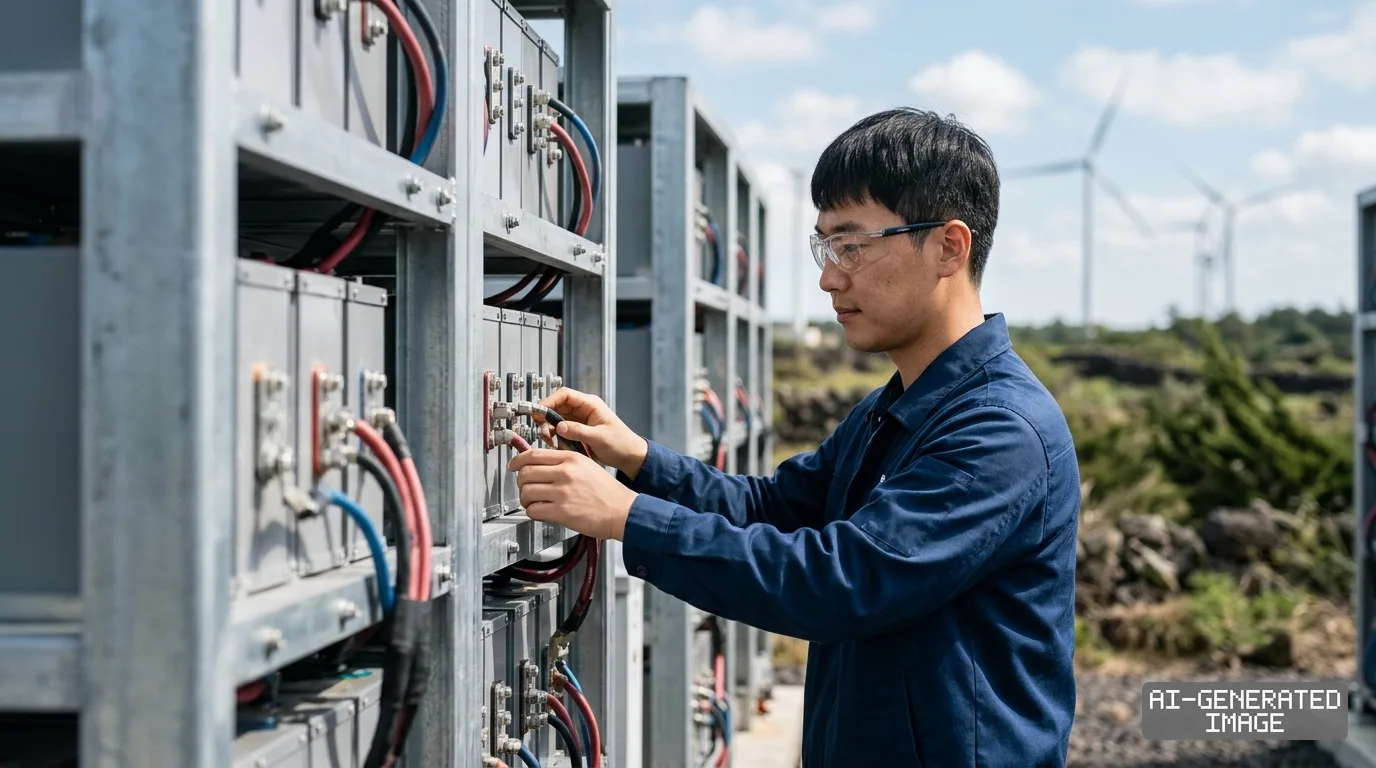
SK On submitted a proposal on Nov. 20, 2026, to supply grid-scale battery systems for a 25-year power contract on Jeju Island, moving to secure utility revenue as EV demand slows.
The tender run by Korea Power Exchange seeks 65 megawatts or 260 megawatt-hours of energy storage capacity. That volume accounts for roughly 5% of peak daytime electricity demand across the island province.
Under the central contract structure, winning operators receive fixed capacity payments over 25 years. The payments provide predictable cash flows to offset volatile merchant power prices on the local wholesale grid.
SK On ran its battery manufacturing plants at 53% of nameplate capacity during the first half of 2024, down from 87% in 2022. Slower electric vehicle adoption left several assembly lines underused.
Parent firm SK Innovation carries more than 20 trillion won ($14.3 billion) in machinery and equipment assets across its battery division. Idle lines generate fixed depreciation expenses that depress operating earnings each quarter.
SK On plans to supply lithium iron phosphate (LFP) cells for the Jeju installation, according to consortium bidding documents. The chemistry offers lower raw material costs and longer cycle lives than nickel-rich vehicle batteries.
Jeju Island faced renewable curtailment on more than 100 occasions in 2023 when wind and solar output exceeded local transmission capacity. Regulators require large battery systems to absorb midday generation surpluses.
The 25-year contract term exceeds standard seven-year automotive supply agreements. Long-term power off-take agreements allow battery producers to lock in steady volume for dedicated industrial cells without annual price negotiations.
Rival battery makers LG Energy Solution and Samsung SDI have also redirected factory capacity to grid-scale projects. Both producers entered earlier tenders to supply utility installations across mainland substations.
Retooling an electric vehicle battery line for energy storage systems takes four to six months. Battery makers adjust electrode thickness and cell casing dimensions to optimize packs for stationary discharge cycles.
Fixed capacity tariffs shield battery operators from swings in system marginal prices. The state grid operator compensates facility owners for keeping storage capacity available during evening peak demand periods.
South Korean cell producers are pursuing similar stationary storage contracts in North America. State utility mandates in California and Texas offer 10-year to 15-year off-take agreements for high-capacity systems.
SK On joined a project consortium that includes local engineering and renewable energy development firms. The partnership divides capital expenditure between civil construction, electrical converters and cell pack manufacturing.
Deploying cells into multi-decade utility assets helps battery companies amortize facility construction debt. Steady cash receipts reduce refinancing risks across capital-intensive manufacturing networks during vehicle market downturns.
The pivot to stationary cells alters raw material procurement. SK On sources iron phosphate precursors from regional suppliers, bypassing volatile cobalt markets that govern nickel-manganese-cobalt battery chemistries.
Korea Power Exchange plans to complete bid evaluations and select preferred operators by late December 2026, according to the tender timetable. Selected projects must complete grid interconnection by December 2027.
SK On has not published a regulatory filing disclosing its exact equity stake in the consortium or the agreed price per kilowatt-hour.
The Ministry of Trade, Industry and Energy intends to expand central storage contracts to mainland provinces starting in 2027 to manage rising solar generation in southwestern agricultural zones.
Impact map
How this development propagates across the region and out to global buyers.
| Event | Korea | China | Japan | Global impact |
|---|---|---|---|---|
| Jeju BESS auction | SK On bids 260 MWh of LFP capacity to absorb factory depreciation | CATL and BYD face exclusion under Korean public procurement rules | Panasonic remains focused on US auto cells without domestic grid bids | Utility storage absorbs excess cell supply as EV growth tempers |
In this story
- Companies
- SK On
- Tickers
- 096770.KS
- Exposed
- LG Energy SolutionSamsung SDI
- Policy
- Procurement Rules
- Impact
- CapexOrder BookCost Structure
Track every Procurement Rules development →
Related briefings
- LG Energy Solution exits $1.45B Korea grid storage tender Also on Procurement Rules, SK On, Samsung SDI
- Samsung SDI embeds AI fire diagnosis across 7.1 GWh of utility ESS Also on Procurement Rules, SK On, Samsung SDI
- SK On introduces 20-year warranty for grid-scale energy storage Also on Procurement Rules, SK On, Samsung SDI
- Korea Waives Power Grid Fees for ESS Operators to Revive Utility Batteries Also on Procurement Rules, Samsung SDI, LG Energy Solution
Sources
Reporting
Confidence: medium — how we grade this
The documents behind this briefing are linked above. East Asia Brief produces its English text with AI assistance under human editorial review, and does not translate or republish other outlets' articles. See our methodology and AI policy. Spotted an error? Tell us.
The Morning Brief
What changed in Korean, Chinese and Japanese industry overnight — and what it means for your supply chain. One email, weekday mornings, US time. Free.
The Morning Brief is in preparation. Leave your address and we will write to you once — when the first issue is ready. Nothing before that.