Samsung SDI debuts cylindrical LFP cells for AI data centers at DCWA
The South Korean cell maker showcased emergency backup power units that passed UL indoor fire testing as hyperscalers demand safer chemistries for power-dense server facilities.
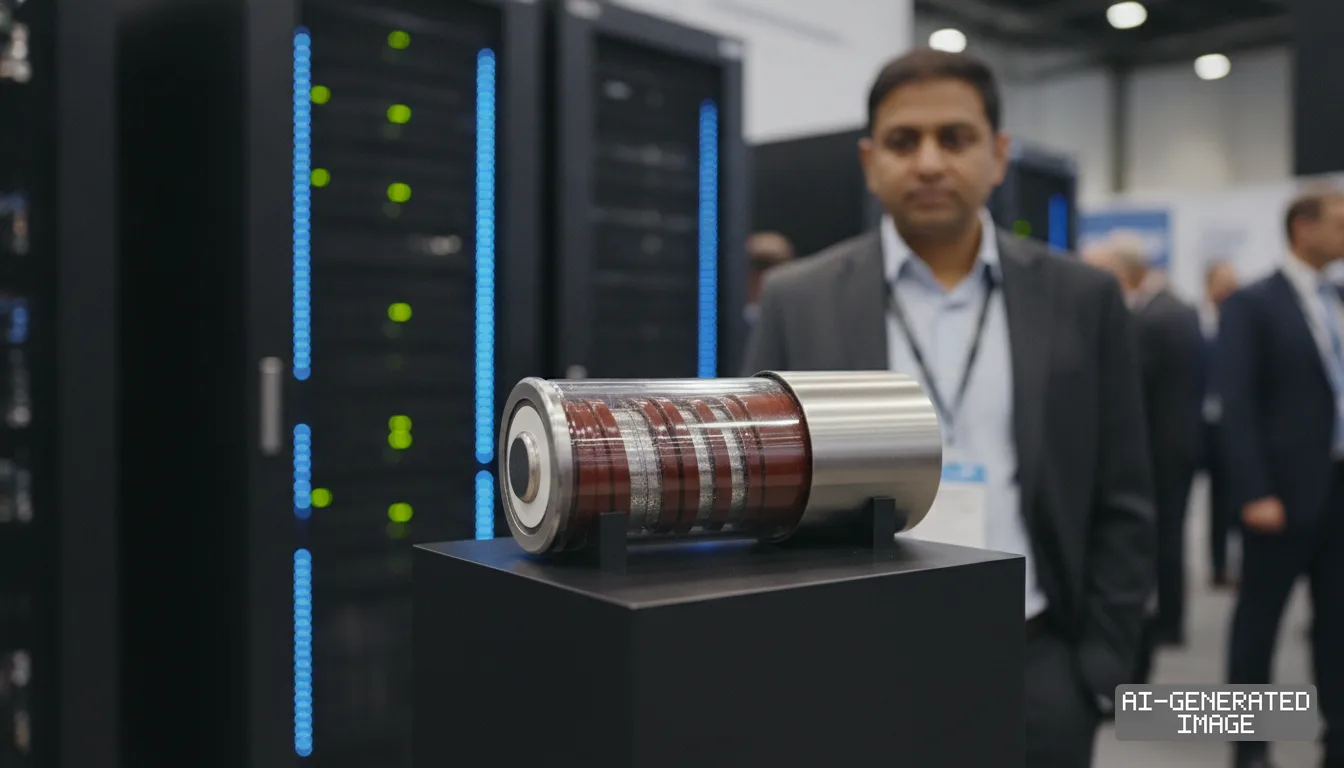
Samsung SDI unveiled its first cylindrical lithium iron phosphate battery on Sept. 29, 2026, targeting emergency backup power systems in artificial intelligence data centers across global networks.
The physical reveal occurred at Data Centre World Asia 2026 in Singapore, where more than 600 infrastructure equipment vendors gathered to exhibit high-power electrical hardware.
Samsung SDI is backing its LFP expansion with a 1.6 trillion won ($1.18 billion) cathode contract, covering three years of material procurement for North American energy storage systems.
Artificial intelligence data centers require continuous power support as graphic processor clusters create sharp electrical load spikes that strain local transmission grids during heavy computing workloads.
Uninterruptible power supply racks maintain steady voltage when grid feeds drop out, providing essential runtime until auxiliary diesel generators or industrial battery containers can synchronize.
Server facilities historically installed valve-regulated lead-acid batteries before migrating to ternary nickel-cobalt-manganese cells to save floor area inside expensive computing buildings.
Ternary chemistries deliver high volumetric energy density, but their thermal breakdown point occurs near 210 degrees Celsius, creating severe fire propagation risks inside enclosed data halls.
Lithium iron phosphate tolerates internal operating temperatures exceeding 270 degrees Celsius, making the chemistry structurally resistant to oxygen release and runaway combustion during electrical short circuits.
Iron phosphate cells traditionally suffer from lower operating voltage and sluggish electron transport, which constrained their ability to deliver instant high-current discharge bursts during sudden blackouts.
Samsung SDI said it used proprietary structural engineering in the cylindrical LFP cell to lower internal electrical resistance and expand usable discharge capacity under rapid load changes.
Cylindrical steel enclosures manage internal pressure spikes better than rectangular packaging, preventing pouch swelling and mechanical stress when cells undergo repeated charge cycles.
Alongside the new LFP format, Samsung SDI displayed 21700 ternary nickel cells modified with bottom-mounted directional vents to improve emergency thermal protection inside battery backup units.
Bottom venting routes flaming gasses downward toward specialized exhaust channels, preventing hot vapor from igniting electrical busbars and adjacent cell clusters inside standard nineteen-inch server racks.
In its uninterruptible power supply zone, Samsung SDI exhibited central system hardware that satisfied all evaluation standards in UL Solutions indoor Large-Scale Fire Test protocols.
The UL Solutions benchmark measures whether thermal runaway in a single cell induces propagation across surrounding battery modules, a requirement for high-density indoor server facility installations.
Rising land prices and power density limits require data center operators to shrink auxiliary electrical rooms to maximize square footage for revenue-generating server racks.
Samsung SDI previously demonstrated that high-power cell integration reduces uninterruptible power supply installation footprints by 33% compared to previous-generation storage cabinets.
Beyond internal server racks, Samsung SDI presented its containerized Samsung Battery Box 2.0 system, which uses large prismatic LFP cells for bulk substation energy buffering.
The SBB 2.0 platform incorporates module-level direct liquid injection mechanisms that spray fire suppressant straight into overheating cells before thermal energy spreads through the steel container.
North American cloud operators are restructuring their hardware supply chains to comply with tightening federal procurement rules that penalize reliance on Chinese battery cell manufacturers.
StarPlus Energy, the Indiana joint venture between Samsung SDI and Stellantis, is converting assembly lines from electric passenger vehicle cells to stationary energy storage systems.
To supply that manufacturing line, Samsung SDI signed a 1.6 trillion won ($1.18 billion) procurement agreement with Korean cathode producer L&F in March 2026.
L&F is constructing 60,000 metric tons of annual LFP cathode capacity outside China, giving Samsung SDI compliant active material for North American data center projects.
Samsung SDI plans to start mass production of prismatic LFP cells in Indiana in October 2026, delivering initial energy storage units to American customers before year-end.
The company did not publish cell dimensions, amp-hour capacity ratings or a commercial production timetable for the newly unveiled cylindrical LFP format.
Hyperscale data center operators will conduct qualification tests on Samsung SDI prototype samples through November 2026 ahead of planned utility grid expansions in early 2027.
Impact map
How this development propagates across the region and out to global buyers.
| Event | Korea | China | Japan | Global impact |
|---|---|---|---|---|
| Cylindrical LFP launch for AI backup | Samsung SDI diversifies from ternary cells into data center LFP, supported by L&F's 1.6T won cathode contract | CATL and BYD face displacement in North American hyperscale backup tenders due to foreign entity rules | Panasonic and GS Yuasa see increased price competition in high-discharge industrial UPS lines | Hyperscale operators gain non-Chinese LFP battery sources that meet UL indoor large-scale fire standards |
| Cylindrical LFP launch for AI backup | Samsung SDI diversifies from ternary cells into data center LFP, supported by L&F's 1.6T won cathode contract | CATL and BYD face displacement in North American hyperscale backup tenders due to foreign entity rules | Panasonic and GS Yuasa see increased price competition in high-discharge industrial UPS lines | Hyperscale operators gain non-Chinese LFP battery sources that meet UL indoor large-scale fire standards |
In this story
- Companies
- Samsung SDI
- Tickers
- 006400.KS
- Exposed
- StellantisUL Solutions
- Policy
- Economic SecuritySubsidies
- Impact
- Supply ChainCapexOrder Book
Track every Economic Security development → Track every Subsidies development →
Related briefings
- Korean battery makers deploy directional venting to block thermal runaway in EV and ESS packs Also on UL Solutions, Samsung SDI
- Samsung SDI clears UL fire safety test for utility LFP battery systems Also on Stellantis, Samsung SDI, Order Book
- Samsung SDI restarts Synergy Cells investment for 2028 ramp Also on Stellantis, Samsung SDI, Order Book
- Innometry sweeps Samsung SDI US ESS battery inspection orders Also on Stellantis, Samsung SDI, Order Book
Sources
Reporting
Confidence: medium — how we grade this
The documents behind this briefing are linked above. East Asia Brief produces its English text with AI assistance under human editorial review, and does not translate or republish other outlets' articles. See our methodology and AI policy. Spotted an error? Tell us.
The Morning Brief
What changed in Korean, Chinese and Japanese industry overnight — and what it means for your supply chain. One email, weekday mornings, US time. Free.
The Morning Brief is in preparation. Leave your address and we will write to you once — when the first issue is ready. Nothing before that.