BYD files immersion cooling patent to prevent EV pack fires
The two-chamber filing separates electrical connectors in a dry zone while submerging cells in dielectric liquid, targeting fast-charging thermal runaway across storage and vehicles.
BYD disclosed a two-chamber immersion cooling patent on Oct. 6, 2026, detailing an enclosure that submerges battery cell modules directly in dielectric liquid to suppress EV thermal runaway.
The filing, published under specification CN 122868832 A, addresses catastrophic fire risks across utility battery cabinets and passenger vehicles. It outlines a structural enclosure that eliminates indirect aluminum cold plates entirely.
China's intellectual property agency published the March 2025 application after 19 months of review. BYD held a 31% share of China's power battery market during that period, but the document discloses no enclosure weight metrics.
The design tackles the central vulnerability of high-power lithium batteries: rapid heat generation during extreme charging cycles. Traditional systems pump chilled water and glycol mixtures through exterior pipes to draw away heat.
Those indirect cooling setups create substantial thermal barriers between the cell and the coolant. Heat must transfer through cell walls, thermal interface pads and aluminum cold plates before reaching the moving liquid.
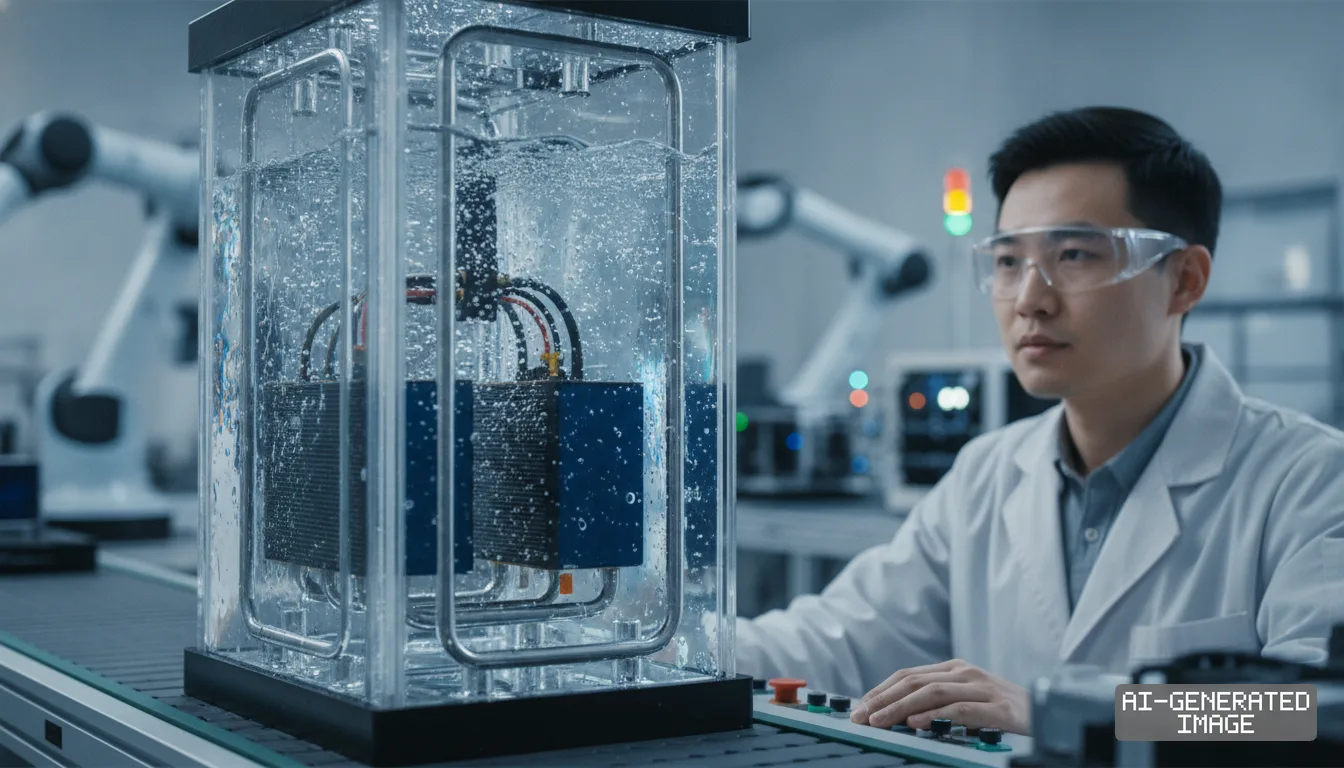
By contrast, immersion cooling eliminates intermediate materials entirely. Submerging cell modules in dielectric fluid — an electrically non-conductive liquid engineered to absorb heat without causing short circuits — provides direct thermal transfer across all module surfaces.
Direct liquid contact slashes thermal resistance, enabling uniform temperature control across individual cells. That uniform dissipation suppresses hotspot creation, which serves as the primary trigger for battery thermal runaway events.
Deploying liquid immersion inside automotive battery enclosures introduces severe mechanical challenges. Liquid must be hermetically contained within the pack, while high-voltage connections and digital sensors must remain completely dry and isolated.
BYD structured the patent around a physical two-chamber enclosure to resolve that sealing boundary. The cabinet segregates high-voltage switching equipment from the fluid volume, preventing conductive contamination and insulation breakdown.
The lower compartment of the enclosure houses the liquid reservoir. Cell modules sit fully submerged in dielectric fluid within this sealed chamber, maximizing surface contact to extinguish localized temperature spikes quickly.
The upper section functions as an isolated dry compartment. Power distribution units, circuit breakers, electronic controllers and harness plugs remain situated above the liquid surface within this sealed chamber, the patent filing said.
Placing connection terminals in the upper dry chamber minimizes hydrostatic fluid pressure on seals, the document said. Hydraulic pressure rises with liquid depth, making submerged wire pass-throughs prone to catastrophic leakage over vehicle lifycles.
The architecture also incorporates dedicated conduit channels linking the two zones. These insulated conduits allow busbars to deliver power to the lower cells without exposing the upper electronics bay to splashing dielectric fluid.
The patent filing directly exposes Contemporary Amperex Technology to heightened architectural competition. CATL commands 37% of global electric vehicle battery shipments and utilizes indirect cold-plate assemblies across its high-voltage Qilin battery packs.
Adopting immersion cooling would force broad changes across BYD's proprietary battery platforms. The company equips 100% of its passenger electric vehicles and its utility-scale MC Cube storage systems with indirect liquid-chilled Blade cells.
Energy storage systems represent the initial commercial target for immersion architecture. Stationary utility cabinets can absorb the added fluid weight more easily than passenger electric vehicles, which face stringent curb-weight and energy-density targets.
Automakers face growing thermal management bottlenecks as charging speeds advance toward 400 kilowatts. Delivering such extreme electrical current causes cell resistance to spike, overwhelming the heat-dissipation limits of standard bottom-mounted cooling plates.
Immersion cooling provides the heat extraction capacity required for five-minute ultra-fast charging sessions. Uniform fluid circulation prevents adjacent cells from exceeding critical operating temperatures during sustained high-rate DC charging.
Material costs present another substantial hurdle for commercial deployment. Dielectric coolants carry prices roughly three to four times higher than conventional ethylene glycol mixtures, raising overall pack manufacturing expenses.
Fluid replacement and vehicle crash integrity present additional operational questions for automakers. In severe side-impact collisions, rupturing an immersion battery pack could release substantial volumes of synthetic fluid onto road surfaces.
The patent specification does not state whether BYD plans to install immersion enclosures in passenger cars, and the company has not published supplier procurement contracts for commercial dielectric fluids.
Following publication by the China National Intellectual Property Administration, the patent entered a statutory public review phase. That review window runs through Jan. 5, 2027, before formal patent examiners determine final claim allowances.
The patent office will examine specific claims covering the liquid-tight partition wall and vertical electrical conduits under Chinese patent examination guidelines.
Impact map
How this development propagates across the region and out to global buyers.
| Event | Korea | China | Japan | Global impact |
|---|---|---|---|---|
| BYD immersion cooling patent | LG Energy Solution and Samsung SDI monitor immersion thermal standards | CATL defends 37% share as BYD shifts from cold plates | Panasonic and chemical suppliers face synthetic coolant demand shifts | Automakers weigh higher fluid costs against fast-charging fire prevention |
In this story
- Companies
- BYD Company Limited
- Tickers
- 002594.SZ
- Exposed
- Contemporary Amperex Technology
- Policy
- Economic Security
- Impact
- Supply ChainCapexCost Structure
Track every Economic Security development →
Related briefings
- Corvus Energy and BYD introduce Blue Whale marine LFP battery system Also on BYD Company Limited
- BYD readies solid-state battery road trial as rivals advance Also on Contemporary Amperex Technology, Cost Structure
- CATL and Kuehne+Nagel agree on electric freight logistics Also on Contemporary Amperex Technology, Cost Structure
- LG Energy Solution validates cobalt-free LMR battery cells Also on Contemporary Amperex Technology, Cost Structure
Sources
Reporting
Confidence: medium — how we grade this
The documents behind this briefing are linked above. East Asia Brief produces its English text with AI assistance under human editorial review, and does not translate or republish other outlets' articles. See our methodology and AI policy. Spotted an error? Tell us.
The Morning Brief
What changed in Korean, Chinese and Japanese industry overnight — and what it means for your supply chain. One email, weekday mornings, US time. Free.
The Morning Brief is in preparation. Leave your address and we will write to you once — when the first issue is ready. Nothing before that.