South Korea starts unannounced quarantine checks on merchant ships
Decree No. 1215 ends routine onboard screening to accelerate port entry for 10,000 low-risk vessels while allowing unheralded maritime inspections.
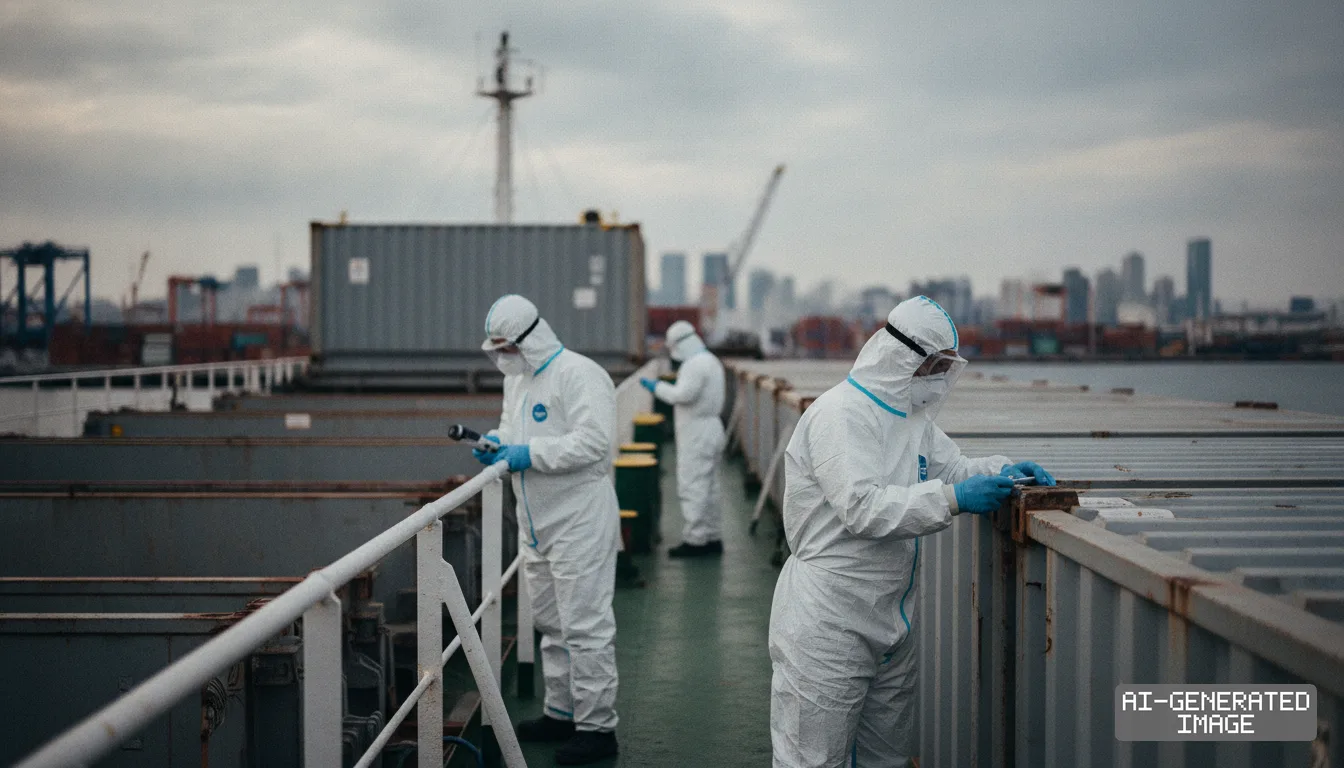
South Korea's disease control agency put unannounced random quarantine inspections into effect on Nov. 27, 2026, authorizing port officials to board foreign merchant vessels without prior warning or active disease symptoms.
The Korea Disease Control and Prevention Agency issued the operational mandate under Ministry of Health and Welfare Decree No. 1215, amending the Quarantine Act to eliminate screening blind spots across domestic commercial seaports.
The agency estimates the broader regulatory reform will speed port entries for roughly 10,000 low-risk vessels each year by ending routine boarding inspections that previously accounted for 57.6% of maritime crew rotation checks.
Quarantine station directors now hold statutory authority to pull container carriers and bulk freighters for surprise inspections, dispatching medical inspection teams directly to terminal berths as vessels secure their mooring lines.
Foreign merchant vessels must submit to physical health screenings even if they carry valid ship sanitation certificates, report zero symptomatic crew members and arrive from ports outside designated infection control zones.
Flag carrier HMM, which moves roughly 30% of container cargo volume entering South Korea, faces potential schedule disruptions across its domestic gateway calls whenever dockside health inspections extend vessel laytime.
Dry bulk operator Pan Ocean, which handles approximately 100 million metric tons of cargo annually, must similarly manage unannounced inspection delays across South Korea's raw material import berths in Gwangyang and Pohang.
Before the regulatory change took effect, quarantine inspectors boarded incoming vessels only when crew members reported fevers, when onboard deaths occurred, when disease vectors appeared or after transiting designated hotspots.
The KDCA designed the random sampling regime to maintain high-risk scrutiny while compelling ocean carriers to preserve sanitary standards aboard vessels operating routine coastal and regional routes.
Vessels calling at deepwater anchorages without berthing at terminal quays will transition to document-based reviews, eliminating physical boardings for vessels conducting midstream transfers or awaiting cargo allocations.
The shift to paper screenings for anchored ships removes the hazard of inspectors scaling rope pilot ladders during adverse sea conditions, which local maritime officials identified as an ongoing safety issue.
The revised regulation also consolidates three separate passenger and crew reporting documents into a single standardized Health Status Declaration, reducing clerical processing for shipmasters prior to arrival.
The statutory revision traces back to legislative amendments passed by South Korea's National Assembly on April 23, 2026, establishing the statutory framework for surprise sampling across maritime and aviation sectors.
The National Busan Quarantine Station released localized operating instructions on Nov. 27, 2026, instructing terminal officers to execute the surprise boarding protocols across Busan Port's container terminals.
Busan handles roughly 75% of South Korea's total container throughput, making the port a primary transit choke point where unanticipated inspection holds can disrupt tight feeder schedules.
Freight forwarders and shipping agencies have alerted vessel operators that random selection will halt cargo operations until inspectors clear the ship, introducing friction for just-in-time supply chains.
Container lines operating intra-Asia loops connecting South Korea, China and Japan operate on narrow port windows, where unexpected berth delays can trigger missed transshipment connections at regional hubs.
Ocean carriers face elevated risk of terminal demurrage fees and bunker fuel surcharges if random checks force ships to increase sailing speeds to regain lost scheduling buffers.
The South Korean government modeled the selective inspection approach after maritime protocols in the United States and Japan, which emphasize risk-tiered boarding over uniform harbor checks.
The decree does not state the target sampling percentage for arriving vessels, and the disease agency has not published estimates for cargo clearance delays or potential carrier demurrage costs.
Port quarantine authorities across Busan, Incheon and Yeosu began executing random vessel selections on Nov. 27, 2026, under the active provisions of the amended ministerial decree.
Impact map
How this development propagates across the region and out to global buyers.
| Event | Korea | China | Japan | Global impact |
|---|---|---|---|---|
| random vessel quarantine inspections | HMM and Pan Ocean face berth inspection delays across Busan and Incheon terminals | feeder ships on Bohai and Yangtze corridors risk scheduling misalignments | short-sea container services connecting Hanshin ports face buffer adjustments | liner operators absorb demurrage exposure while 10,000 low-risk ships gain faster clearance |
In this story
Track every Standards development →
Related briefings
- Shipyards Fill VLCC Slots as Crude Tanker Rates Hit Records Also on Pan Ocean
- HMM seals $1.44B green containership order with HD Hyundai Also on HMM, Standards, Compliance
- Korea directs 464 billion won to deploy uncrewed ships by 2032 Also on HMM, Standards
- India pitches $10 billion coastal yard hubs to Korean shipbuilders Also on HMM
Sources
Primary documents
Reporting
Confidence: high — how we grade this
The documents behind this briefing are linked above. East Asia Brief produces its English text with AI assistance under human editorial review, and does not translate or republish other outlets' articles. See our methodology and AI policy. Spotted an error? Tell us.
The Morning Brief
What changed in Korean, Chinese and Japanese industry overnight — and what it means for your supply chain. One email, weekday mornings, US time. Free.
The Morning Brief is in preparation. Leave your address and we will write to you once — when the first issue is ready. Nothing before that.