China waives African import tariffs to secure mineral flows
South African shipments to Chinese ports surge under a two-year duty exemption covering 53 nations, anchoring battery feedstock and metal refining in Beijing's orbit.
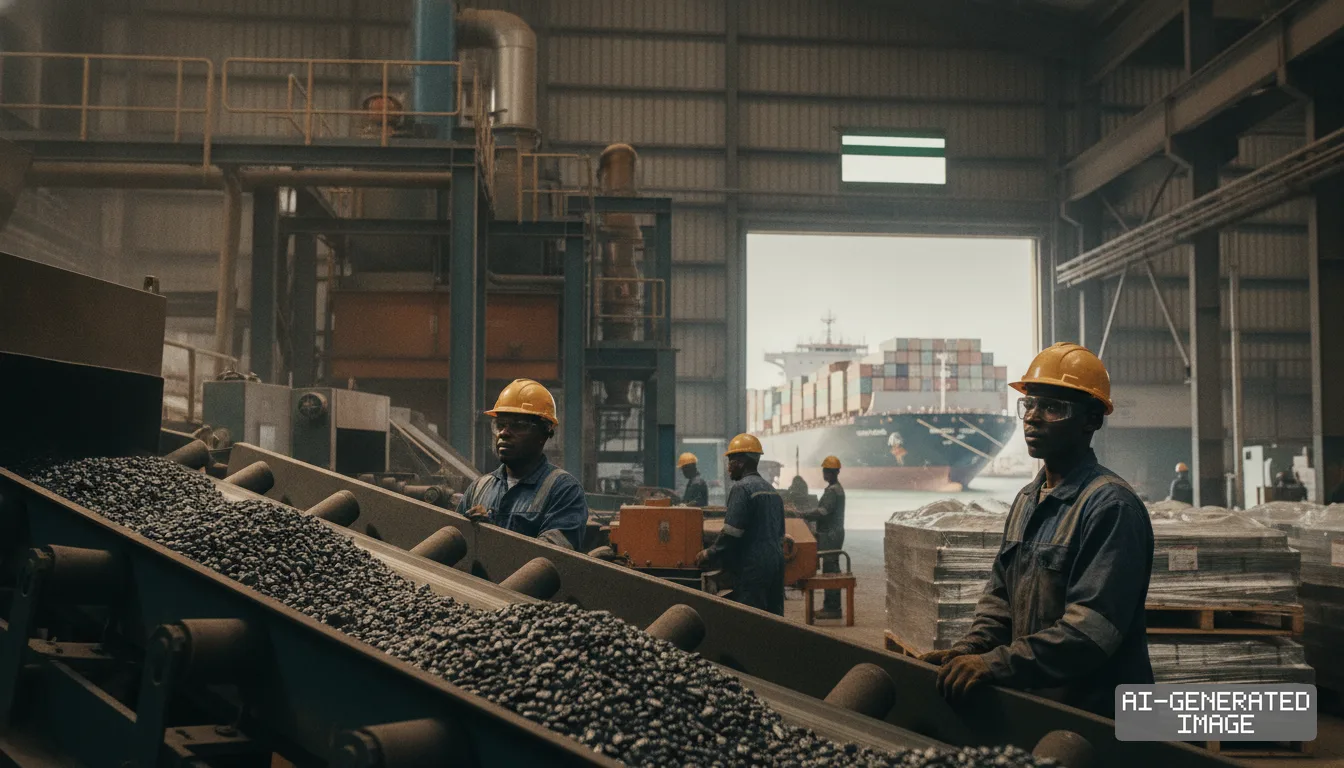
South Africa's trade ministry released trade data on Oct. 23, 2026, showing customs declarations to China jumped 199% following the rollout of Beijing's unilateral zero-tariff trade preference.
The surge reflects the rapid rerouting of processed minerals and industrial goods toward Chinese smelters, reinforcing Beijing's grip on raw material supply lines against Western diversification efforts.
Chinese customs clearances for African goods totaled 193.8 billion yuan ($27.3 billion) in May and June alone, expanding 23.5% compared to the prior-year period.
The tariff exemption, which took effect May 1, eliminated import duties on 100% of tariff lines for 53 African nations maintaining diplomatic ties with China.
Only 47 tariff lines governing sensitive agricultural goods remain subject to tariff-rate quotas — limits where imports above a set volume face standard duties — leaving industrial commodities completely duty-free.
South African Trade, Industry and Competition Minister Parks Tau reviewed the program's initial milestones during a bilateral briefing in Pretoria, calling on domestic producers to expand value-added exports.
Between June 1 and Aug. 31, the South African Revenue Service issued 25,975 certificates of origin to qualify outbound shipments for Chinese duty exemptions, Tau said.
Pretoria paired the trade preference with a strategic portfolio identifying 100 high-value industrial product categories, including fabricated metals, refined chemicals and specialized automotive components.
The zero-tariff framework represents a structural shift from raw ore extraction toward domestic beneficiation — the industrial treatment that refines raw ore into higher-purity metal concentrates.
Chinese President Xi Jinping laid down four principles for African mineral cooperation earlier this month, asserting that African resources must foster local processing rather than basic extraction.
Beijing has targeted 20 non-least developed African nations, including South Africa, Egypt, Nigeria, Kenya and Botswana, under a temporary preferential window running through April 30, 2028.
The remaining 33 least developed African countries already enjoyed permanent duty-free access, consolidating an uninterrupted trade perimeter across almost the entire African continent.
The preferential tariff schedule covers all 53 African nations that maintain formal diplomatic ties with Beijing, excluding only Eswatini, which maintains diplomatic relations with Taiwan.
The Chinese Ministry of Finance set clear regional value content requirements, stipulating that non-originating materials must undergo substantial transformation within African partner countries before qualifying for preferential tariff treatment.
The duty waiver applies strict rules of origin to ensure third-party producers cannot transship unprocessed cargo through African ports to avoid standard border duties.
Bilateral trade between South Africa and China totaled 642 billion rand ($36.2 billion) in 2025, up from 483 billion rand in 2021, according to South African government records.
South African exports to China accounted for 222 billion rand of that sum, driven predominantly by bulk manganese, chrome ore and platinum group metals.
The elimination of tariff friction now allows Chinese refiners to procure refined intermediates at lower landed costs than competitors in Europe, Japan and the United States.
Western capital has attempted to direct African mineral flows toward domestic battery supply chains through the Minerals Security Partnership, an initiative led by Washington to counter Chinese dominance.
Beijing's unilateral duty elimination undercuts those efforts by immediately lowering the tax hurdle for African processors that export directly to Chinese industrial hubs.
By lowering duties to zero on intermediate products, Beijing encourages African smelters to perform crushing and smelting stages locally before shipping concentrated feedstock to Chinese coastal manufacturing bases.
The unilateral scheme contrasts with the United States African Growth and Opportunity Act, which excludes multiple value-added mineral categories and imposes stringent periodic eligibility reviews on participating governments.
South African exporters who shipped qualifying goods without prior documentation can obtain retrospective certificates within one year of dispatch to recover customs deposits from Chinese authorities.
South African trade officials are scheduled to present the Top 100 value-added portfolio directly to Chinese industrial buyers at the China International Import Expo in Shanghai next month.
Negotiators from the Southern African Customs Union and Beijing are currently drafting an early harvest agreement to convert China's unilateral concession into a permanent, reciprocal trade treaty.
The current tariff preference for South Africa and 19 other middle-income African economies will expire on April 30, 2028, unless extended by the Chinese State Council.
The Chinese General Administration of Customs has not published country-by-country cargo volumes for individual processed mineral tariff lines under the zero-tariff regime.
The Chinese Ministry of Commerce has also not stated whether the two-year preferential window will be renewed when the decree reaches its statutory expiration in 2028.
Impact map
How this development propagates across the region and out to global buyers.
| Event | Korea | China | Japan | Global impact |
|---|---|---|---|---|
| China Africa Zero Tariff Policy | Korean battery refiners face higher procurement costs as African intermediates route to China | Chinese refiners secure duty-free feedstock, lowering input costs across critical minerals | Japanese trading houses encounter tighter merchant availability for South African manganese and platinum | Western critical mineral supply chains face widening cost disparities against Chinese processors |
In this story
- Policy
- TariffsLocal Content Rules
- Impact
- Supply ChainPricing
Track every Tariffs development → Track every Local Content Rules development →
Related briefings
- Korean battery makers win US ESS orders as tariffs hit China Also on Local Content Rules, Tariffs, Pricing
- MOT secures $7.6M Samsung SDI order for US LFP battery plant Also on Local Content Rules, Tariffs
- Trump 100% China tariff threats hit Asian intermediate hubs Also on Local Content Rules, Tariffs
- Stellantis pushes Leapmotor European parts past 40% in Spain Also on Local Content Rules, Tariffs
Sources
Primary documents
Reporting
Confidence: high — how we grade this
The documents behind this briefing are linked above. East Asia Brief produces its English text with AI assistance under human editorial review, and does not translate or republish other outlets' articles. See our methodology and AI policy. Spotted an error? Tell us.
The Morning Brief
What changed in Korean, Chinese and Japanese industry overnight — and what it means for your supply chain. One email, weekday mornings, US time. Free.
The Morning Brief is in preparation. Leave your address and we will write to you once — when the first issue is ready. Nothing before that.