Samsung Heavy profit jumps 42% on floating LNG and high-value ships
Operating profit climbed to 338.4 billion won in the third quarter as floating liquefaction facilities and premium carriers lifted margins to 10.7%.
Samsung Heavy Industries reported on Nov. 2 that its third-quarter operating profit rose 42.1% year on year to 338.4 billion won ($253.3 million), driven by high-margin floating liquefaction projects.
Revenue climbed 19.6% from a year earlier to 3.1504 trillion won ($2.36 billion), the company said. Operating profit margin reached 10.7%, maintaining double-digit profitability despite fewer working days during domestic holidays.
The shipbuilder secured $12.4 billion in new orders through September, reaching 89% of its $13.9 billion annual target. That order volume covers 48 vessels and offshore units, including 20 liquefied natural gas carriers and two floating units.
Cumulative revenue for the first nine months reached 9.2834 trillion won ($6.95 billion), an 18.8% increase year on year. Operating profit over the same nine-month period rose 65.5% to 936.5 billion won ($701 million).
Samsung Heavy said it expects to meet its full-year revenue guidance of 12.8 trillion won ($9.58 billion). Yard slots at its Geoje facility remain committed through 2028, supporting sustained production pricing across high-value vessel categories.
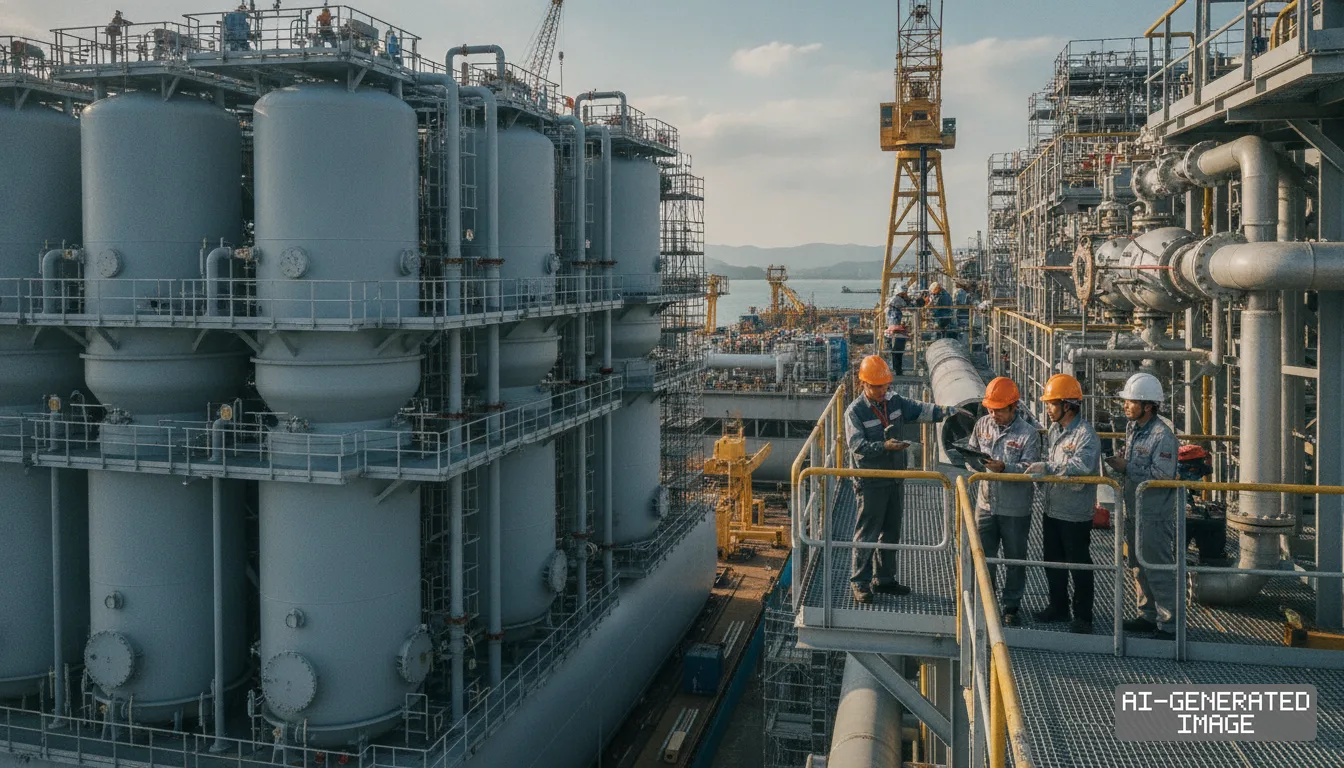
The profit expansion reflects rising construction shares for floating liquefied natural gas (FLNG) units — specialized offshore hulls that extract, liquefy and store natural gas at sea — alongside high-priced conventional LNG carriers.
FLNG production requires complex topside chemical processing systems that fit on a single marine hull. Engineering tolerances for cryogenic equipment at sea create substantial technological hurdles that keep entry barriers high for shipbuilders worldwide.
Chinese shipbuilders, including Hudong-Zhonghua Shipbuilding and Jiangnan Shipyard, have captured dominant volume shares in standard bulk vessels, container carriers and conventional LNG transport hulls. Yet Chinese yards have not secured commercial FLNG construction work.
Samsung Heavy holds a dominant position in the floating liquefaction sector, having delivered four of the world's operational deepwater FLNG hulls. That established operational record allows the Korean yard to command premium contract pricing.
Conventional merchant vessel construction faces margin erosion as Asian steel plate costs and labor expenditures fluctuate. Floating liquefaction contracts insulate the shipyard through negotiated engineering schedules and milestone billing arrangements with major global energy developers.
Pre-tax profit for the third quarter rose 332.5% to 610.7 billion won ($457.2 million), the company said. Non-operating gains contributed 272.3 billion won ($203.8 million), primarily through favorable forward foreign exchange settlement closures.
Net profit reached 470.8 billion won ($352.5 million), advancing 235.6% from the third quarter of 2025. Solid cash generation from delivery milestones reduced shipyard financing costs and strengthened net balance sheet reserves.
Rival domestic shipyards also posted higher third-quarter earnings. HD Korea Shipbuilding and Offshore Engineering reported an operating profit of 1.4472 trillion won ($1.08 billion), marking a 37.3% expansion over the prior-year period.
Hanwha Ocean posted operating profit of 485.7 billion won ($363.6 million), up 67.6% over the same three months. The three major South Korean shipyards have all pivoted toward high-specification gas transport and offshore platforms.
Samsung Heavy is preparing bids for nearshore and deepwater liquefaction terminals in North America. Export developers seek floating offshore platforms to avoid lengthy terrestrial environmental reviews and reduce initial capital expenditures for onshore terminal facilities.
The shipbuilder is advancing negotiations for the second Delfin FLNG hull in the United States. Delfin Midstream designated Samsung Heavy as its exclusive engineering, procurement, construction and installation contractor under a continuing letter of award.
The company is also pursuing the Western FLNG production vessel planned for British Columbia in Canada. Winning both projects would replenish the builder's offshore order book into the next decade and absorb premium drydock capacity.
Operating results eased modestly from the second quarter, when revenue was 2.5% higher. Summer vacations and Chuseok holidays cut shipyard operating hours during August and September, though higher contract pricing offset the volume decrease.
Global LNG carrier charter rates moderated during 2026, yet demand for long-term production infrastructure remains robust. Energy developers require continuous liquefaction capacity to supply European and Asian import utilities seeking diversified non-pipeline gas volumes.
Samsung Heavy targets signing final binding engineering and construction contracts for both the Delfin and Western FLNG units before Dec. 31. Those execution dates depend on final investment decisions from the commercial developers.
The company has not disclosed the definitive contract values for either North American FLNG project, and official filings do not settle the exact margin differential between individual offshore hulls and standard LNG carriers.
Impact map
How this development propagates across the region and out to global buyers.
| Event | Korea | China | Japan | Global impact |
|---|---|---|---|---|
| High-margin FLNG construction | Samsung Heavy achieves 10.7% margin with $12.4B backlog | Yards lead merchant volume but remain locked out of FLNG topside work | Importers secure long-term cargo flow from Korean-built floating terminals | Floating LNG market expands toward $3.6B in 2026 to bypass onshore permits |
| High-margin FLNG construction | Samsung Heavy achieves 10.7% margin with | — | — | — |
| High-margin FLNG construction | Samsung Heavy achieves 10.7% margin with $12.4B backlog | Yards lead merchant volume but remain locked out of FLNG topside work | Importers secure long-term cargo flow from Korean-built floating terminals | Floating LNG market expands toward $3.6B in 2026 to bypass onshore permits |
In this story
- Companies
- Samsung Heavy Industries
- Tickers
- 010140.KS
- Exposed
- HD Korea Shipbuilding and Offshore EngineeringHanwha OceanDelfin Midstream
- Impact
- Order BookPricingCost Structure
Related briefings
- Samsung Heavy expands Busan R&D center into offshore engineering hub Also on Delfin Midstream, Samsung Heavy Industries, Hanwha Ocean
- Samsung Heavy posts 42% operating profit rise on gas vessels Also on Delfin Midstream, Samsung Heavy Industries, Pricing
- Won rebound splits Korean shipbuilders on currency hedging Also on HD Korea Shipbuilding & Offshore Engineering, Samsung Heavy Industries, Hanwha Ocean
- HD Hyundai and Hanwha Ocean Lock In LNG Carrier Berth Slots Through 2029 Also on HD Korea Shipbuilding & Offshore Engineering, Samsung Heavy Industries, Hanwha Ocean
Sources
Reporting
Confidence: medium — how we grade this
The documents behind this briefing are linked above. East Asia Brief produces its English text with AI assistance under human editorial review, and does not translate or republish other outlets' articles. See our methodology and AI policy. Spotted an error? Tell us.
The Morning Brief
What changed in Korean, Chinese and Japanese industry overnight — and what it means for your supply chain. One email, weekday mornings, US time. Free.
The Morning Brief is in preparation. Leave your address and we will write to you once — when the first issue is ready. Nothing before that.