Petronas and Samsung Heavy name PFLNG Tiga at Geoje shipyard
The 2.0-million-tonne nearshore unit expands Malaysia's floating LNG output by 74% ahead of its planned sail-away in February 2027.
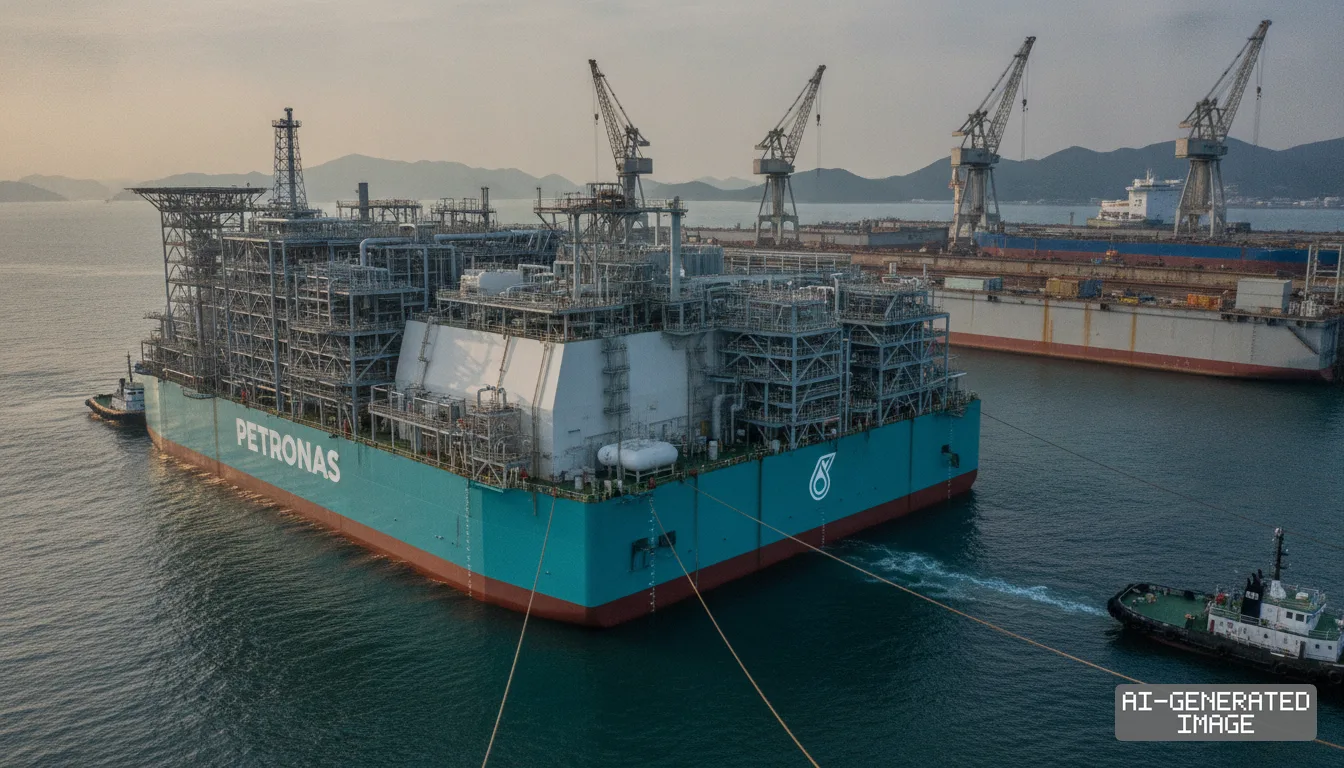
Petronas confirmed Nov. 25 that it named PFLNG Tiga, the world's first nearshore floating liquefied natural gas facility, at Samsung Heavy Industries' Geoje shipyard in South Korea.
The 2.0-million-tonne-per-year facility expands Petronas's floating liquefaction capacity by 74%. The unit lifts the Malaysian state energy firm's floating output from 2.7 million tonnes across two operating plants to 4.7 million tonnes.
Samsung Heavy Industries won the engineering, procurement and construction hull contract alongside topside fabrication in December 2022. The shipbuilder booked 1.96 trillion won ($1.4 billion) for its scope within the consortium.
Consortium partner JGC of Japan oversees overall project management, topside engineering and coastal infrastructure. The Japanese contractor previously partnered with Samsung Heavy Industries on the PFLNG Dua deepwater production vessel.
The newly named facility measures 281 meters in length, 64 meters in width and 32 meters in depth. Its launching weight exceeded 50,000 tons when workers floated the hull in February 2025.
Floating liquefied natural gas plants extract, treat, liquefy and store natural gas directly over marine fields. The vessels eliminate the expensive subsea pipelines required to pump raw gas to terrestrial liquefaction terminals.
Nearshore facilities operate moored close to coastlines rather than hundreds of kilometers out at sea. The setup reduces structural stress from rough ocean swells while linking directly into regional pipeline grids.
The naming milestone validates Samsung Heavy Industries' dominant position in complex offshore structures. South Korean shipbuilders have shifted away from commodity cargo vessels to protect yard margins.
Samsung Heavy Industries has secured construction orders for five of the nine floating liquefaction units awarded worldwide. That tally gives the South Korean builder more than 50% of the global market for operational and ordered units.
Global energy majors seek proven construction records before committing billions of dollars to modular liquefaction plants. Yard delays on complex offshore gas installations routinely drive up capitalized financing costs.
Petronas pioneered commercial offshore liquefaction with the 1.2-million-tonne PFLNG Satu in 2016. The company later introduced the 1.5-million-tonne PFLNG Dua for deepwater operations offshore Sabah.
Deploying PFLNG Tiga allows Petronas to monetize stranded coastal reserves that lack dedicated pipeline corridors. The vessel will anchor at the Sipitang Oil and Gas Industrial Park on Sabah's western coast.
Natural gas will feed into the plant from offshore Sabah blocks to supply liquefied gas for regional export. Rising Asian demand for clean-burning transitional fuels supports the long-term economics of the venture, project partners said.
The project brings together Japanese systems engineering and South Korean modular fabrication. JGC engineered the 40,000-ton topside modules, while Samsung Heavy Industries assembled them using a 9,000-ton floating crane.
Close yard coordination allowed the consortium to maintain delivery milestones agreed during front-end engineering design. High structural integration between the hull and topside modules reduced field-welding hours at Geoje.
Offshore production shields operators from terrestrial site-clearing expenses, environmental permitting disputes and onshore property acquisitions. Floating units also permit relocation to new gas fields once initial reservoirs deplete.
The shipyard is completing final electrical integration, piping insulation and topside pre-commissioning work across the 11 integrated modules. Technicians test cryogenic storage tanks designed to hold commercial liquefied volumes prior to carrier loading.
Samsung Heavy Industries has not published standalone execution costs or contract revisions on its investor relations portal as of Nov. 25, leaving final commissioning margins undisclosed.
Sail-away from Geoje is scheduled for mid-February 2027, followed by hook-up work in Sipitang ahead of commercial gas production in the third quarter of 2027.
Impact map
How this development propagates across the region and out to global buyers.
| Event | Korea | China | Japan | Global impact |
|---|---|---|---|---|
| PFLNG Tiga nearshore facility delivery | Samsung Heavy Industries secures execution milestones for 1.96 trillion won order book | Chinese shipbuilders remain excluded from current premium high-capacity FLNG contracts | JGC Corporation leads consortium, booking topside engineering and Sabah onshore EPC | Adds 2.0 MTPA flexible LNG supply to Asia-Pacific market by late 2027 |
In this story
- Companies
- Samsung Heavy Industries
- Tickers
- 010140.KS
- Exposed
- JGC Holdings
- Policy
- Procurement Rules
- Impact
- Order BookCapexSupply Chain
Track every Procurement Rules development →
Related briefings
- COOEC takes $800M QatarEnergy offshore contract for subsea lines Also on JGC Holdings, Order Book
- US Envoy Visits Samsung Heavy to Expand Naval Fleet Repair Also on Samsung Heavy Industries, Procurement Rules, Order Book
- Hanwha Ocean exits 6 trillion won offshore wind development Also on Samsung Heavy Industries, Order Book
- Korean yards lift Q3 R&D spending 78% to $327M for naval robotics Also on Samsung Heavy Industries, Order Book
Sources
Reporting
Confidence: medium — how we grade this
The documents behind this briefing are linked above. East Asia Brief produces its English text with AI assistance under human editorial review, and does not translate or republish other outlets' articles. See our methodology and AI policy. Spotted an error? Tell us.
The Morning Brief
What changed in Korean, Chinese and Japanese industry overnight — and what it means for your supply chain. One email, weekday mornings, US time. Free.
The Morning Brief is in preparation. Leave your address and we will write to you once — when the first issue is ready. Nothing before that.