Mitsubishi Heavy buys Shimonoseki site in $638M yard plan
The group signed a contract on Oct. 2 to acquire 14.5 hectares for a new hull block plant, backed by up to 40 billion yen in Japanese economic security subsidies.
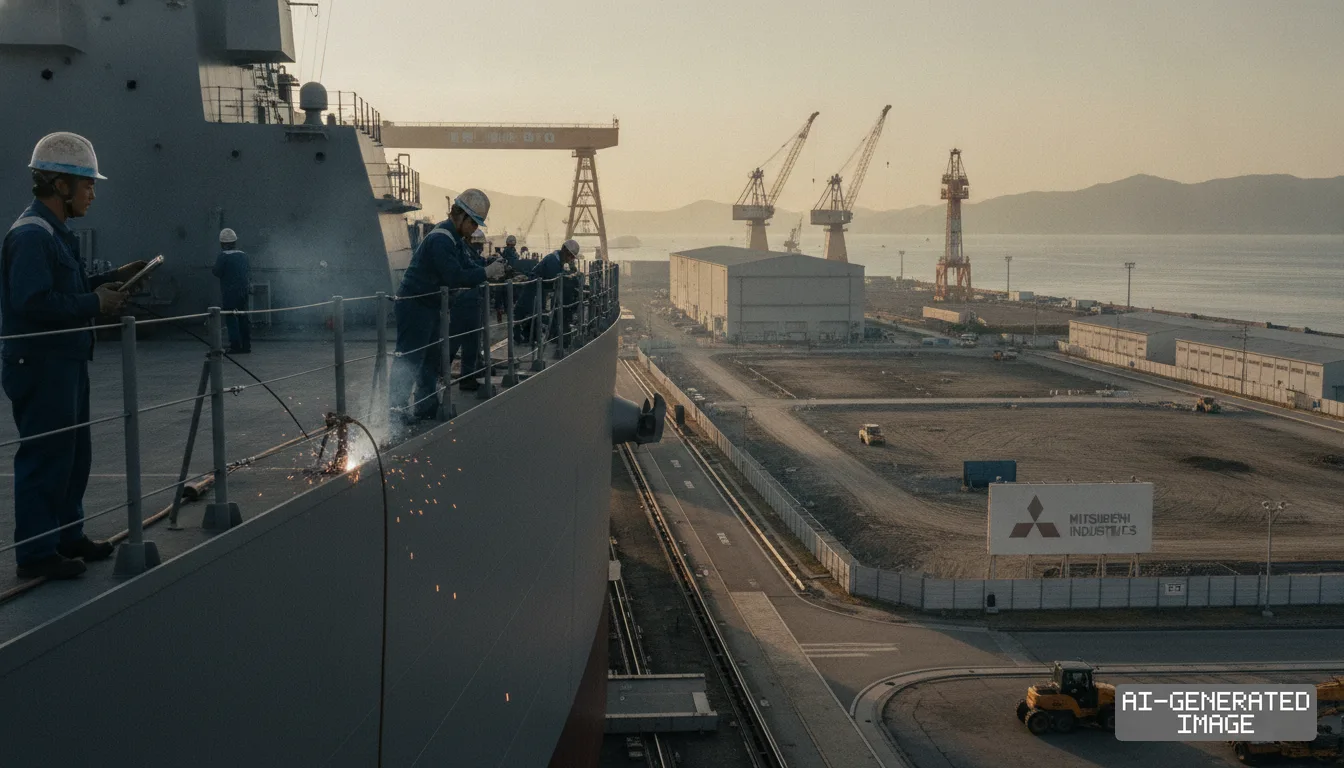
Mitsubishi Heavy Industries signed a contract on Oct. 2, 2026, to acquire 14.5 hectares of industrial land in Shimonoseki, launching a 100 billion yen ($638 million) shipyard capacity expansion.
The transaction marks the first major shipyard land acquisition by a prime Japanese defense contractor in two decades. Japanese shipbuilders had steadily closed building docks since the 2008 financial crisis.
Japan's Ministry of Land, Infrastructure, Transport and Tourism approved up to 40 billion yen ($255 million) in subsidies on Sept. 11, 2026. The government grant covers 40% of the total capital outlay.
The municipal government of Shimonoseki agreed to sell 144,744 square meters of waterfront property across 10 parcels on Choshu Dejima, an offshore artificial island. The purchase price totaled 3.039 billion yen ($19.4 million).
Mitsubishi Shipbuilding, a maritime engineering unit wholly owned by Mitsubishi Heavy Industries, will build and operate the new hull block fabrication facility.
The company will transfer fabrication lines from its Enoura Plant at the Shimonoseki Shipyard & Machinery Works. That legacy yard operates on a narrow coastal corridor with limited room for automated machinery.
The expansion reverses years of capacity cutbacks across Japan's commercial maritime sector. Japanese builders struggled for two decades to match standard container and bulk carrier prices quoted by Chinese and South Korean yards.
Mitsubishi Heavy Industries had previously exited large commercial merchant tonnage. In 2022, the group transferred its flagship Koyagi plant in Nagasaki, which housed one of the largest building docks in Japan, to rival Oshima Shipbuilding.
Other major domestic yards are receiving state capital under the same economic security policy. The transport ministry awarded 6.1 billion yen to Oshima Shipbuilding and 15.6 billion yen to Kawasaki Heavy Industries on Sept. 11, 2026.
A separate funding round on Sept. 4 granted 113.8 billion yen to Imabari Shipbuilding and 49.4 billion yen to Japan Marine United. Total public-private commitments reached 900 billion yen across eight approved corporate plans.
Tokyo classified ship hulls as specified critical goods under the Economic Security Promotion Act in early 2026. The designation permits direct subsidies for dry dock renovations, heavy crane installations and automated welding workshops.
Japan's cabinet set a national objective on July 21, 2026, to double domestic shipbuilding output. The policy roadmap targets 18 million gross tons annually by 2035, up from nine million gross tons produced in 2024.
The Shimonoseki facility focuses on specialized commercial vessels. The order book includes liquefied natural gas-fueled passenger ferries, roll-on/roll-off freight carriers and undersea cable-laying vessels.
The yard also constructs maritime security vessels, including patrol ships for the Japan Coast Guard and partner nations. Mitsubishi Heavy Industries delivered an offshore patrol vessel to Indonesia earlier this year.
South Korean yards hold more than 70% of worldwide orders for large liquefied natural gas carriers. Chinese state shipyards dominate dry bulk and standard container tonnage with lower labor and domestic plate steel costs.
Building modern block fabrication shops on Choshu Dejima allows Mitsubishi Shipbuilding to construct larger modular hull sections indoors. Assembling pre-outfitted blocks reduces the number of days a vessel occupies a dry dock.
The Shimonoseki municipal assembly approved the property transfer on Sept. 4, 2026, under Agenda No. 134. Choshu Dejima was completed to handle container cargo and had vacant industrial parcels available since 2019.
Groundwork at the Choshu Dejima artificial island site begins in April 2027, according to project filings. Heavy foundation piling and workshop construction will proceed through late 2029.
The new hull block manufacturing facility will begin commercial operations in March 2030, the company said in its project timeline.
Subsidies disbursed through the Shipbuilding Industry Revival Fund will extend through fiscal 2034. The multiyear program matches corporate capital spending across an eight-year operational ramp.
The announcement does not state the targeted annual production capacity of the new facility in compensated gross tonnage. Mitsubishi Heavy Industries has not published output forecasts for individual ship types.
Mitsubishi Heavy Industries shares closed at 2,045 yen on the Tokyo Stock Exchange on Oct. 2, 2026, before the Shimonoseki land contract was formally announced.
Impact map
How this development propagates across the region and out to global buyers.
| Event | Korea | China | Japan | Global impact |
|---|---|---|---|---|
| Shimonoseki yard expansion | shields LNG carrier backlog as Japan targets coastal ferries | faces Japanese capacity challenge in specialized Ro-Ro vessels | Mitsubishi Heavy lifts hull block output with 40 billion yen subsidy | specialized fleet operators gain domestic delivery berths by 2030 |
In this story
- Companies
- Mitsubishi Heavy IndustriesMitsubishi Shipbuilding
- Tickers
- 7011.T
- Exposed
- Oshima ShipbuildingKawasaki Heavy IndustriesImabari ShipbuildingJapan Marine United
- Policy
- SubsidiesEconomic Security
- Impact
- CapexSupply ChainOrder Book
Track every Subsidies development → Track every Economic Security development →
Related briefings
- Japan Clears $635 Million in Subsidies to Modernize Shipyards by 2035 Also on Oshima Shipbuilding, Kawasaki Heavy Industries, Mitsubishi Shipbuilding
- Mitsubishi Heavy Industries refines Mogami frigate design for Oceanian naval tenders Also on Kawasaki Heavy Industries, Mitsubishi Heavy Industries, Order Book
- Japanese shipbuilders standardize electric coastal feeder designs to cut renewal costs Also on Mitsubishi Shipbuilding, Mitsubishi Heavy Industries, Order Book
- Mitsubishi Shipbuilding builds five patrol ships for Manila in loan pact Also on Mitsubishi Shipbuilding, Mitsubishi Heavy Industries, Order Book
Sources
Primary documents
Reporting
Confidence: high — how we grade this
The documents behind this briefing are linked above. East Asia Brief produces its English text with AI assistance under human editorial review, and does not translate or republish other outlets' articles. See our methodology and AI policy. Spotted an error? Tell us.
The Morning Brief
What changed in Korean, Chinese and Japanese industry overnight — and what it means for your supply chain. One email, weekday mornings, US time. Free.
The Morning Brief is in preparation. Leave your address and we will write to you once — when the first issue is ready. Nothing before that.