Paladin expands rare earth recycling to 150 metric tonnes
The $5 million capital expansion in Ohio scales secondary NdFeB magnet processing by Q3 2027 to supply automotive and defense contractors seeking non-Chinese feedstocks.
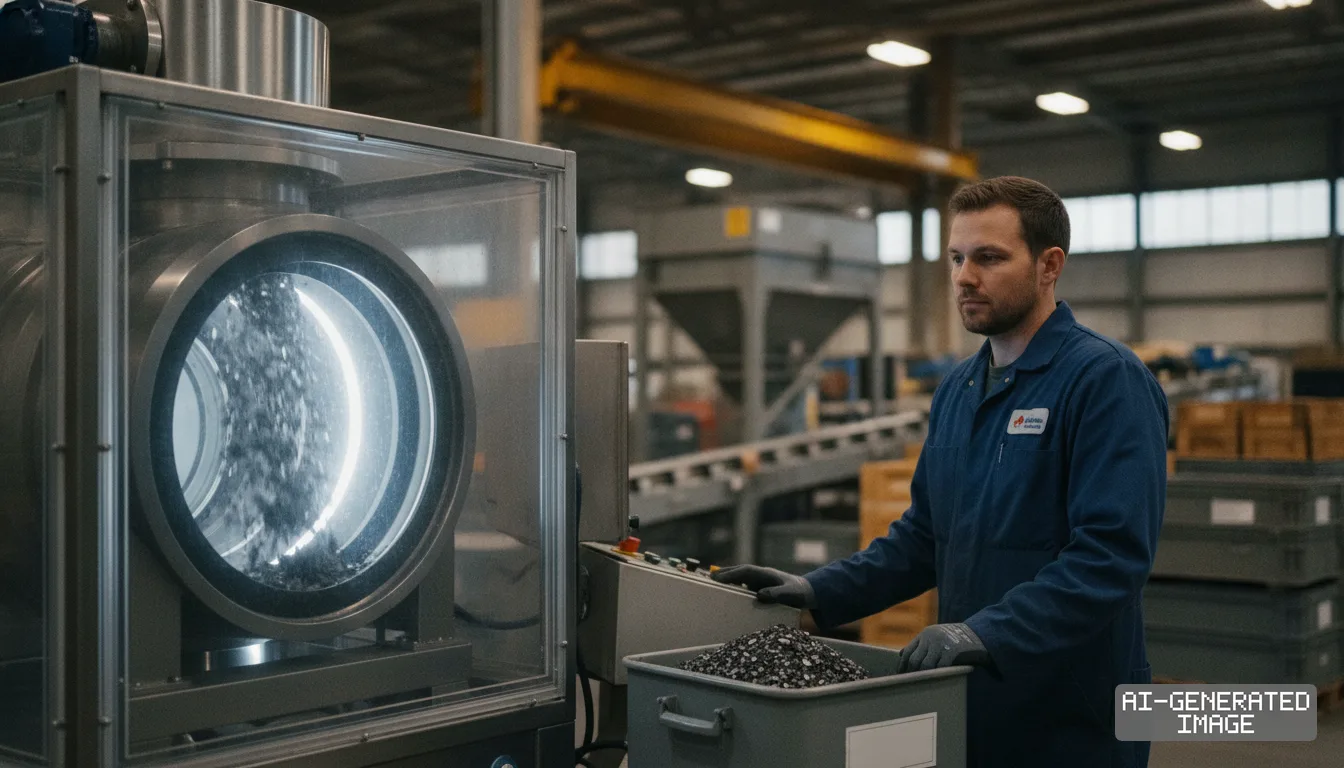
Paladin EnviroTech committed more than $5 million on Oct. 10, 2026, to expand its rare earth magnet recycling plant in Fairfield, Ohio, establishing independent feedstock channels for permanent magnet manufacturers.
The capital program scales annual secondary rare earth output from roughly 40 metric tonnes to 150 metric tonnes on a three-shift schedule. Commercial processing at the higher run rate begins by the third quarter of 2027.
Paladin operates the processing assets through REcapture, a joint venture formed with metallurgy specialist Critical Materials Recycling. The venture extracts light and heavy rare earth elements from end-of-life electronic and industrial hardware without foreign refining steps.
The expansion targets neodymium iron boron magnet scrap to insulate North American manufacturers against Chinese mineral export curbs. China currently controls more than 90% of global permanent magnet manufacturing and heavy rare earth refining capacity.
Automotive assemblers and defense suppliers require magnet feedstocks that bypass Asian refining channels. Paladin provides those buyers with domestic chain-of-custody documentation to satisfy federal procurement standards and economic security guidelines.
Enterprise computer storage hardware serves as the initial volume feedstock for the Fairfield plant. Data storage manufacturer Western Digital supplies decommissioned drives under a recycling partnership with Paladin to divert permanent magnets from shredder waste streams.
Hard disk drive actuators provide predictable concentrations of neodymium and praseodymium. These two light rare earths generate the magnetic force required in precision servo motors, defense electronics and industrial automation equipment.
Paladin also processes spent magnets retrieved from electric vehicle drivetrains, industrial wind turbine generators and decommissioned hospital magnetic resonance imaging machines. Each industrial waste stream delivers distinct element ratios for specialty alloy production.
Medical imaging magnets carry exceptional concentrations of heavy rare earth elements, according to Luke Wray, Paladin senior vice president of critical materials and defense. Magnets recovered from decommissioned MRI units contain between 13% and 16% dysprosium, Wray said.
Dysprosium allows permanent magnets to retain magnetic properties at elevated operating temperatures inside vehicle traction motors. The element remains heavily restricted under Chinese mineral export regulations enacted during prior trade disputes.
The Fairfield facility extracts target elements through a proprietary non-acidic selective leaching process engineered by Critical Materials Recycling. The chemical procedure dissolves rare earth elements without generating corrosive acidic wastewater streams typical of conventional hydrometallurgical refineries.
The closed-loop chemical extraction system achieves a rare earth recovery rate between 97% and 98%, the venture said. Total asset value recovery across all contained base metals reaches approximately 90%.
Recovered materials exit the leaching process as mixed rare earth oxides ready for metallurgical reduction. Downstream metal fabricators can convert the mixed oxides into specialty NdFeB alloys for direct sintering.
Paladin manages collection, data destruction and mechanical disassembly across six industrial locations in the United States. Initial electronics consolidation occurs at sorting hubs in St. Cloud, Minnesota, Tampa, Florida, and Boone, Iowa.
Dismantled magnet modules move under tracked transit manifests to the Fairfield plant for chemical processing. Customers receive batch-level certificates verifying raw material origin, carbon intensity metrics and regulatory compliance records.
The company is also preparing international processing networks to serve automotive supply chains in allied manufacturing economies. Paladin operates facilities in the Netherlands and Ireland, and plans an operational entry into South Korea.
Paladin holds commercial links with South Korean processor Daeheung M&T to facilitate regional material flows. That partnership provides off-take channels into Asian magnet makers operating outside Chinese regulatory controls.
Private equity sponsor SER Capital Partners established Paladin EnviroTech in July 2025 to scale circular infrastructure assets. The sponsor is backing circular processing capacity as greenfield critical mineral mine development timelines exceed a decade.
Primary mining remains essential for long-term mineral supplies, but secondary recovery provides immediate industrial bridge volumes, Wray said. Recycling supplies qualified oxide units years ahead of domestic mine construction schedules.
A 150-tonne annual capacity represents a small share of the 20,000 metric tonnes of magnet scrap generated globally each year. The Fairfield output nonetheless supplies crucial seed feedstock for domestic motor pilot lines.
Installation of upgraded leaching equipment at Fairfield is scheduled to conclude before commercial commissioning begins on July 1, 2027. Full three-shift operations will reach the targeted 150-tonne annual output pace during the fourth quarter of 2027.
Paladin has not published the capital expenditure breakdown for its planned European and Asian facilities, nor has the company disclosed binding off-take pricing formulas with downstream automotive magnet fabricators.
Western Digital continues dispatching decommissioned enterprise drives to Paladin facilities under their multi-year recovery arrangement. Recovered magnet units from those consignments will feed the initial expansion trial runs in Ohio.
Impact map
How this development propagates across the region and out to global buyers.
| Event | Korea | China | Japan | Global impact |
|---|---|---|---|---|
| Secondary NdFeB magnet processing expansion | Daeheung M&T gains non-Chinese feedstock channel for alloy processing | China heavy rare earth refiners face early bypass across US defense magnet channels | Japanese magnet makers gain secondary non-China dysprosium channel for EV traction motors | Western magnet supply chains secure 150 tonnes of secondary oxide feedstock by 2027 |
In this story
- Companies
- Paladin EnviroTech
- Exposed
- Western DigitalDaeheung M&T
- Policy
- Export ControlsEconomic Security
- Impact
- Supply ChainCapexPricing
Track every Export Controls development → Track every Economic Security development →
Related briefings
- Metlen warns Europe may lose gallium supply to US buyers Also on Export Controls, Pricing
- Tokyo Electron nears 1 trillion yen profit on memory capex Also on Export Controls, Pricing
- TSMC captures 72.5% foundry share as gap with Samsung widens Also on Export Controls, Pricing
- US and Japan coordinate on yttrium to counter China chip bottleneck Also on Export Controls, Pricing
Sources
Reporting
Confidence: medium — how we grade this
The documents behind this briefing are linked above. East Asia Brief produces its English text with AI assistance under human editorial review, and does not translate or republish other outlets' articles. See our methodology and AI policy. Spotted an error? Tell us.
The Morning Brief
What changed in Korean, Chinese and Japanese industry overnight — and what it means for your supply chain. One email, weekday mornings, US time. Free.
The Morning Brief is in preparation. Leave your address and we will write to you once — when the first issue is ready. Nothing before that.