Samsung Medical Center tests dual humanoid surgical robots
The 13.84 billion won state project deploys two collaborative machines alongside a human lead surgeon in a simulated operating theater ahead of a late 2026 review.
Samsung Medical Center announced on Sept. 9, 2026, that it will demonstrate a dual-humanoid surgical assistant system in a simulated operating theater, marking the first three-way clinical workflow test.
The 13.84 billion won ($10.3 million) state grant funds 54 months of development under the Korean ARPA-H project. The initiative runs through December 2029, the Ministry of Health and Welfare said.
The trial marks a shift for humanoid robotics away from warehouse transport toward high-precision medical manipulation. Operating theaters require continuous multi-axis tool control and sub-millimeter positioning that standard industrial cobots cannot manage in crowded suites.
South Korea's health ministry selected the hospital in July 2025 to direct the project, titled physical artificial intelligence-based humanoid surgical assistant robots. The program pairs tertiary hospital clinicians with domestic robotics manufacturers to resolve operating room staffing shortfalls.
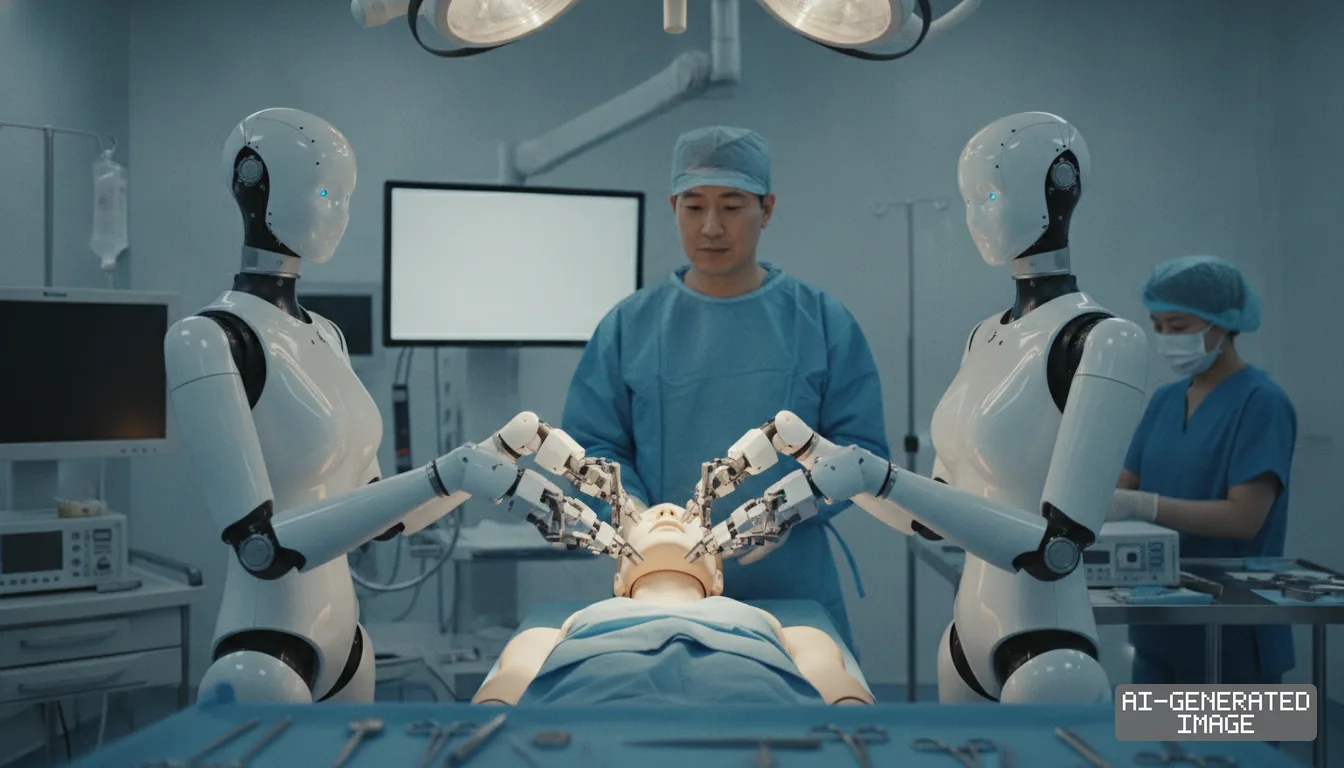
The upcoming public trial features two collaborative humanoid machines working beside a single lead human surgeon. The entire exercise takes place in an exact mock operating room rather than on live patients.
One humanoid functions as a scrub nurse during the mock procedure. It processes spoken orders from the surgeon, identifies the requested instruments, and delivers each tool with the handle positioned for immediate grip.
The scrub robot also collects used instruments and returns them to dedicated trays. This cycle closes the loop on repetitive pass-back tasks that consume nurse attention during lengthy procedures, hospital researchers said.
The second humanoid serves as a bedside assistant doctor. It uses one mechanical arm to hold and steer a laparoscopic camera, maintaining the surgical field of view without manual drift.
The assistant robot simultaneously uses its second arm for tissue retraction, pulling organs aside to expose target anatomy. Merging camera holding and tissue retraction into one machine replaces two human assistants at the operating table.
The trial also demonstrates precision operative tasks conducted through master-slave teleoperation. A human physician operates hand controllers while the humanoid mimics the operator's wrist and finger movements on synthetic tissue.
The teleoperated unit executes incision, tissue dissection, and suturing in real time. The robot does not act autonomously, leaving all surgical judgment and supervisory authority with the licensed physician, the development team said.
Samsung Medical Center directs the research consortium under the operational title ORchestra. Project lead Jung Yong-gi, an otorhinolaryngology professor at the hospital, manages development teams across seven corporate and academic institutions.
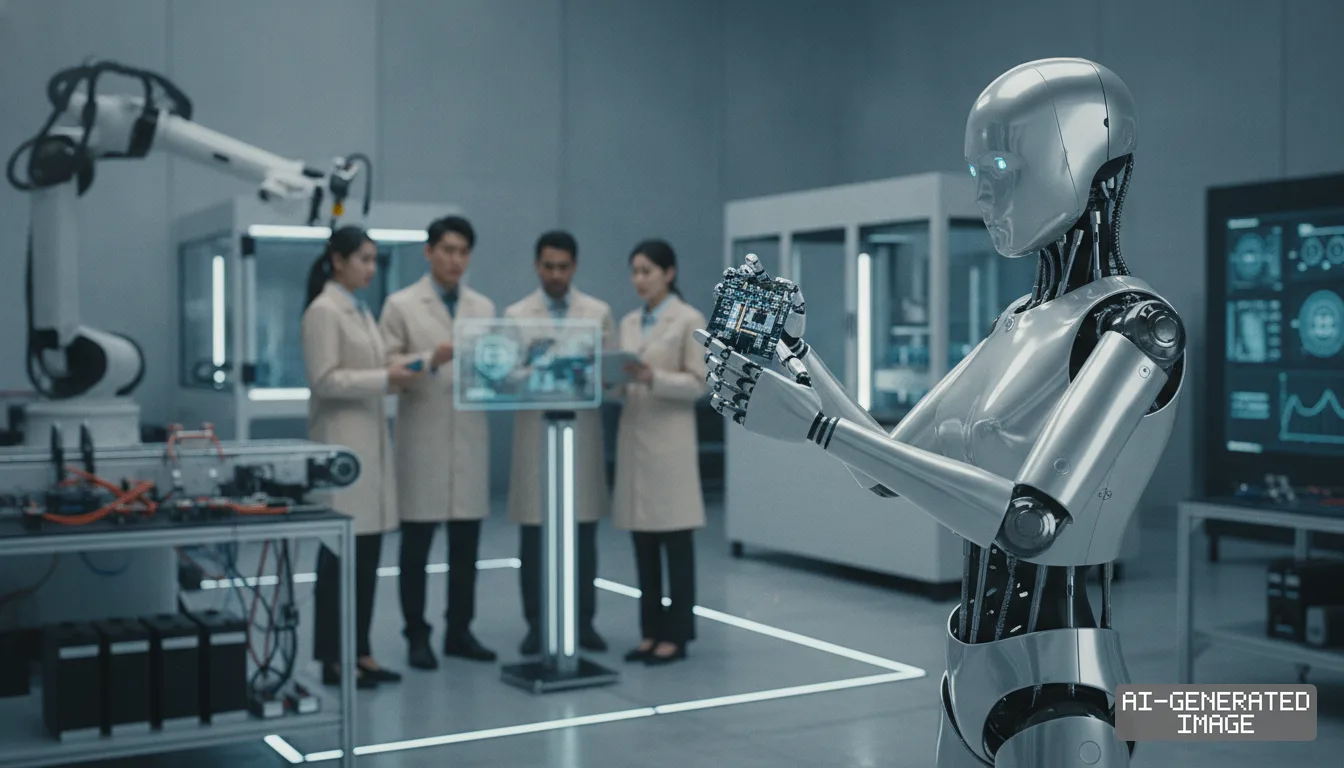
Rainbow Robotics provides the underlying humanoid hardware platform. The company adapted its RB-Y1 mobile dual-arm manipulator to fit the spatial confines and hygiene requirements of an active surgical suite.
Aidin Robotics manufactures the tactile end-effectors, supplying smart grippers and second-generation multi-joint hands. The hardware incorporates multi-axis force sensors to register contact pressure and prevent tissue tears during instrument exchanges.
Software developer Hahea Ho designs physical artificial intelligence algorithms that translate human motor inputs into robotic joint trajectories. The models filter hand tremors and prevent mechanical collisions between the two robot bodies.
Academic researchers from Seoul National University, Sungkyunkwan University, and the Samsung Advanced Institute for Health Sciences and Technology contribute biomechanical modeling. Clinical teams at the National Cancer Center and Jeonbuk National University Hospital evaluate workflow usability.
South Korean hospitals face chronic shortages of specialized scrub nurses and surgical residents across essential medical departments. Emergency night operations and regional acute-care centers experience the greatest staffing gaps, health ministry data show.
Traditional surgical systems, such as Intuitive Surgical's da Vinci platform, rely on stationary multi-arm consoles bolted over the operating table. Those systems require dedicated disposable instruments and cannot pass tools or reposition general surgical supplies.
Dual humanoids that use standard surgical hand tools avoid the proprietary consumable lock-in associated with fixed surgical platforms. Mobile bipedal units can also move between standard surgical theaters without dedicated floor anchors.
Hospital leadership shared internal testing results during a research symposium on June 19, following an initial notice on June 15. The upcoming public session marks the first live external demonstration of the synchronized two-robot architecture.
The hospital notice did not state a target date for in-human clinical trials, and the consortium has not published projected commercial unit costs. Regulators also have not established a formal medical reimbursement category for physical AI assistants.
The public demonstration takes place on Sept. 16 at 3:00 p.m. at the Samsung Life Ilwon Station Building in southern Seoul. The project faces its first competitive stage review under health ministry inspectors in late 2026.
Impact map
How this development propagates across the region and out to global buyers.
| Event | Korea | China | Japan | Global impact |
|---|---|---|---|---|
| dual-humanoid surgical assistant demo | Rainbow Robotics and Aidin Robotics validate physical AI in mock OR under 13.84B won state grant | domestic surgical robotics developers lack multi-humanoid clinical workflows | medical robotics sector maintains focus on specialized laparoscopic arms | operating room automation shifts from fixed consoles toward mobile humanoid assistants |
In this story
- Companies
- Samsung Medical CenterRainbow RoboticsAidin Robotics
- Tickers
- 277810.KS
- Exposed
- Intuitive Surgical
- Policy
- Subsidies
- Impact
- Supply ChainCapex
Track every Subsidies development →
Related briefings
- Korean electronics component suppliers deploy AI dual-arm robots as factory labor pool shrinks Also on Rainbow Robotics
- Bigwave Robotics partners with automation suppliers to scale US physical AI Also on Rainbow Robotics
- KFTC opens supply contract probe into tier-one robotics and battery parts Also on Rainbow Robotics
- Samsung SDS develops robot orchestration platform for 2027 Also on Rainbow Robotics
Sources
Primary documents
Reporting
Confidence: high — how we grade this
The documents behind this briefing are linked above. East Asia Brief produces its English text with AI assistance under human editorial review, and does not translate or republish other outlets' articles. See our methodology and AI policy. Spotted an error? Tell us.
The Morning Brief
What changed in Korean, Chinese and Japanese industry overnight — and what it means for your supply chain. One email, weekday mornings, US time. Free.
The first issue goes out shortly. Sign up now and you will not miss it.