Korean robotics makers unveil climbing inspection units at RobotWorld
DIDEN Robotics demonstrated its Spider platform carrying 30-kilogram payloads across vertical steel hulls to automate shipyard inspection in domestic docks.
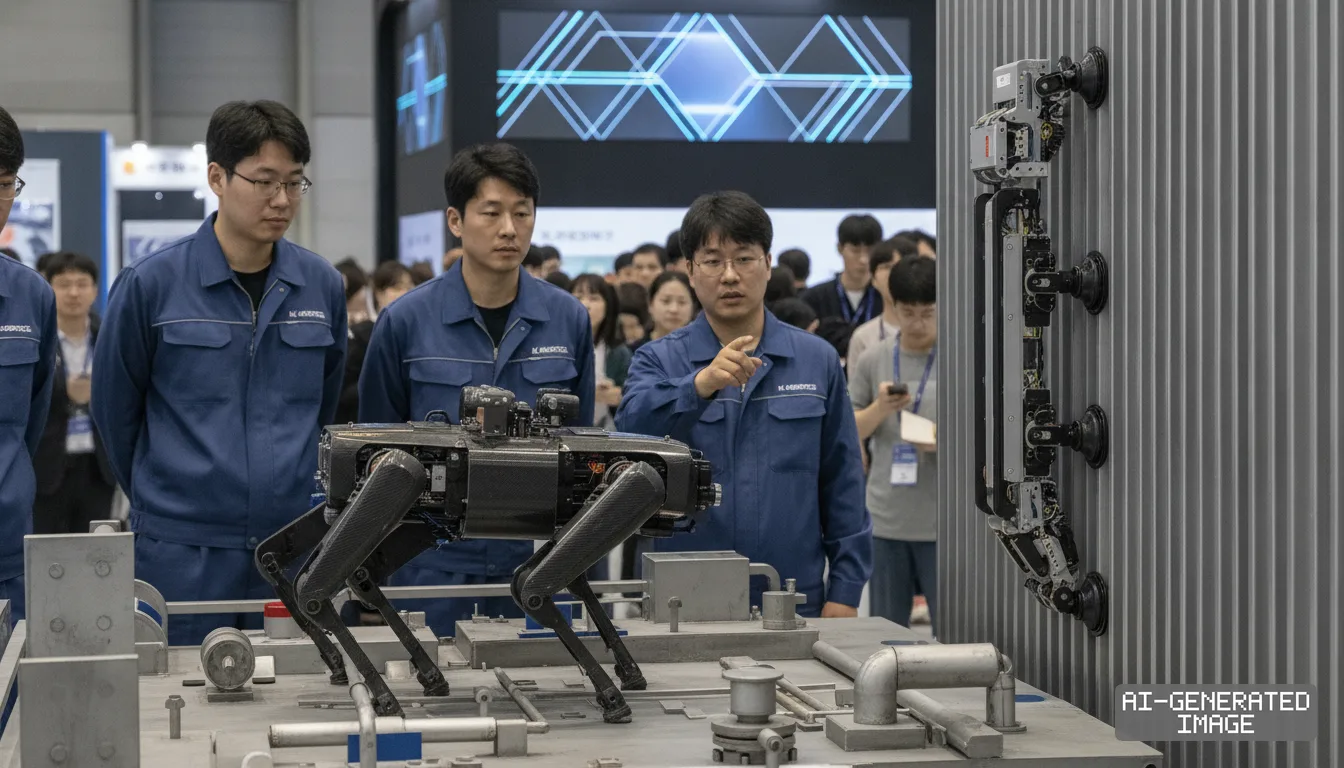
South Korean robotics makers demonstrated specialized quadruped and vertical-climbing platforms on Nov. 4, 2026, advancing automated inspection systems toward commercial mass production for domestic shipyards and heavy industrial facilities.
The demonstrations took place at RobotWorld 2026 at the KINTEX convention center in Goyang. The annual trade fair, organized by South Korea's Ministry of Trade, Industry and Energy, drew 402 exhibiting companies from 17 countries across 1,198 exhibition booths.
DIDEN Robotics showcased its DIDEN Spider quadruped climbing robot moving across vertical steel structures. The machine is engineered to carry up to 30 kilograms of payload equipment while clearing interior obstacles measuring up to 40 centimeters.
The platform uses electropermanent magnet footpads to grip flat and curved structural steel plates. Electropermanent magnets switch magnetic states using brief electrical pulses, maintaining holding force without drawing continuous power during hull adhesion.
That grip enables the robot to crawl through narrow internal block apertures within ship hulls. Human workers currently enter those confined cavities manually, carrying heavy welding torches and diagnostic instruments under extreme ergonomic strain.
DIDEN demonstrated the unit traversing mock vessel compartments and conducting automated seam welding. The company designed the chassis to access tight double-bottom tanks and ballast voids that conventional rail-mounted welding carriages cannot enter.
Samsung Heavy Industries and a second domestic shipbuilder have signed commercial supply contracts for the platform. DIDEN Robotics also executed an equipment supply agreement with an undisclosed European shipyard operator.
Initial commercial shipments began in December 2025 under early procurement schedules. The startup plans to begin deployment trials for a companion bipedal model, named DIDEN Walker, in December 2026.
Full commercial mass production for the DIDEN Spider will begin in 2027, the company said. The production timeline aligns with shipyard efforts to reduce human exposure to high-temperature welding fumes and enclosed fall hazards.
DIDEN Robotics deployed its platforms directly into operational vessel assembly blocks rather than testing environments, Chief Executive Kim Jun-ha said. Operating on active assembly blocks verifies that magnetic footpads tolerate steel mill scale, primer paints and uneven weld beads.
Rainbow Robotics separately demonstrated its industrial quadruped robot, designated RBQ-10, during the opening session. The 42-kilogram machine leaped onto a one-meter elevated platform, absorbed the landing force without chassis instability and executed backflip recovery routines.
The developer designed the quadruped for autonomous facility inspection at electric power stations, chemical plants and defense installations. The RBQ-10 navigates irregular outdoor surfaces, steep metal stairs and debris fields that immobilize wheeled inspection carts.
Rainbow Robotics deployed approximately 30 proof-of-concept units to enterprise and government testing partners in 2026. That fleet represents the largest single-year trial deployment of industrial quadrupeds conducted by a domestic robot manufacturer to date.
The trial units collect operational telemetry across varied industrial environments. Rainbow Robotics plans to use performance data gathered from active factory sites to begin full commercial mass production in 2027.
The twin unveilings address acute structural labor shortages across heavy manufacturing sectors in South Korea. Shipyards in Ulsan and Geoje face diminishing numbers of skilled hull welders, accelerating investments in robotic hull maintenance.
Climbing quadrupeds offer shipbuilders flexible mobility inside complex hull blocks without the fixed infrastructure required by gantry robots. A magnetic walker shifts between hull compartments through standard manholes, cutting setup time for non-destructive weld testing.
Operational safety requirements in Korean shipyards have also increased regulatory pressure on yard operators. Deploying robotic inspection units inside enclosed double hulls limits human presence in toxic gas zones and poorly ventilated chambers.
Rainbow Robotics focuses its ground quadruped on perimeter surveillance and thermal plant monitoring. The platform incorporates high-torque joint actuators that allow the 42-kilogram robot to recover balance when traversing slick metal gratings or wet pipeline corridors.
Field testing at thermal utilities evaluates whether the RBQ-10 can detect high-pressure steam leaks and bearing overheating. Autonomous patrol routines allow plant operators to reduce human inspection rounds through hazardous turbine buildings and switchyards.
Both manufacturers manufacture core mobility hardware domestically, reducing reliance on foreign supply chains. Proprietary actuator modules, custom cycloidal reducers and dedicated motor drivers allow the builders to support heavy industrial maintenance schedules directly.
The domestic focus shields Korean heavy industries from supply disruptions affecting imported robotic spare parts. Operating inspection robots in abrasive shipyard environments causes rapid wear on mechanical linkages, necessitating predictable local replacement component pipelines.
RobotWorld 2026 concludes its exhibition schedule at KINTEX on Nov. 7, 2026. Shipbuilders and plant operators will continue joint validation trials ahead of the planned commercial rollouts in December 2026 and 2027.
The companies have not published contract values or unit pricing for the shipyard units, and DIDEN Robotics did not identify its European shipyard customer due to nondisclosure terms.
Impact map
How this development propagates across the region and out to global buyers.
| Event | Korea | China | Japan | Global impact |
|---|---|---|---|---|
| Industrial quadruped commercialization | Samsung Heavy Industries deploys magnetic climbing robots to automate ship block welding | Shipyards rely on manual welding squads, widening automation gap in mega-block assembly | Heavy fabricators test wheeled crawler alternatives with higher setup times in dry docks | Marine engineering contractors cut enclosed-space inspection overhead and insurance risk |
In this story
- Companies
- DIDEN RoboticsRainbow RoboticsSamsung Heavy Industries
- Tickers
- 277810.KS010140.KS
- Policy
- Standards
- Impact
- Supply ChainOrder BookCost Structure
Track every Standards development →
Related briefings
- Korea tests quadruped robots for $247 million state rollout Also on Rainbow Robotics, Standards, Cost Structure
- Korea begins 1,700 public robot rollout to back local makers by 2027 Also on Rainbow Robotics, Standards, Order Book
- SFA and Rainbow Robotics partner on AI manufacturing robots Also on Rainbow Robotics, Cost Structure, Order Book
- Rainbow Robotics taps E Tech Group to expand US cobot fleet Also on Rainbow Robotics, Cost Structure, Order Book
Sources
Primary documents
Reporting
Confidence: high — how we grade this
The documents behind this briefing are linked above. East Asia Brief produces its English text with AI assistance under human editorial review, and does not translate or republish other outlets' articles. See our methodology and AI policy. Spotted an error? Tell us.
The Morning Brief
What changed in Korean, Chinese and Japanese industry overnight — and what it means for your supply chain. One email, weekday mornings, US time. Free.
The Morning Brief is in preparation. Leave your address and we will write to you once — when the first issue is ready. Nothing before that.