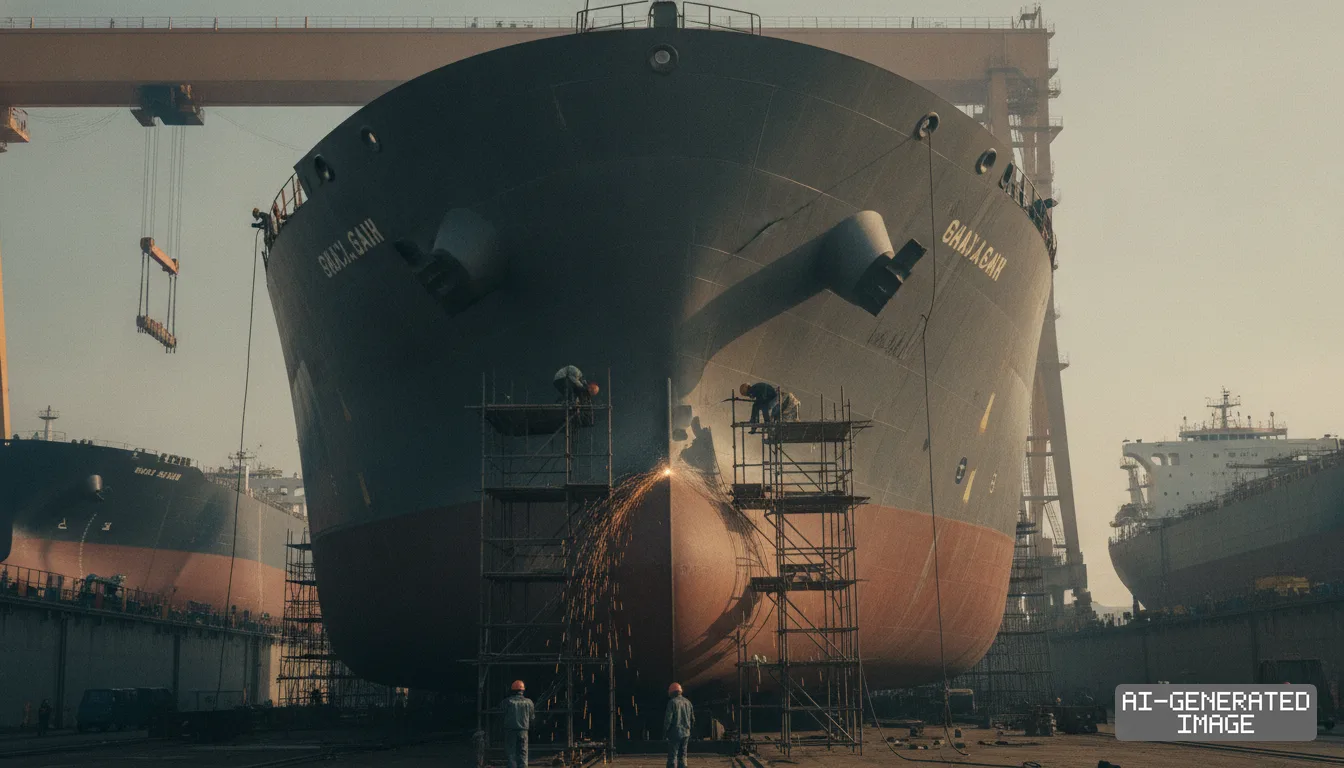
HD Hyundai Heavy launches 8,200-ton Aegis destroyer in Ulsan
The Daeho Kim Jong-seo completes South Korea's planned six-ship Aegis destroyer fleet, with shipbuilder HD Hyundai Heavy Industries securing five of the combatant contracts.
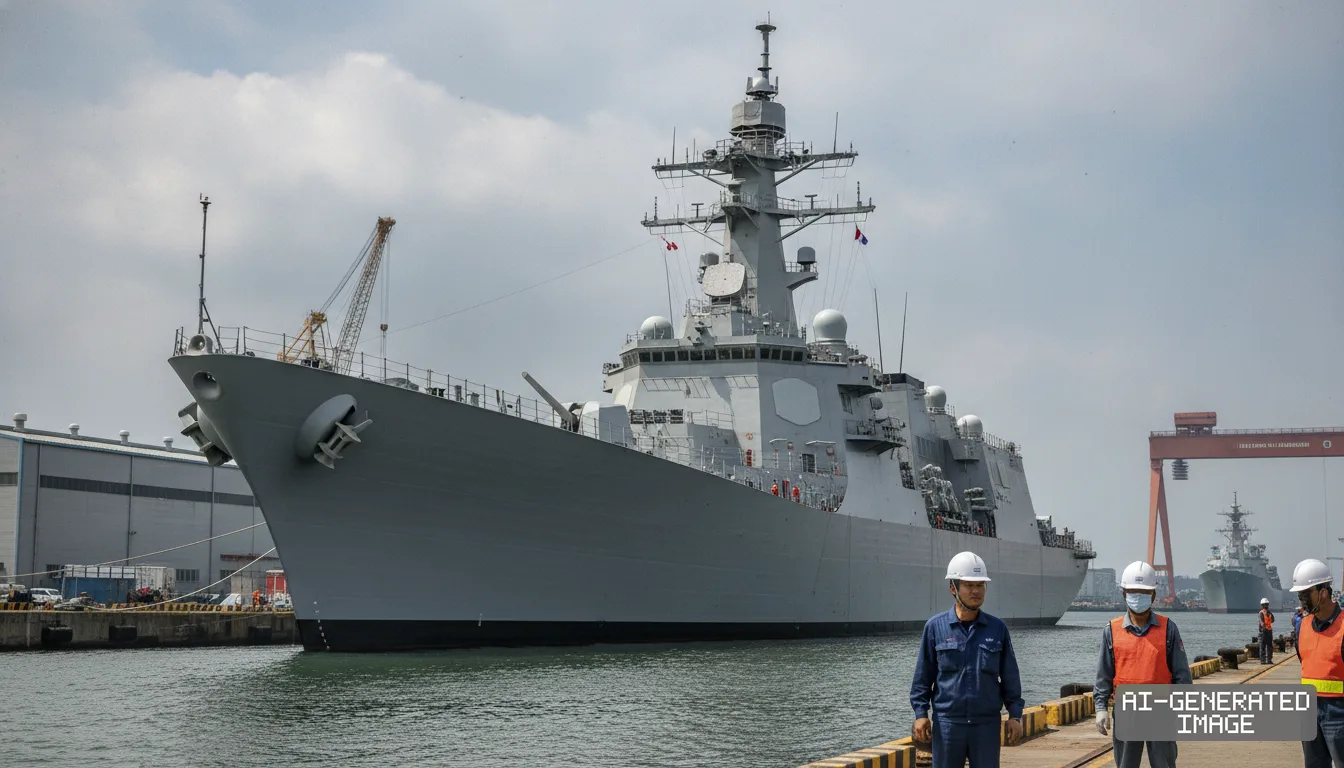
HD Hyundai Heavy Industries launched the 8,200-ton Aegis destroyer Daeho Kim Jong-seo on Sept. 30, 2026, completing South Korea's planned six-ship surface combatant fleet at its Ulsan shipyard.
The vessel is the third and final guided-missile destroyer constructed under the country's KDX-III Batch-II program. The hull measures 170 meters in length and 21 meters in width, displacing 8,200 tons under light-load conditions.
Maximum operating speed reaches 30 knots, or roughly 55 kilometers per hour. A hybrid electric drive propulsion arrangement pairs with four gas turbine engines to lower underwater radiated noise during low-speed submarine patrols.
The launch establishes a complete six-ship Aegis destroyer capability for the Republic of Korea Navy. HD Hyundai Heavy Industries built five of those six warships, giving the shipbuilder an 83% share of the nation's Aegis surface fleet.
Unlike the earlier 7,600-ton Sejong the Great-class destroyers, the Batch-II combatants carry ballistic missile interception systems. The older Batch-I destroyers could detect and track ballistic targets but lacked the capability to destroy incoming warheads.
The upgraded combat architecture enables the vessel to serve as a mobile interceptor node against regional ballistic missile threats. Naval planners assign the platform to the sea-based component of South Korea's strategic three-axis deterrence framework.
An indigenously developed integrated sonar system replaces the imported acoustic packages used on earlier warships. Shipyard engineering data shows the new sonar suite triples the active and passive submarine detection range compared to the Batch-I class.
President Lee Jae-myung and First Lady Kim Hye-kyung attended the naming and blessing ceremony in Ulsan. Defense Minister Kang Shin-chul, Chief of Naval Operations Kim Kyung-ryul and Defense Acquisition Program Administration head Lee Yong-chul took part alongside 350 defense officials.
The warship honors General Kim Jong-seo, an early Joseon dynasty military commander who secured the northern frontier along the Tumen River. The vessel takes both the general's pen name, Daeho, and his formal family name.
HD Hyundai Chairman Chung Ki-sun said the shipyard will protect national economic interests and maritime security by building surface combatants capable of operating across open oceans. The launch coincides with the 50th anniversary of the company's naval shipbuilding operations.
HD Hyundai Heavy Industries designed and delivered the navy's first Aegis combatant, the Sejong the Great, in 2008. The company built the third Batch-I destroyer, the Seoae Ryu Seong-ryong, in 2012, while Hanwha Ocean built the second hull.
The Ulsan shipyard secured all three contracts under the subsequent Batch-II acquisition phase. The builder delivered the lead ship, King Jeongjo the Great, to the naval fleet command in November 2024 following comprehensive combat integration tests.
The second Batch-II hull, Dasan Jeong Yak-yong, launched in September 2025 at the same drydock facility. That warship is conducting contractor sea trials and outfitting reviews ahead of its planned commissioning in December 2026.
The continuous Batch-II construction run shielded the company's naval division from volatile commercial shipbuilding freight cycles. Dedicated defense drydocks and engineering teams maintained steady utilization rates across the three-ship destroyer series.
Special naval combatant programs deliver higher structural operating margins than commercial dry bulk carriers or container vessels. Long-lead government milestone payments also provide predictable working capital across multi-year naval outfitting schedules.
The construction program funneled orders through domestic precision machinery and defense electronics subcontractors. Marine equipment suppliers in the southeastern industrial corridor fabricated high-tensile structural steel plates, auxiliary valves and high-voltage power distribution switchboards.
Hanwha Systems and LIG Nex1 supplied radar processing systems, electronic warfare suites and vertical launching infrastructure. Propulsion packages integrated LM2500 gas turbines supplied by General Electric with domestic auxiliary propulsion motors and reduction gears.
The domestic defense industry uses naval execution records to compete for surface combatant orders and fleet maintenance agreements overseas. HD Hyundai Heavy Industries has sought warship construction partnerships and maintenance, repair and overhaul tenders in the United States and the Indo-Pacific region.
The shipyard moved the Daeho Kim Jong-seo to an outfitting pier immediately following the slipway launching ceremony. Engineering personnel will install internal communication links, sensitive optical consoles and mission control workstations over the next several months.
The company announcement does not disclose the procurement status of specific interceptor missiles such as the SM-3, and the Defense Acquisition Program Administration has not published a contract breakdown for the weapon payload.
Sea acceptance trials will begin in early 2027 to validate deep-water hull stability, shaft horsepower output and integrated sensor processing. HD Hyundai Heavy Industries plans to deliver the completed destroyer to the navy in December 2027.
Impact map
How this development propagates across the region and out to global buyers.
| Event | Korea | China | Japan | Global impact |
|---|---|---|---|---|
| KDX-III Batch-II launch | HD Hyundai Heavy secures 83% of Aegis builds, with five of six naval hulls | PLA Navy monitors expanded sea-based ballistic missile defense perimeter | JMSDF gains interoperable Aegis partner hull in southern operational sector | US naval maintenance and foreign combatant sales pipeline gains reference hull |
In this story
- Companies
- HD Hyundai Heavy IndustriesHD Hyundai
- Tickers
- 329180.KS267250.KS
- Exposed
- Hanwha SystemsLIG Nex1General Electric
- Policy
- Economic Security
- Impact
- Order BookSupply ChainCapex
Track every Economic Security development →
Related briefings
- HD Hyundai and Hanwha Ocean split naval platforms for export Also on LIG Nex1, Hanwha Systems, HD Hyundai Heavy Industries
- China confirms reciprocal tariff talks with US on $30B trade Also on General Electric
- Hanwha Ocean Wins $508 Million Thai Stealth Frigate Program Also on Hanwha Systems, HD Hyundai Heavy Industries, Order Book
- Korean shipbuilders validate quiet electric propulsion on naval unmanned surface vessels Also on Hanwha Systems, HD Hyundai Heavy Industries, Order Book
Sources
Reporting
Confidence: medium — how we grade this
The documents behind this briefing are linked above. East Asia Brief produces its English text with AI assistance under human editorial review, and does not translate or republish other outlets' articles. See our methodology and AI policy. Spotted an error? Tell us.
The Morning Brief
What changed in Korean, Chinese and Japanese industry overnight — and what it means for your supply chain. One email, weekday mornings, US time. Free.
The Morning Brief is in preparation. Leave your address and we will write to you once — when the first issue is ready. Nothing before that.