Fanuc raises profit outlook as factory robot margin hits 26%
The Japanese automation leader raised annual operating profit guidance by 10.4% after Chinese electronics demand and aerospace retooling lifted July-September margins.
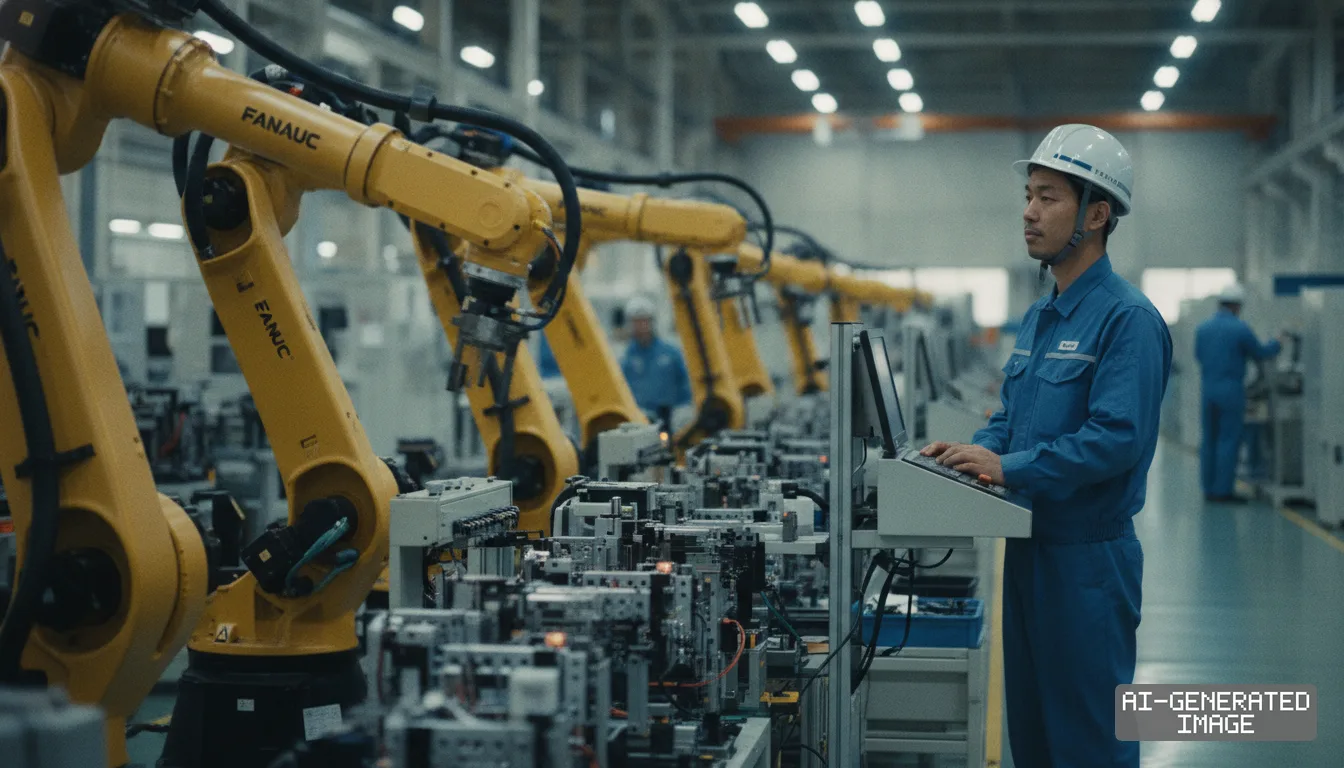
Fanuc Corporation reported on Oct. 24, 2026, that its quarterly operating margin reached 26.0% in the three months ended September, driven by recovering orders for computer numerical control systems and industrial robots.
The operating margin expanded 5.4 percentage points from 20.6% a year earlier. Operating profit for the second quarter rose 47% to 61.6 billion yen ($410 million) on consolidated sales of 242.7 billion yen ($1.62 billion).
For the first half ended Sept. 30, operating profit climbed 35.7% to 116.66 billion yen on revenue of 473.71 billion yen ($3.16 billion). That performance accounted for 48.3% of the company's upgraded annual profit target.
The results offer a benchmark for global capital expenditure. Fanuc supplies computer numerical control systems that command roughly half the global machine tool market, making its order book an early indicator for industrial factory investment.
Following the first-half surge, Fanuc raised its full-year operating profit forecast by 10.4% to 240.7 billion yen. It lifted its net sales projection to 1.01 trillion yen ($6.76 billion), its highest annual revenue target on record.
The company also increased its consolidated ordinary profit guidance by 13.9% to 308.0 billion yen, up from 271.0 billion yen. Management expects second-half ordinary income to expand 33.6% over the prior year period.
Rebounding demand in China generated the bulk of new order volume. Orders across all product lines jumped 49.0% year on year during the July-September quarter, with factory automation orders surging 130.1%.
Chinese manufacturers accelerated procurement of machine tools to produce artificial intelligence data center hardware and semiconductor equipment. Capital spending also expanded for precision components used in humanoid robotics and new-energy vehicle assembly lines.
The factory automation unit booked first-half revenue of 119.9 billion yen ($799 million), an increase of 15.4%. Computer numerical control controllers accounted for 26% of consolidated sales in the second quarter.
The Robomachine division, which manufactures electric injection molding systems and compact machining centers, recorded the fastest pace of expansion. Division revenue advanced 31.2% year on year to 83.3 billion yen ($555 million).
Robot division revenue grew 12.6% to 194.3 billion yen ($1.30 billion) during the six-month period. Industrial robot shipments rose as American aerospace contractors expanded automation to address skilled labor shortages and clear manufacturing backlogs.
Automotive manufacturing demand showed regional divergence. While electric vehicle retooling orders in North America gained momentum, automotive-related robot sales in China fell 14.3% year on year during the July-September quarter as domestic carmakers slowed assembly investments.
Strong general industrial demand offset that automotive weakness in mainland factories. Electronics subcontractors and precision equipment makers continued replacing manual assembly with multi-axis automated lines.
In South Korea, Japan and Taiwan, capital spending expanded across semiconductor fabrication infrastructure. Foundries and advanced packaging facilities increased equipment procurement for high-bandwidth memory testing lines and thermal management modules.
Operating margins widened partly because factory utilization rose at Fanuc's main manufacturing complex in Yamanashi Prefecture. Higher absorption of fixed overhead costs shielded operating earnings against persistent wage inflation and raw material costs.
The company's 26.0% operating margin outpaces domestic automation rivals. Japanese peer Yaskawa Electric Corporation projects a 9.6% operating margin for the current fiscal year, reflecting heavier exposure to European machinery markets where capital investment remains subdued.
Currency movements also supported the profit improvement. Fanuc calculated first-half results at an average exchange rate of 159.37 yen per US dollar, although its second-half forecast assumes a conservative rate of 150 yen per dollar.
European industrial orders showed initial signs of stabilization. European factory operators increased replacement orders for legacy computerized controllers, ending four consecutive quarters of sequential contracting demand.
Service division sales expanded 12.7% to 76.2 billion yen ($508 million). Fanuc operates more than 260 maintenance facilities worldwide, generating predictable, high-margin software updates and field maintenance contracts that soften machinery replacement downturns.
Fanuc approved an interim dividend of 72.54 yen per share, a 41% increase from 51.33 yen a year earlier. The total distribution of 67.09 billion yen becomes effective on Dec. 1, 2026.
The board authorized a share repurchase program worth up to 50 billion yen ($333 million). The program will retire shares from the open market between November and March.
Fanuc did not disclose its full-year final dividend target, marking the figure as undecided in regulatory filings. The company also did not publish a detailed delivery schedule for its accumulated order backlog across individual business units.
Global production planners now face longer lead times for specialized five-axis controller modules. Machinery builders in Nagoya and Osaka report delivery queues stretching past four months for custom computer numerical control units.
The recovery in component orders suggests capital equipment spending has passed its cyclical trough. Component shipments scheduled through December indicate factory operators are replenishing parts inventories ahead of projected 2027 manufacturing expansions.
Impact map
How this development propagates across the region and out to global buyers.
| Event | Korea | China | Japan | Global impact |
|---|---|---|---|---|
| Factory automation demand rebound | Memory chipmakers secure CNC tools for HBM packaging | Electronics and humanoid robot machining offset 14.3% robot auto drop | Fanuc expands Yamanashi output as operating margin reaches 26.0% | Factory automation tool backlogs extend lead times past four months |
In this story
- Companies
- Fanuc
- Tickers
- 6954.T
- Exposed
- Yaskawa Electric
- Impact
- CapexOrder BookCost Structure
Related briefings
- Yaskawa Electric raises sales outlook to 600 billion yen Also on Yaskawa Electric, Fanuc, Cost Structure
- Fanuc and Google launch AI welding robot to read blueprints Also on Yaskawa Electric, Fanuc, Cost Structure
- China Antimonopoly Review Imposes Harsher Operational Remedies on Automation Mergers Also on Yaskawa Electric, Fanuc, Cost Structure
- Harmonic Drive shifts to integrated actuators to fight China rivals Also on Yaskawa Electric, Fanuc, Cost Structure
Sources
Reporting
Confidence: medium — how we grade this
The documents behind this briefing are linked above. East Asia Brief produces its English text with AI assistance under human editorial review, and does not translate or republish other outlets' articles. See our methodology and AI policy. Spotted an error? Tell us.
The Morning Brief
What changed in Korean, Chinese and Japanese industry overnight — and what it means for your supply chain. One email, weekday mornings, US time. Free.
The Morning Brief is in preparation. Leave your address and we will write to you once — when the first issue is ready. Nothing before that.