Harmonic Drive shifts to integrated actuators to fight China rivals
The Japanese precision reducer pioneer is pushing all-in-one motor and drive units as Chinese suppliers take 60% of their home market and cut standalone gear prices.
Harmonic Drive Systems detailed an integrated actuator architecture for robot joints on Oct. 24, 2026, shifting its core business toward combined motor and drive assemblies as Chinese rivals cut component prices.
The Tokyo-based company invented the commercial strain wave gear, a zero-backlash reducer that controls joint rotation in industrial robot arms and semiconductor wafer transfer tools.
Reduction gears accounted for 77.8% of the ¥59.56 billion ($397 million) in net sales Harmonic Drive Systems posted in the year to March 2026. Integrated mechatronic assemblies generated the remaining 22.2% of company revenue.
Harmonic Drive Systems forecasts net sales of ¥68.0 billion ($453 million) and operating profit of ¥6.2 billion ($41.3 million) for the fiscal year ending March 2027. The company expects automation investments and artificial intelligence robotics to support order intake, according to its investor guidance.
Chinese component makers have eroded the company's historical monopoly in strain wave gearing through aggressive domestic pricing. Harmonic Drive Systems saw sales in its China segment drop 28.0% last fiscal year as local robot builders switched suppliers.
Suzhou-based Leader Harmonious Drive Systems holds more than 60% of China's domestic market for robot strain wave reducers. Leaderdrive generated 349 million yuan ($49.2 million) in revenue in the first half of 2026, a 38.6% increase from a year earlier.
Price competition inside China has reduced the average selling price of basic harmonic reducers by almost half over seven years. Leaderdrive reported a domestic gross margin of 30.15% in the first half of 2026, down from consolidated margins above 52% in 2021.
Leaderdrive earns a 44.60% gross margin on overseas sales, prompting Chinese reducer manufacturers to seek export customers across Europe, Japan and North America. The Suzhou supplier filed in August 2026 to list shares on the Hong Kong Stock Exchange to fund international expansion.
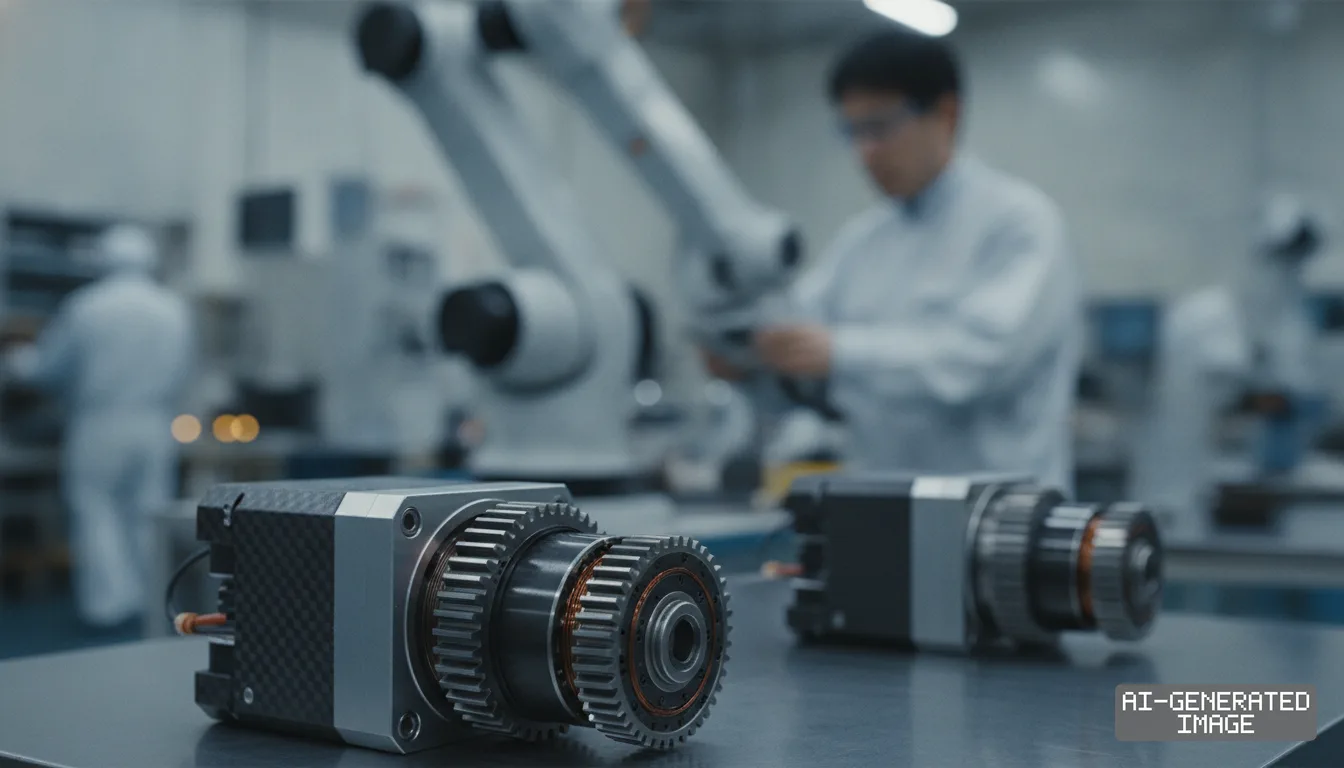
To defend margins against commoditized gearheads, Harmonic Drive Systems is shifting toward fully integrated joint actuators. The unified design combines a strain wave reducer, a brushless servomotor, an absolute encoder and drive electronics in one compact housing.
Integrating the drive directly onto the motor housing reduces external wiring from dozens of leads to a four-conductor bus cable. The shared architecture carries power and CANopen communication lines, which simplifies routing through hollow robotic joint axes, the company said.
For industrial robot builders, integrated actuators cut assembly time and eliminate impedance mismatches between third-party motors and speed reducers. The units provide zero backlash and rated torsional stiffness without requiring customer engineers to tune individual servo loop parameters.
The shift reflects a broader architectural change across the factory automation sector. Collaborative robot makers and humanoid developers increasingly demand pre-tested joint modules rather than discrete mechanical components to accelerate prototype deployment, according to industry technical papers.
Harmonic Drive Systems continues to dominate high-payload industrial arms and semiconductor lithography positioning stages where transmission error must stay below 10 arcseconds. Japanese robotics manufacturers including Fanuc and Yaskawa Electric continue to source high-precision gearing from established domestic suppliers, according to company reports.
The Japanese manufacturer relies on proprietary drive configuration software to lock automation customers into its digital motion control ecosystem. Software integration ensures that motor current limits and gear temperature models match reducer fatigue limits across continuous operating cycles, according to technical manuals.
Chinese rivals are also moving into integrated actuators to escape domestic price erosion. Leaderdrive and Zhejiang Laifual Drive have introduced integrated rotary modules for collaborative arms, though Japanese suppliers maintain an advantage in high-temperature grease formulation and flexspline fatigue life.
Strain wave gear manufacturing requires specialized alloy steels and precision CNC gear-grinding tools sourced largely from Japan and Germany. Rising raw material prices and currency volatility have lifted production overhead across Japanese precision machining facilities, Harmonic Drive Systems said in financial filings.
The emergence of bipedal humanoid robots presents a high-volume market for lightweight rotary actuators. A single humanoid frame requires between 14 and 28 strain wave reducers across its shoulder, elbow, waist and leg joints, creating intense competition between Japanese and Chinese component vendors.
Harmonic Drive Systems revised its medium-term management plan in June 2026 to prioritize AI robotics, aerospace and electric mobility systems. The company set a target of 10% or more for return on equity under its business plan running through fiscal 2030.
The company has not published a discrete hardware filing for a new actuator model on Oct. 24, and its investor releases do not state shipment targets for integrated units.
Harmonic Drive Systems begins distribution of its HA-Navigator Ver.1.5.0.0 configuration software in late October 2026, adding setup profiles for new actuator models connected to its HA-900A servo drivers.
Leaderdrive awaits regulatory clearance from the China Securities Regulatory Commission and the Hong Kong Stock Exchange for its planned dual-listing offering before the end of the year.
Impact map
How this development propagates across the region and out to global buyers.
| Event | Korea | China | Japan | Global impact |
|---|---|---|---|---|
| Actuator integration shift | Domestic cobot builders evaluate integrated joint units to cut wiring overhead | Leaderdrive counters with rotary modules to offset domestic reducer price war | Harmonic Drive Systems shifts revenue mix toward mechatronics as China sales fall 28% | Industrial robot builders reduce joint assembly labor and cable fatigue failures |
In this story
- Companies
- Harmonic Drive SystemsLeaderdrive
- Tickers
- 6324.T688017.SH
- Exposed
- FanucYaskawa ElectricZhejiang Laifual Drive
- Impact
- PricingCost StructureCapex
Related briefings
- Harmonic Drive pitches integrated actuators for robot joints in 2026 Also on Leaderdrive, Harmonic Drive Systems, Cost Structure
- Harmonic Drive Systems holds premium on robot joint demand Also on Leaderdrive, Harmonic Drive Systems, Pricing
- Yaskawa Electric raises sales outlook to 600 billion yen Also on Harmonic Drive Systems, Yaskawa Electric, Fanuc
- Japan accelerates grants for rare-earth-reduced robot motor magnets under economic security act Also on Harmonic Drive Systems, Yaskawa Electric, Fanuc
Sources
Reporting
Confidence: medium — how we grade this
The documents behind this briefing are linked above. East Asia Brief produces its English text with AI assistance under human editorial review, and does not translate or republish other outlets' articles. See our methodology and AI policy. Spotted an error? Tell us.
The Morning Brief
What changed in Korean, Chinese and Japanese industry overnight — and what it means for your supply chain. One email, weekday mornings, US time. Free.
The Morning Brief is in preparation. Leave your address and we will write to you once — when the first issue is ready. Nothing before that.