DN Solutions pairs Addiguru AI vision with metal 3D printers
The in-situ defect system identifies powder bed flaws before components enter secondary five-axis machining, which represents up to 50% of finished part expenses.
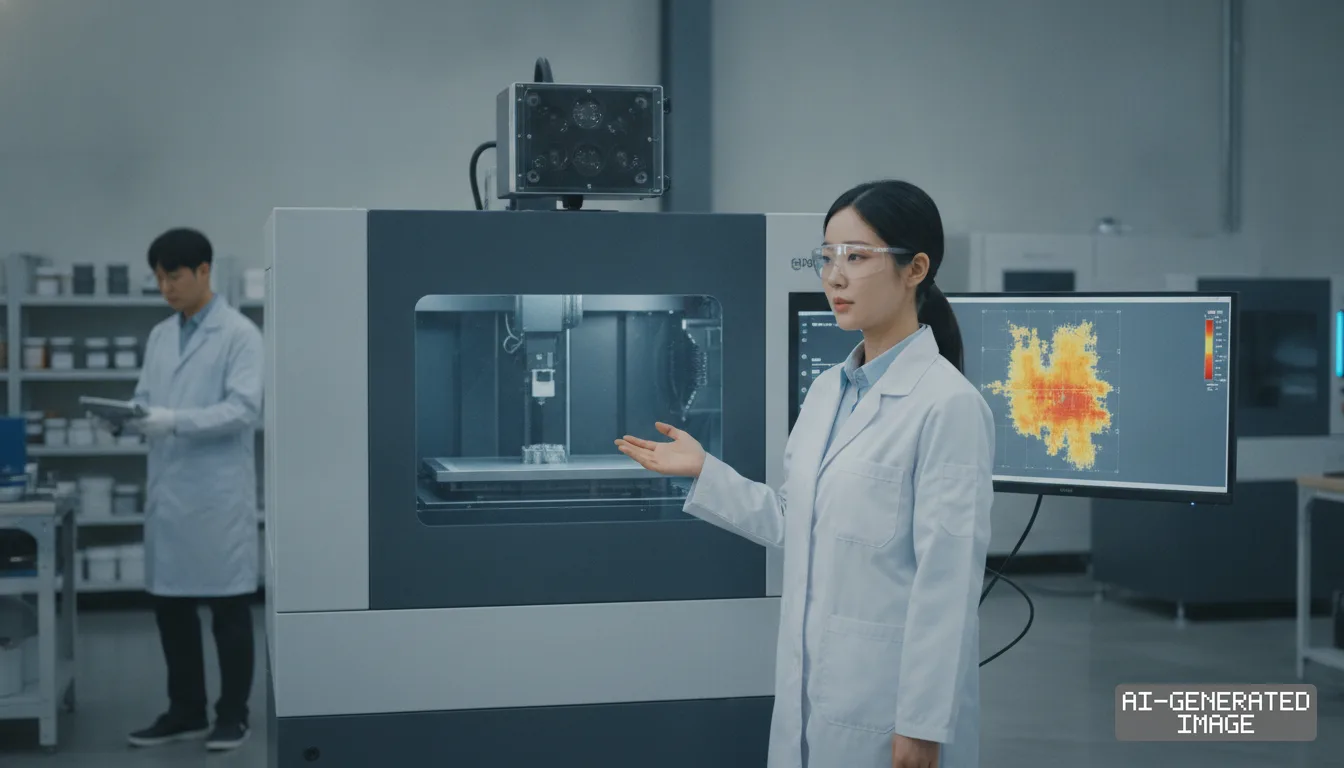
South Korean machine tool builder DN Solutions unveiled an in-situ defect-detection system developed with software maker Addiguru on Nov. 25, 2026, targeting commercial laser powder bed fusion printers.
The platform identifies layer anomalies before printed blanks enter secondary milling and inspection. Post-build machining and non-destructive evaluation account for 30% to 50% of finished metal component costs.
Engineers from both companies demonstrated the automated setup at the Formnext 2026 trade fair in Frankfurt. The demonstration processed live powder bed imagery on a DN Solutions DLX metal printer.
Laser beam powder bed fusion — melting fine metal powders with focused lasers layer by layer — creates complex structural parts. Builds often require tens of thousands of consecutive powder spreads.
Small disruptions during powder recoating can generate porosity, lack of fusion or severe thermal distortion. Left unnoticed, internal structural voids remain hidden within the solid metallic matrix until final testing.
Addiguru designed its computer vision software to process individual top-surface layer photographs in real time. The software automatically flags recoater streaks, particulate spatter and uneven powder distributions across the build plate.
Reviewing thousands of layer images manually requires hours of specialized engineering labor. The algorithmic platform highlights defective coordinates and alerts machine operators when an anomaly crosses preset tolerance thresholds.
Catching defects during the print phase allows operators to abort a compromised build immediately. Scrapping an early print eliminates downstream expenditures on thermal annealing, five-axis CNC finishing and quality certification.
A defect found during the build costs a reprint, DN Solutions Vice President Vino Suntharakumaran said. Found after five-axis finishing and computed tomography, it costs every accumulated machine hour, Suntharakumaran said.
Identifying anomalies early prevents plants from loading flawed geometries onto precision cutting equipment, Addiguru Chief Executive Shuchi Khurana said. Unnecessary finish milling wastes machine spindle availability and skilled labor, Khurana said.
Non-destructive quality assurance constitutes one of the steepest bottlenecks in additive manufacturing. Industrial computed tomography scanning and specialized coordinate measurement often exceed the baseline cost of raw laser sintering.
DN Solutions operates as South Korea's largest machine tool builder and ranks third globally by revenue. The Changwon-based company, formerly known as Doosan Machine Tools, has expanded rapidly into additive systems.
The company developed its DLX series to connect additive deposition directly with subtractive milling. Combining additive machines with five-axis machining centers like the DVF series forms the core of its factory strategy.
The DLX product line includes chambers spanning build volumes up to 450 millimeters on each axis. The systems process certified high-performance materials, including aerospace-grade Inconel 718 and medical Ti-6Al-4V titanium.
Addiguru operates out of New Orleans, developing machine-independent quality monitoring platforms for metal printing. The software firm previously secured top marks in the United States ASTRO America additive monitoring competition.
The software achieved 96% accuracy in identifying build swelling and layer distortion during benchmark tests. The algorithms registered deviation signals 50 to 100 layers earlier than conventional optical monitoring systems.
The joint demonstration at Formnext relied strictly on optical cameras mounted above the powder bed. The setup logged anomalies without altering the laser scan parameters or disrupting machine cycle times.
Integrating defect filtering ahead of subtractive milling protects expensive cutting inserts. Machining porous or warped additive parts accelerates tool wear, damages toolholders and risks spindle collision during automated finishing.
Following the Formnext demonstration, technical teams will evaluate combining optical image analysis with machine controller data and thermal sensor streams.
DN Solutions plans to install integrated additive and subtractive manufacturing cells at its European Additive Solution Center in Guetersloh, Germany. The center supports customer testing and parameter development across Europe.
The companies did not disclose commercial terms for the software partnership, and announcements do not state whether Addiguru algorithms will ship as standard factory equipment on new DLX systems.
Technical evaluations covering combined sensor feeds and machine telemetry will continue across test installations through early 2027.
Impact map
How this development propagates across the region and out to global buyers.
| Event | Korea | China | Japan | Global impact |
|---|---|---|---|---|
| AI in-situ defect monitoring integration | DN Solutions integrates defect filtering into DLX metal printers to protect downstream CNC milling | Competitors face widened software gap in automated closed-loop metal AM certification | High-end machine tool builders assess vision integration for hybrid additive-subtractive lines | Aerospace and medical manufacturers curb post-processing waste, where finishing claims 30% to 50% of part costs |
In this story
- Companies
- DN SolutionsAddiguru
- Impact
- Supply ChainCost Structure
Related briefings
- DN Solutions pairs Addiguru AI vision with metal 3D printers Also on Addiguru, DN Solutions, Cost Structure
- Proposed 15% US tariff spares Taiwan machine tools from heavy blow Also on DN Solutions
- DN Solutions Unveils AI Machining Cell at Robotworld 2026 Also on DN Solutions
- TSMC extends 2nm runs through 2028 as customers bypass A16 Also on Cost Structure
Sources
Reporting
Confidence: high — how we grade this
The documents behind this briefing are linked above. East Asia Brief produces its English text with AI assistance under human editorial review, and does not translate or republish other outlets' articles. See our methodology and AI policy. Spotted an error? Tell us.
The Morning Brief
What changed in Korean, Chinese and Japanese industry overnight — and what it means for your supply chain. One email, weekday mornings, US time. Free.
The Morning Brief is in preparation. Leave your address and we will write to you once — when the first issue is ready. Nothing before that.