Chinese heavy machinery plants install automated ultrasonic gantries to verify welds
Excavator and crane builders automate non-destructive thick-plate weld testing to satisfy European structural certification requirements for exported heavy equipment.
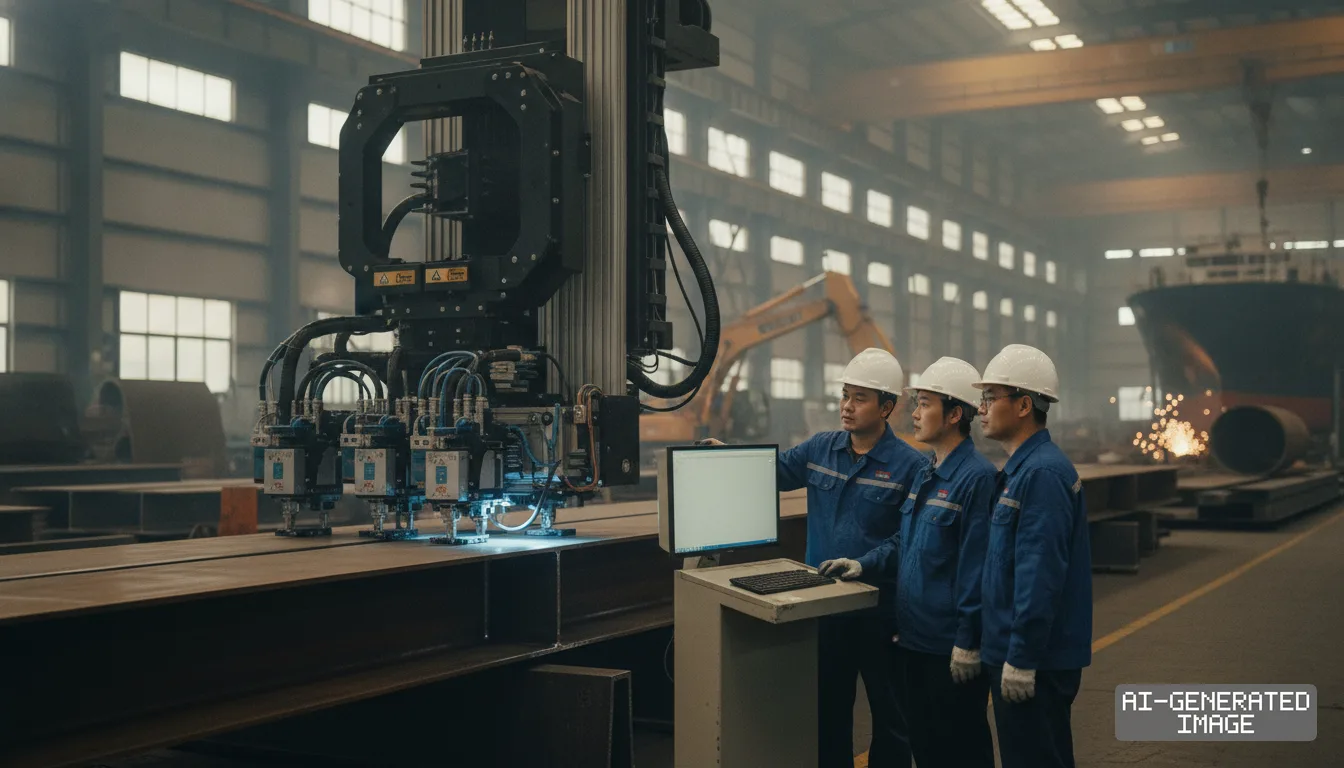
Chinese heavy machinery manufacturers and industrial vessel fabricators are installing multi-axis automated ultrasonic testing gantries across their heavy plate welding lines to meet European structural verification requirements for export-bound equipment. The automated inspection stations replace manual non-destructive testing on thick-section structural steel, allowing crane, excavator, and specialized vessel builders to produce fully digitized, auditable volumetric records of load-bearing seams.
The deployment addresses conformity assessment rules under European Machinery Directives and structural standard EN 1090-2, which require documented non-destructive examination of critical welds in high-stress machinery frames and booms. European buyers and certification bodies require verifiable digital inspection data to validate structural integrity, a hurdle that traditional manual testing struggled to clear at volume. By mounting ultrasonic probe arrays on multi-axis motorized bridges, fabricators can inspect welded joints directly behind production lines without moving heavy subassemblies to separate examination bays.
The automated systems employ Phased Array Ultrasonic Testing (PAUT) transducer assemblies suspended from rigid overhead gantries that travel along the linear and radial axes of large workpieces. These gantries inspect medium-to-thick carbon and alloy steel plates ranging from 6 millimeters to over 200 millimeters in thickness, covering longitudinal butt welds, circumferential joints, and planar seam geometries. Integrated water-film and localized immersion acoustic coupling mechanisms ensure continuous ultrasonic beam transmission between probe faces and unmachined plate surfaces, preventing signal dropout during rapid scanning.
Manual ultrasonic testing requires technicians to sweep handheld probes across weld caps while visually monitoring single-channel A-scan traces, an approach vulnerable to operator fatigue and missed defect orientations. The gantry-mounted phased array systems steer ultrasonic sound beams electronically through pre-programmed focal laws, capturing volumetric cross-sections across the weld cap, heat-affected zone, and root pass in a single mechanical pass. Hardware controllers record time-corrected gain data and spatial coordinates from optical encoders, generating synchronized A-scan, B-scan, C-scan, and sectoral S-scan images that map internal planar flaws, lack of sidewall fusion, porosity, and crack formations.
The testing configurations align with Chinese technical standards including JB/T 4730.3 for ultrasonic testing of pressure equipment, GB/T 11345, and GB/T 29712 for weld imperfection acceptance, alongside international benchmarks such as ASME Section V Article 4 and RCC-M design and construction rules. Integrating these baseline standards into automated defect recognition software allows systems to flag non-compliant indications automatically against predefined amplitude and length thresholds, minimizing subjective evaluation on the factory floor.
Corporate filings reflect the operational transition across heavy fabrication sectors. In its regulatory disclosures, BaoSe Co., Ltd. detailed the deployment and proprietary commissioning of automated phased array ultrasonic scanning systems for thick-plate weld verification in specialized pressure vessels and nuclear fusion vacuum chamber components. Similarly, intelligent manufacturing equipment supplier Hefei Metalforming Intelligent documented investments in automated scanning and inspection cells designed to verify structural welds in heavy industrial forming machinery.
The automation of weld verification also eliminates reliance on traditional radiographic testing using industrial X-ray tubes or gamma-ray isotopes. Radiographic inspections require safety exclusion zones and production pauses to shield plant personnel from ionizing radiation, creating operational bottlenecks in high-throughput heavy equipment facilities. Gantry-based ultrasonic systems operate continuously alongside active fabrication cells, allowing automated submerged-arc welding and inspection routines to run in parallel without radiation hazards or hazardous chemical processing for radiographic film.
For manufacturing engineers and non-destructive testing equipment vendors, the factory integration of gantry AUT expands demand for multi-channel acquisition instruments, motorized positioning hardware, and specialized data analysis platforms. Industry forecasts indicate that China's automated and robotic ultrasonic inspection cell market will expand at a 9.4 percent compound annual growth rate through 2036, driven primarily by quality mandates in heavy fabrication, nuclear vessel manufacturing, and export-oriented structural equipment.
Equipment builders use the resulting inspection databases to compile digital quality dossiers for third-party auditing agencies such as TÜV Rheinland, DNV, and Bureau Veritas prior to European customs clearance. Each weldment maintains a permanent digital record linking raw plate heats, welding machine parameters, and phased array scan maps. That unalterable data package satisfies customer-mandated traceability standards and insulates manufacturers against structural failure claims during machinery operation overseas.
Provincial industrial technology programs and national equipment classifications have designated heavy-plate ultrasonic gantries as priority industrial automation targets. The Liaoning Department of Science and Technology listed high-capacity non-destructive testing gantry systems in its 2026 Frontier Technology Guide, while national customs guidelines continue to categorize automated ultrasonic machinery under strategic fabrication technology. Adoption remains driven by segment-specific export certifications and pressure-retaining safety codes rather than an omnibus heavy equipment mandate, keeping commercial compliance timelines as the primary operational driver for machinery builders.
Impact map
How this development propagates across the region and out to global buyers.
| Event | Korea | China | Japan | Global impact |
|---|---|---|---|---|
| automated NDT gantry adoption | heavy equipment competitors | export fabricators comply | inspection robotics suppliers | European cert compliance |
In this story
- Companies
- BaoSe Co.Ltd.Hefei Metalforming Intelligent
- Tickers
- 300402.SZ603011.SS
- Exposed
- TÜV Rheinland
- Policy
- Economic SecurityTechnical Standards
- Impact
- ComplianceSupply ChainCapex
Track every Economic Security development →
Related briefings
- Korean battery makers deploy directional venting to block thermal runaway in EV and ESS packs Also on Technical Standards, Compliance
- China servo motor makers squeeze foreign rivals on cost and delivery Also on Technical Standards
- Chinese private yards expand dual-fuel bulker berths as European owners accelerate green fleet renewal Also on Ltd.
- Japan Linear Guide Makers Expand Ultra-Clean Units for 2nm Fab Robotics Also on Ltd.
Sources
Primary documents
Reporting
Confidence: high — how we grade this
The documents behind this briefing are linked above. East Asia Brief produces its English text with AI assistance under human editorial review, and does not translate or republish other outlets' articles. See our methodology and AI policy. Spotted an error? Tell us.
The Morning Brief
What changed in Korean, Chinese and Japanese industry overnight — and what it means for your supply chain. One email, weekday mornings, US time. Free.
The Morning Brief is in preparation. Leave your address and we will write to you once — when the first issue is ready. Nothing before that.