Automakers scale floor robot tracks to handle heavy EV packs
External floor-mounted rails took 62% of 2026 track installations as plants deploy seventh-axis systems from Güdel and KUKA for body-in-white welding lines.
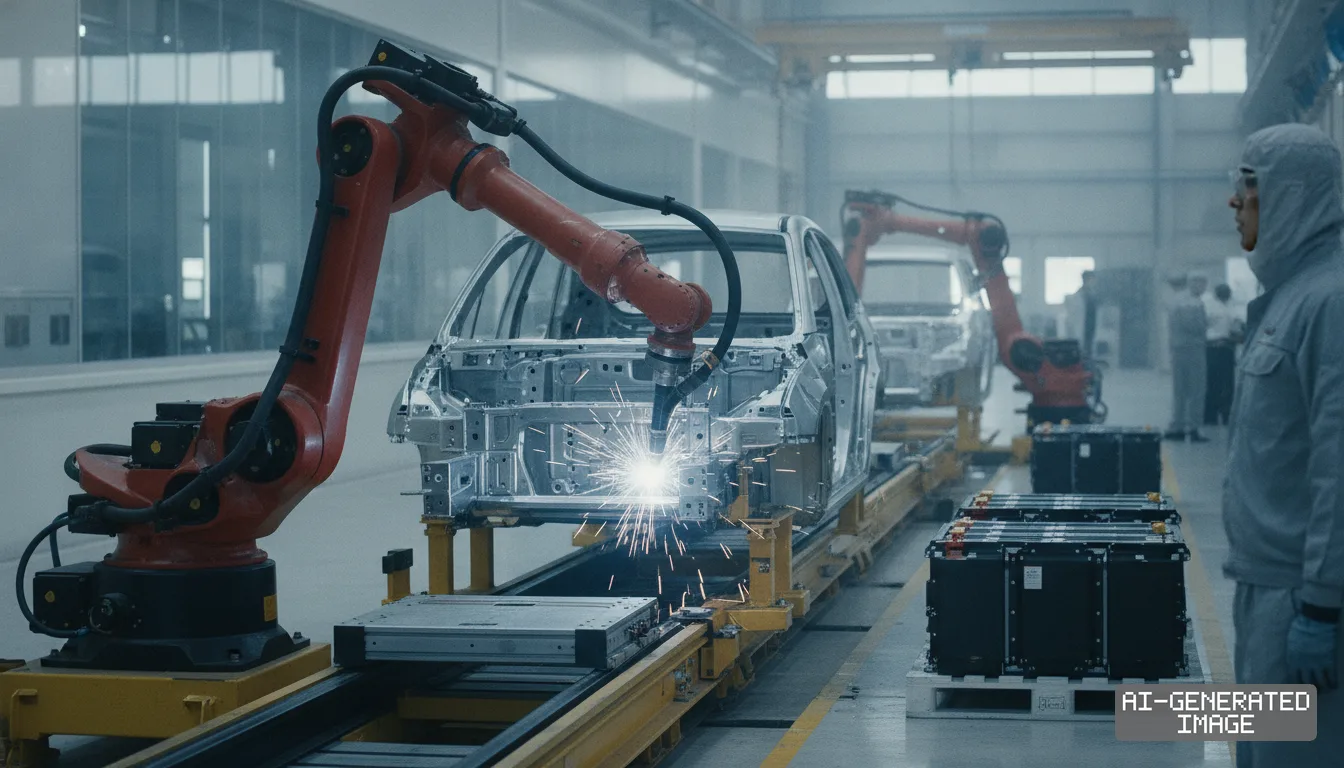
Future Market Insights released industrial data Nov. 20 showing floor-mounted linear track systems accounted for 62.0% of global robot track installations in 2026, driven by heavier electric vehicle structures and battery packs.
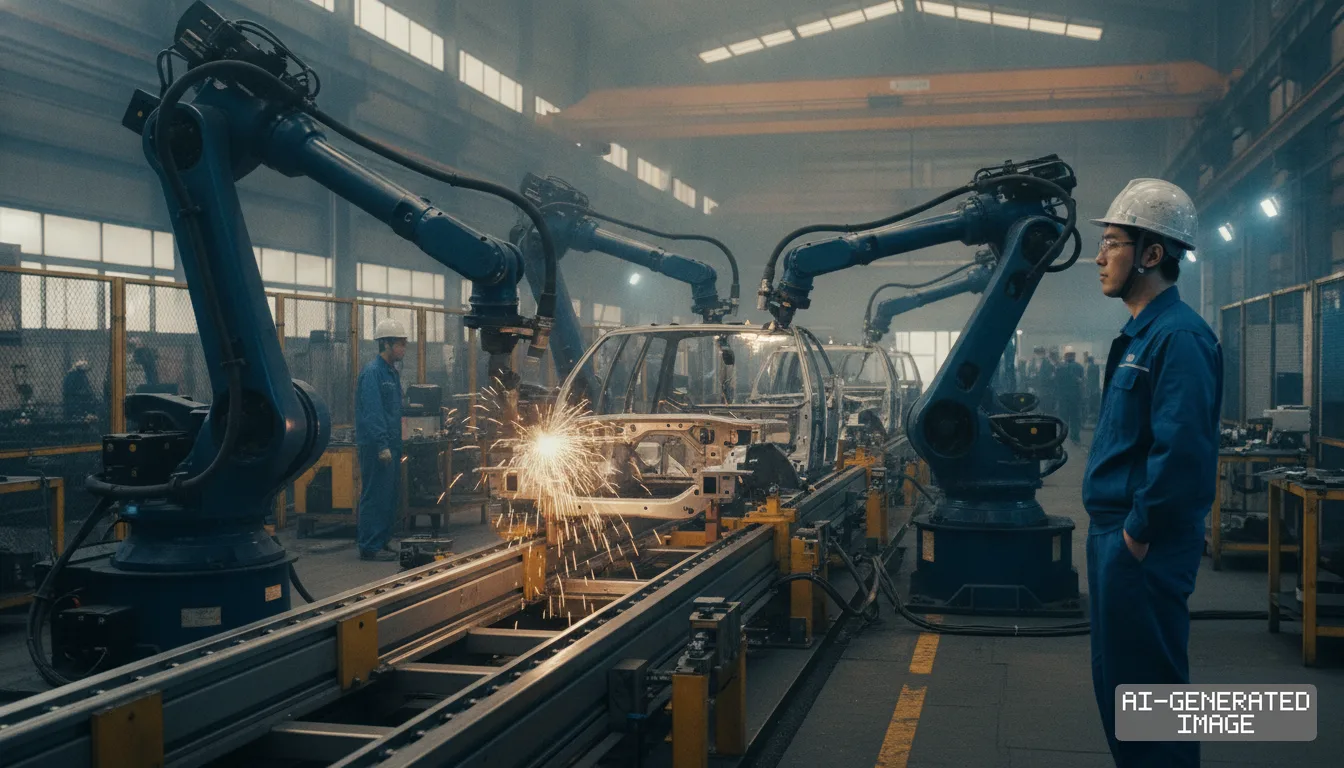
Automakers are deploying linear tracks — external floor rails that translate articulated robots along factory bays — to expand the operating envelope of six-axis welding arms. The shift lets one robot service multiple stations.
Floor installations dominate the hardware market over ceiling or gantry alternatives, according to the research group. The 62.0% market share reflects rising capital expenditure on body-in-white welding lines and structural tray assembly.
Automotive body shops traditionally assigned fixed articulated robots to dedicated welding cells. Rising vehicle curb weights and integrated battery chassis now require larger work envelopes that stationary pedestals cannot cover efficiently.
Adding a seventh linear axis allows a single heavy-payload robot to weld panels across two or three fixtures. That layout reduces total robot counts while cutting floor space requirements in assembly plants.
Motion controllers treat the linear rail as an integrated external axis rather than an asynchronous conveyor. That synchronization enables robots to deposit spot welds and structural adhesives while moving along the track.
Linear tracks also ease the mechanical strain on robotic wrists by transferring translational motion to the floor rail. Rather than stretching joint links to maximum reach, the carriage glides into optimal spot-welding posture.
Swiss automation supplier Güdel has focused equipment delivery on its TrackMotion Floor TMF-4-B line. The system is engineered specifically for body-in-white spot welding and material handling in high-volume automotive plants.
Güdel designed the TMF-4-B carriage to accommodate adapter plates for more than 130 articulated robot models. Its modular beam sections use a weld-free bolt-on anchoring system, allowing factory technicians to realign tracks without hot work.
For larger tooling and structural battery handling, Güdel supplies the heavier TMF-6 track system. The TMF-6 rail handles dynamic loads from robots weighing up to six metric tons, maintaining positioning repeatability within 0.02 millimeters.
German robot manufacturer KUKA has standardized its automotive framing cells around the KL 4000 linear unit. The modular track supports rated payloads of up to 4,000 kilograms per carriage.
KUKA configures the KL 4000 in modular beam segments of 1.5 meters and two meters. Total track length reaches 31.5 meters with an effective travel distance of 30.4 meters, the company said.
Up to four driven carriages can run simultaneously on a single KL 4000 rail. Shared mounting bases let plants bolt heavy-duty KR QUANTEC and KR FORTEC robot models to identical hole patterns without field welding.
For complete battery enclosure installation and gigacasting part extraction, KUKA offers the KL 5000 linear axis. The KL 5000 handles payloads of up to 5 metric tons and extends across travel runs up to 31 meters.
Electric vehicle plants across China, South Korea and Japan are adopting standardized seventh-axis rails to retool framing areas. Integrating longer tracks allows production engineers to feed modular battery packs directly into underbody mating cells.
Vehicle assembly plants in eastern China have rapidly integrated these long-stroke linear units into high-volume body shops. Automakers use extended rails to bridge pre-assembly sub-lines directly into main body framing systems.
Demand for high-rigidity linear rails increases procurement volumes for precision motion hardware. Japanese motion specialists such as THK and NSK supply hardened ground racks, profile guides and lateral guide rollers to European track builders.
Bolt-on foundation designs eliminate certified welding labor during initial track installation. Eliminating hot-work permits accelerates line commissioning by several days when automakers retool existing plants for new vehicle architectures, plant engineers said.
Integrated internal cable carriers protect high-flex power cables and coolant lines across extended strokes. The enclosed track beams shield guide surfaces from weld spatter, extending maintenance intervals in continuous three-shift body shops.
Car-body variants with distinct wheelbases can pass through the same welding cell without dedicated hardware. Programming software simply shifts carriage stop coordinates along the linear axis to match each chassis length.
Reconfiguring an existing assembly line becomes faster because track extensions connect to installed modular beams. Plants can lengthen an operational axis by adding standard two-meter segments without replacing existing drive carriages.
The research release does not cite any formal bilateral technical pact between Güdel and KUKA. International standards organizations have also not published mandatory mechanical dimensions for seventh-axis robot track mounting interfaces.
Automotive procurement committees finalize equipment delivery schedules for 2027 body shop expansions through the second quarter of 2027. Meanwhile, Future Market Insights will track linear axis shipments across its ten-year forecast window ending in 2036.
Impact map
How this development propagates across the region and out to global buyers.
| Event | Korea | China | Japan | Global impact |
|---|---|---|---|---|
| Industrial robot linear track adoption | Battery pack and EV body lines integrate modular seventh-axis tracks to cut static robot counts | High-volume auto plants expand multi-carriage floor tracks to link sub-assembly with framing | Component makers THK and NSK capture higher precision rack and guide orders for linear modules | Automotive OEM capex shifts toward 62.0% floor-mounted track share to handle heavier vehicle platforms |
In this story
Related briefings
- Factory automation shifts to linear tracks in $559 million market Also on Güdel, KUKA
- Japan's AIRoA unveils domestic general-purpose robot roadmap for AI Also on THK
- Estun Automation completes buyout of robotics unit Codroid Also on KUKA, Order Book
- FANUC UK restructures sales leadership to target aerospace and defense Also on KUKA, Order Book
Sources
Reporting
Confidence: medium — how we grade this
The documents behind this briefing are linked above. East Asia Brief produces its English text with AI assistance under human editorial review, and does not translate or republish other outlets' articles. See our methodology and AI policy. Spotted an error? Tell us.
The Morning Brief
What changed in Korean, Chinese and Japanese industry overnight — and what it means for your supply chain. One email, weekday mornings, US time. Free.
The Morning Brief is in preparation. Leave your address and we will write to you once — when the first issue is ready. Nothing before that.