MH Materials partners with KIMS on Dy-free magnet pilot line
The partnership eliminates dysprosium and cuts neodymium use by 30% to lower raw material costs by 34%, targeting robotic actuator motors under development at affiliate MH Dynamics.
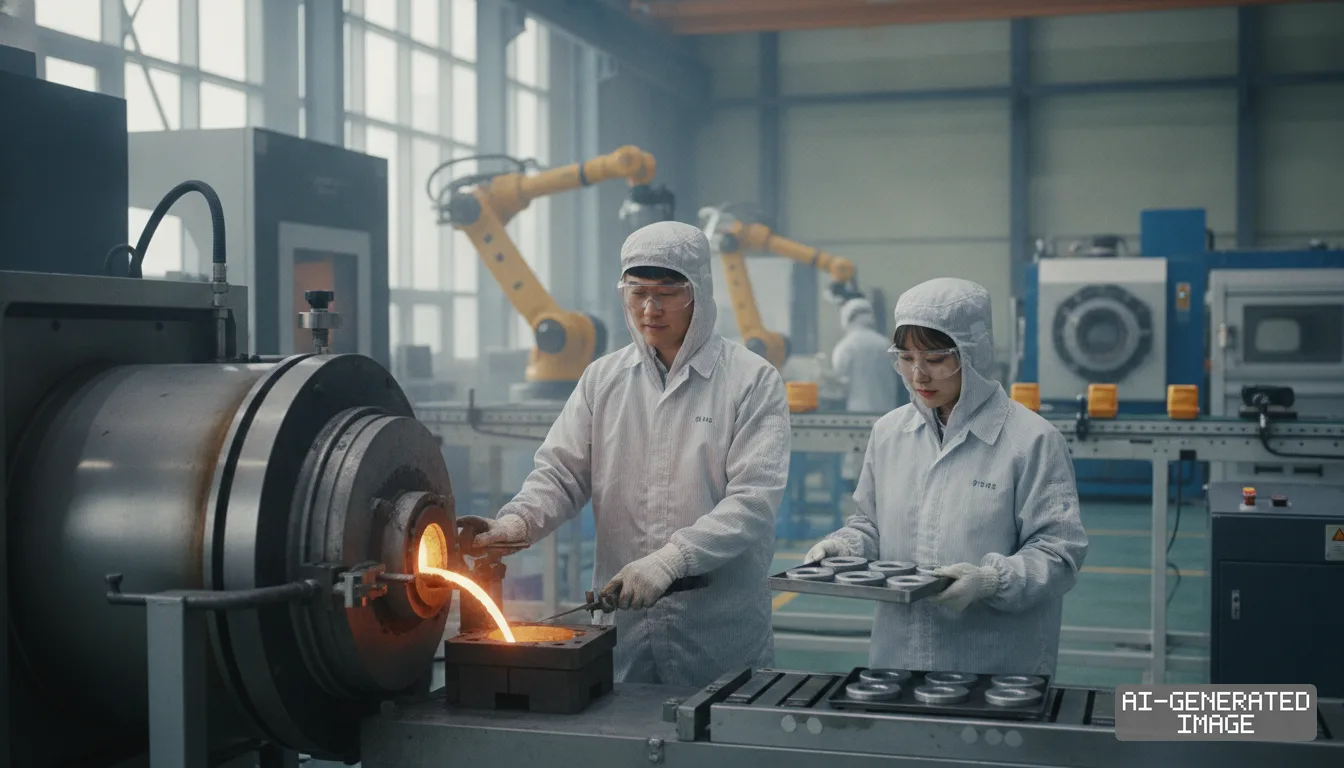
MH Materials partnered with the Korea Institute of Materials Science on Oct. 16, 2026 to commercialize permanent magnets that eliminate heavy rare earths and reduce neodymium content by 30%.
The agreement establishes a joint program to construct an annual 50-ton pilot production line in Changwon. The partners plan to scale commercial capacity between 1,000 and 10,000 tons annually based on order volume.
Substituting cerium for 30% of the neodymium and eliminating dysprosium and terbium cuts raw material expenses by approximately 34% per kilogram. MH Materials announced the cost projection during the signing ceremony in Changwon.
The project adopts a hot-deformation manufacturing method rather than standard powder sintering. MH Materials expects the deformation technique to lower factory processing expenses by an additional 15% compared with conventional sintered magnet production.
Conventional high-temperature magnets require dysprosium and terbium to prevent thermal demagnetization. The KIMS formulation maintains coercivity — the physical ability of a magnet to resist demagnetization under opposing magnetic fields or extreme heat — without those two elements.
Cerium serves as a lower-cost substitute for part of the neodymium content. Because cerium trades at a steep discount to neodymium, the chemical formulation lowers input costs while reducing vulnerability to light rare earth supply disruptions.
MH Materials plans to deliver the first magnets from the 50-ton pilot line to its affiliate, MH Dynamics. MH Dynamics develops robotic actuators that require high torque density in miniature electric motor housings.
Supplying robotic actuator motors provides a captive test platform before seeking automotive qualification. Industrial drive units operate under severe vibration and heat cycles, testing whether the hot-deformed material maintains structural integrity in commercial operation.
MH Materials was established in 1953 as Manho Rope & Wire, manufacturing wire rope, elevator cable and specialty steel wire. Shareholders approved changing the corporate name to MH Materials on Sept. 18, 2026.
The company notified investors of the corporate charter amendments in a regulatory disclosure on Sept. 3, 2026. MH Materials trades under ticker 001080 on the Korea Exchange, where its shares trade in Seoul.
Chief Executive Kwan-heon Lim and KIMS Vice President Chang-hoon Lee signed the commercialization agreement at 1:30 p.m. local time on Oct. 16, 2026. The signing took place at KIMS headquarters in Changwon.
The research team at KIMS led by principal researcher Jeong-goo Lee developed the underlying alloy composition. Under the agreement, MH Materials will commercialize the magnets under the proprietary brand name MH HIMAG.
The brand name stands for Motion and Harmony High Magnet. KIMS and MH Materials plan to specify technology transfer licensing royalties and operational covenants after completing performance tests on the pilot manufacturing line.
South Korea imports nearly all of its sintered permanent magnets, relying heavily on Chinese processors for vehicle traction motors and wind turbines. China controls more than 90% of global rare earth refining and magnet fabrication.
The Chinese commerce ministry restricts exports of heavy rare earth separation technology and monitors shipments of high-grade neodymium permanent magnets through licensing quotas. By eliminating dysprosium and terbium, the Changwon project removes exposure to those curbs.
In Japan, Daido Electronics developed heavy-rare-earth-free permanent magnets in partnership with Honda Motor. Daido Electronics supplies those magnets for hybrid vehicle traction motors, but the design retains full neodymium concentrations without cerium substitution.
Retaining full neodymium concentrations leaves manufacturers exposed when light rare earth prices rise. MH Materials executives said combining heavy rare earth elimination with a 30% reduction in neodymium creates a wider cost advantage against Japanese peers.
Hot deformation presses heated magnetic ribbons to align crystal grains along a preferred magnetic axis. This method yields finer grain structures than standard sintering, which can improve mechanical strength and reduce cracking in high-speed rotors.
MH Materials has not filed a regulatory capital expenditure disclosure with the Financial Supervisory Service. The company has not published the total capital budget or equipment procurement schedule for the 50-ton pilot line.
The official agreement also leaves the timeline for the larger 1,000-to-10,000-ton manufacturing facility unconfirmed. Management said that future investment will proceed in phases based on customer qualification and bilateral supply commitments.
Pilot facility testing will continue through 2027 as MH Materials prepares prototype magnets for MH Dynamics actuators. Commercial delivery contracts with third-party automotive or industrial suppliers will require formal licensing agreements following that validation phase.
Impact map
How this development propagates across the region and out to global buyers.
| Event | Korea | China | Japan | Global impact |
|---|---|---|---|---|
| Dy/Tb-free permanent magnet pilot line | MH Materials diversifies from steel wire into 50-ton magnet pilot line for MH Dynamics actuators | Chinese refiners face long-term erosion of heavy rare earth market leverage | Daido Electronics maintains Dy-free lead but carries unmitigated neodymium cost exposure | EV and robotics supply chains gain non-Chinese magnet sourcing channel |
In this story
- Companies
- MH Materials
- Tickers
- 001080.KS
- Exposed
- MH DynamicsDaido ElectronicsHonda Motor
- Impact
- Supply ChainCost StructureCapex
Related briefings
- Japan accelerates grants for rare-earth-reduced robot motor magnets under economic security act Also on Honda Motor, Cost Structure
- Honda opens R&D center to 30 South Korean mobility suppliers Also on Honda Motor, Cost Structure
- Suzuki selects BYD LFP battery cells for inaugural Japanese mini EV Also on Honda Motor, Cost Structure
- LG Energy Solution secures 240,000 tons of Canadian lithium from Elevra Also on Honda Motor, Cost Structure
Sources
Primary documents
Reporting
Confidence: high — how we grade this
The documents behind this briefing are linked above. East Asia Brief produces its English text with AI assistance under human editorial review, and does not translate or republish other outlets' articles. See our methodology and AI policy. Spotted an error? Tell us.
The Morning Brief
What changed in Korean, Chinese and Japanese industry overnight — and what it means for your supply chain. One email, weekday mornings, US time. Free.
The Morning Brief is in preparation. Leave your address and we will write to you once — when the first issue is ready. Nothing before that.