KOGAS shifts LNG storage protocols to smooth winter inventory builds
South Korea's state gas utility adopts dynamic working capacity limits across five import terminals to cut spot exposure before peak winter demand.
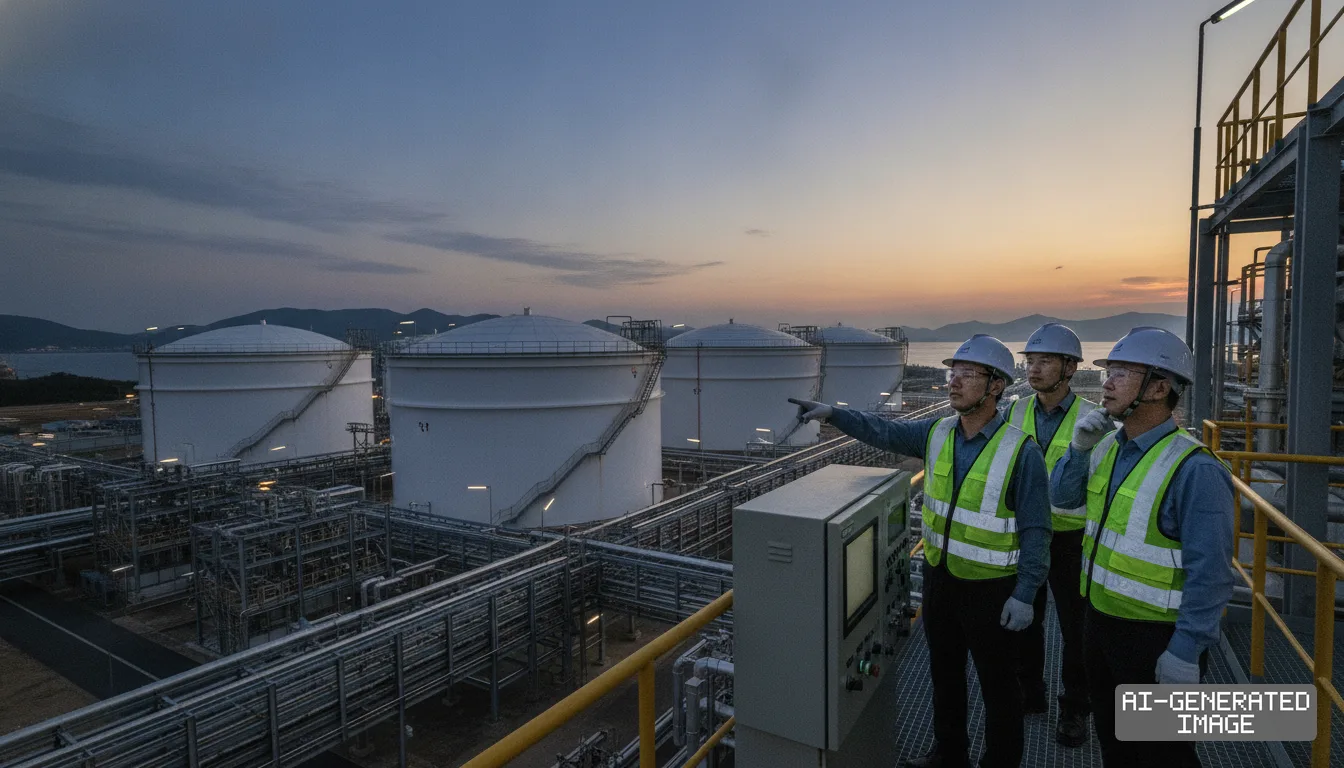
Korea Gas Corporation (KOGAS) has implemented a dynamic storage management protocol across its domestic liquefied natural gas receiving terminals, altering the injection pacing and seasonal inventory buffers that govern South Korea's winter fuel reserves. The revised framework replaces static monthly inventory targets with floating working-capacity thresholds tied to daily sendout volatility, terminal tank turnaround rates, and spot market pricing differentials.
The state-run utility operates 77 above-ground and membrane LNG storage tanks across four active import terminals in Pyeongtaek, Incheon, Tongyeong, and Samcheok, with initial capacity at a fifth terminal in Dangjin entering phased commissioning. South Korea represents the world's third-largest LNG importing nation, where seasonal temperature extremes create a substantial consumption delta between summer power generation troughs and winter heating peaks. In previous heating seasons, rigid fill mandates enforced by the Ministry of Trade, Industry and Energy (MOTIE) required state storage to reach near-maximum nominal capacity by late October, exposing the utility to severe spot procurement premiums during periods of elevated international benchmark pricing.
Under the operational rules enacted for the 2026 2027 procurement cycle, KOGAS calculates minimum safety stock as a rolling 20-day forward consumption cover rather than an absolute volumetric quota. When Asian spot benchmark prices for the Japan Korea Marker (JKM) trade at a wide premium to long-term oil-linked contracts, terminal operators have authorization to throttle late-summer injection runs and utilize existing inventory ullage through early November. The mechanism provides terminal superintendents with operational authority to fluctuate working inventory between 62 percent and 88 percent of gross tank capacity during the September-to-November injection window, depending on shipping slot congestion and downstream pipeline pressurization.
The procedural shift directly affects the spot purchasing patterns of Northeast Asian gas desks. Global cargo traders previously relied on predictable late-third-quarter buy tenders from KOGAS to clear uncommitted volumes from liquefaction plants in the United States, Australia, and Qatar. By establishing flexible inventory absorption windows, the utility intends to capture downward price movements during intermediate shoulder periods while reducing high-cost prompt offloadings at Incheon and Pyeongtaek berths.
The operational parameters also establish daily gas re-allocation channels between KOGAS and private direct importers holding independent terminal access rights. Companies including POSCO International, SK E&S, and GS Energy currently import LNG directly for captive combined-cycle power stations and industrial facilities under private off-take agreements. When terminal tank levels at private facilities such as the Boryeong and Gwangyang LNG terminals reach upper operating safety limits, the dynamic framework permits temporary inter-terminal gas swaps and pipeline wheeling through the national transmission grid operated by KOGAS, mitigating cargo deferral penalties.
Terminal logistics and boil-off gas management dictate the technical boundary conditions of the revised system. During rapid injection campaigns, elevated boil-off gas generation in cryogenic full-containment tanks forces regasification facilities to increase high-pressure sendout or flare surplus vapor to prevent over-pressurization. The flexible intake scheduling allows terminal engineers to balance compressor operation, submerged combustion vaporizers, and open rack vaporizers against actual grid off-take schedules submitted by regional city gas distribution companies and power producers.
Downstream power sector regulations closely match these fuel storage calibrations. South Korea's state-run grid operator, Korea Power Exchange (KPX), determines the dispatch ranking of combined-cycle gas turbine (CCGT) power stations based on fuel cost declarations updated on a monthly schedule. By dampening the cost impact of unhedged autumn spot cargo purchases, KOGAS aims to stabilize the fuel cost component passed into the wholesale system marginal price (SMP), directly influencing generation costs for power producers and retail tariffs determined by Korea Electric Power Corporation (KEPCO).
The revised storage rules maintain absolute emergency reserves designated for sub-zero cold waves and unexpected interruptions in nuclear baseload generation. If national inventory reserves drop below the minimum rolling cover threshold due to prolonged severe weather or pipeline supply constraints, the dynamic protocol triggers emergency spot purchase authorizations alongside mandatory fuel switching at dual-fuel generation units managed by KEPCO generation subsidiaries.
KOGAS completed terminal simulation runs and pressure-balance testing across its 5,100-kilometer nationwide trunk pipeline network in early August. The state utility will present its first consolidated inventory tracking report under the dynamic storage protocol at the Ministry of Trade, Industry and Energy's biannual winter energy supply assessment scheduled for October 2026.
Impact map
How this development propagates across the region and out to global buyers.
| Event | Korea | China | Japan | Global impact |
|---|---|---|---|---|
| Dynamic LNG storage protocol | cuts spot premium exposure | changes regional JKM cargo competition | aligns utility inventory balancing | alters seasonal spot procurement tenders |
In this story
- Companies
- Korea Gas CorporationPOSCO InternationalGS Energy
- Tickers
- 036460.KS047050.KS
- Exposed
- Korea Electric Power Corporation
- Policy
- Economic SecuritySubsidies
- Impact
- Supply ChainCost StructurePricing
Track every Economic Security development → Track every Subsidies development →
Related briefings
- South Korea Gas Distributors Deploy Satellite LNG Vaporization for Off-Grid Demand Also on Korea Gas Corporation, Korea Electric Power Corporation, Cost Structure
- Korea doubles US rare earth imports to counter China quotas Also on POSCO International, Pricing
- Lynas buys Meteoric for $672M to control Brazil rare earths Also on Posco International
- HD Hyundai and Hanwha Ocean split naval platforms for export Also on Posco International
Sources
This briefing carries no sources block. It was written from our desks’ working knowledge of the sector rather than from documents retrieved for this piece. Read it as orientation and check any figure you intend to act on — how we source briefings.
This briefing carries no linked sources: it was written from our desks' working knowledge of the sector rather than from documents retrieved for this piece. East Asia Brief publishes no citation it cannot link. Our English text is produced with AI assistance under human editorial review. See our methodology and AI policy. Spotted an error? Tell us.
The Morning Brief
What changed in Korean, Chinese and Japanese industry overnight — and what it means for your supply chain. One email, weekday mornings, US time. Free.
The Morning Brief is in preparation. Leave your address and we will write to you once — when the first issue is ready. Nothing before that.