Gaon Cable builds US nuclear wire lines in North Carolina
The South Korean supplier will equip its Tarboro factory for reactor circuits, expanding beyond a $50 million distribution cable project.
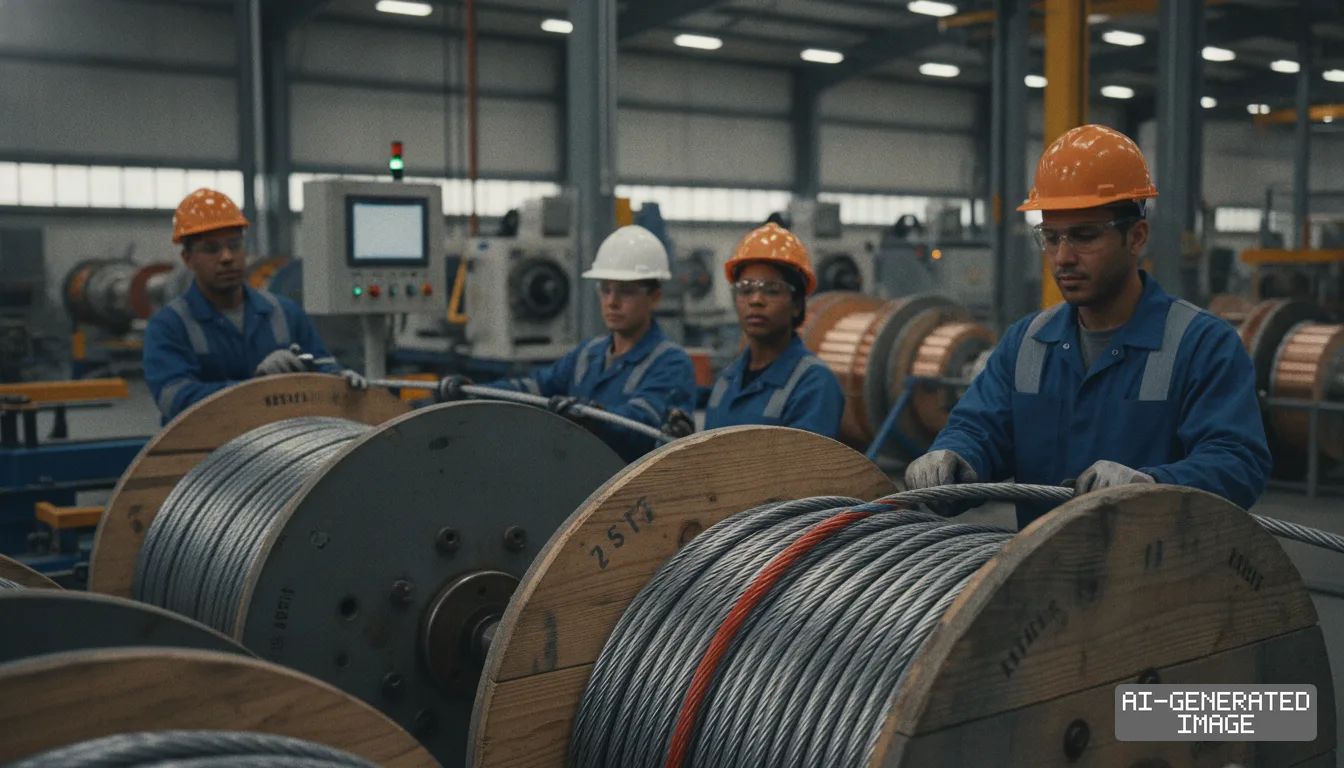
Gaon Cable said Oct. 12, 2026, it will install nuclear power plant cable production lines at its Tarboro factory in North Carolina to supply North American grid modernisations.
The expansion adds specialised wiring to an existing site where the company is completing a $50 million distribution line expansion, targeting both large reactors and small modular units.
A standard commercial reactor requires more than 50,000 electrical circuits to handle electricity delivery, system control and safety instrumentation. Gaon Cable seeks to capture rising replacement orders as American utility operators extend station licenses.
The project operates through LSCUS, a wholly owned American manufacturing subsidiary based in Tarboro. The subsidiary will run the production equipment directly inside its existing North Carolina industrial complex.
LSCUS holds an order backlog of approximately $200 million across its North American wire accounts. Gaon Cable projects the American subsidiary will raise annual revenue from roughly $300 million in 2025 to $500 million in 2026.
Rising power consumption from artificial intelligence data centers has driven United States utilities to solicit clean base-load electricity. That load growth has accelerated decisions to keep operational reactors running longer while reviving decommissioned units.
American equipment supply chains face domestic shortages after decades of limited reactor construction. Power developers must now procure high-specification safety wiring from compliant regional factories or vetted partner allies.
Nuclear-grade wiring carries strict engineering thresholds. Cables inside reactor containments must withstand extreme radiation, thermal exposure and corrosive moisture during long operational cycles.
Because each station requires varied technical ratings across its instrumentation loops, nuclear cabling relies on low-volume, high-mix manufacturing lines. Lead times often stretch when fabricators lack dedicated tooling in North America.
LSCUS will pursue local standard certifications across the United States to clear regulatory reviews. The subsidiary will adapt parent company technical designs to satisfy domestic nuclear criteria.
Gaon Cable also plans to supply South Korean engineering, procurement and construction firms pursuing project bids in North America. Joint contracting allows both sides to lower delivery schedule risks.
The initiative diversifies production at the Tarboro plant beyond overhead transmission lines and commercial conduits. Gaon Cable had historically focused its American manufacturing base on bulk utility grid infrastructure.
Ownership of the Tarboro facility shifted fully to Gaon Cable early last year. The company approved the buyout in November 2024 and finalized the acquisition of the remaining 82% equity stake from LS Cable & System on Jan. 31, 2025.
That acquisition gave Gaon Cable full operational oversight of LSCUS. The group subsequently committed capital to convert the site into an integrated American power cable hub.
Work on the $50 million distribution cable addition at Tarboro is already well advanced. The initial distribution manufacturing line begins commercial operations in the fourth quarter of 2026, with baseline capacity already committed under customer contracts.
A second distribution cable expansion phase will follow closely behind. Gaon Cable plans to commission that secondary line in the second quarter of 2027 to expand output.
The company reported total sales of 1.65 trillion won ($1.22 billion) for 2024, representing an increase of 10% over the previous year. Expanding shipments to North American grid customers provided the main driver for that top-line growth.
By adding nuclear-specific machinery to Tarboro, Gaon Cable intends to serve emerging small modular reactor installations alongside conventional stations. Modular plants demand compact, highly reliable cabling systems that meet American safety codes.
The announcement does not state the capital expenditure figure allocated to the nuclear machinery, and Gaon Cable has not published a commercial delivery date for the dedicated lines. The company issued the plan through a newsroom release rather than an exchange disclosure.
Commissioning of the first phase of the broader Tarboro distribution expansion takes place in October 2026, followed by the planned secondary line commissioning in April 2027.
Impact map
How this development propagates across the region and out to global buyers.
| Event | Korea | China | Japan | Global impact |
|---|---|---|---|---|
| Tarboro nuclear cable line addition | Gaon Cable expands US manufacturing base beyond transmission lines | No direct role, excluded from US nuclear infrastructure supply chain | Cable makers face stiffer competition in US utility procurement | US utilities gain domestic supplier for 50,000-circuit reactor cabling |
In this story
- Companies
- Gaon Cable
- Tickers
- 000500.KS
- Exposed
- LS Cable & System
- Policy
- Economic Security
- Impact
- CapexSupply ChainOrder Book
Track every Economic Security development →
Related briefings
- LS Cable backs Korea Future Materials in $15M US copper push Also on Gaon Cable, LS Cable & System
- LS Eco Energy builds Vietnam samarium hub ahead of defense ban Also on LS Cable & System
- LS Eco Energy builds Vietnam samarium line as US rules loom Also on LS Cable & System
- LS Cable Backs Magnet Unit as China Curbs Hit Robot Motors Also on LS Cable & System
Sources
Primary documents
Reporting
Confidence: high — how we grade this
The documents behind this briefing are linked above. East Asia Brief produces its English text with AI assistance under human editorial review, and does not translate or republish other outlets' articles. See our methodology and AI policy. Spotted an error? Tell us.
The Morning Brief
What changed in Korean, Chinese and Japanese industry overnight — and what it means for your supply chain. One email, weekday mornings, US time. Free.
The Morning Brief is in preparation. Leave your address and we will write to you once — when the first issue is ready. Nothing before that.