South Korean battery makers scale 4695 cylindrical cells for utility EV platforms
LG Energy Solution and Samsung SDI are ramping mass production of high-capacity 4695 cylindrical formats to supply North American commercial fleets and sport utility vehicles.
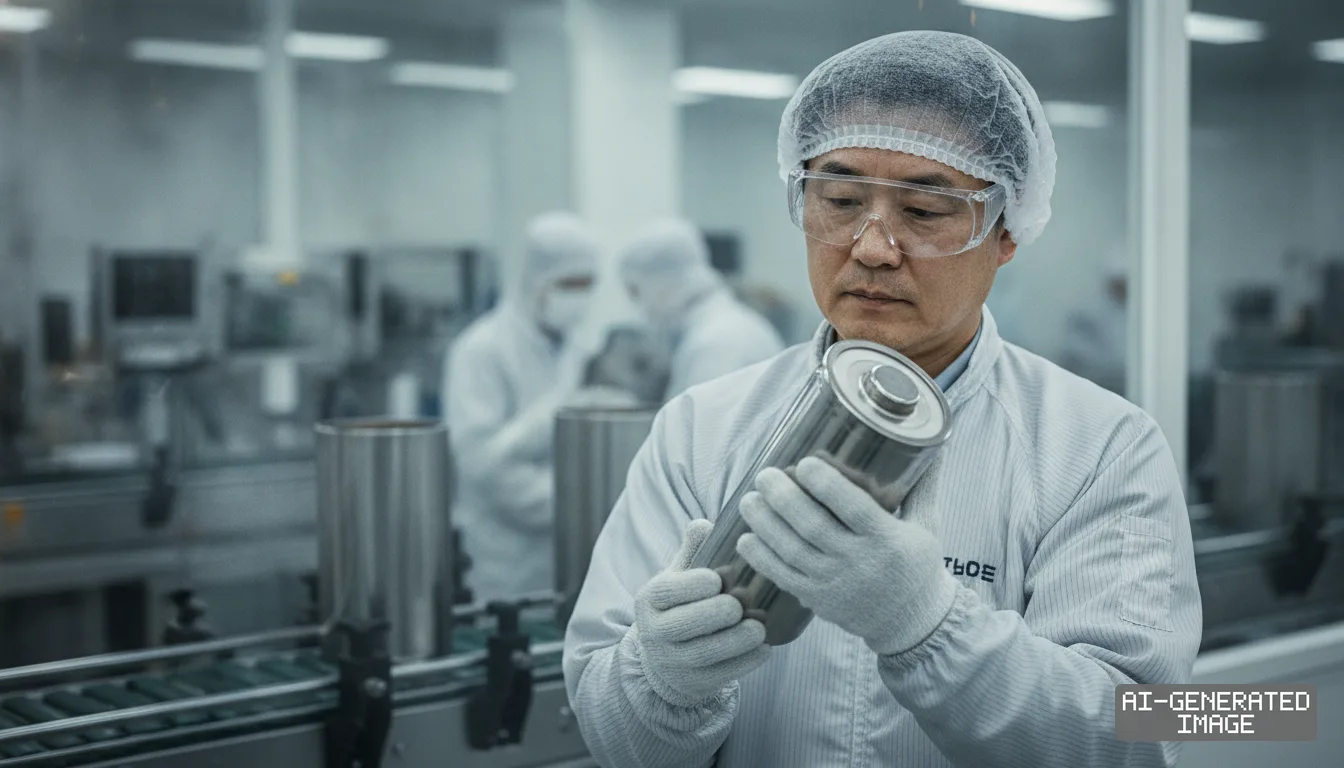
South Korea's leading battery manufacturers are accelerating commercial production and capacity expansion for 4695 cylindrical cells, establishing the 46-millimeter diameter and 95-millimeter height form factor as a primary architecture for heavy-duty electric utility vehicles, commercial transport fleets, and sport utility platforms.
The 4695 specification represents a substantial dimensional and volumetric evolution over legacy 2170 cylindrical cells. By expanding the cell casing diameter to 46 millimeters and extending vertical height to 95 millimeters, cell makers pack more than six times the volumetric energy capacity into a single container. The format incorporates a tabless internal electrode architecture where current collector foils connect directly to the end caps rather than through narrow welded metal tabs. This structural design shortens electrical conduction pathways across the wound jelly roll, dramatically lowering internal electrical resistance and enabling sustained high-power draw and high-rate fast charging without precipitating rapid localized thermal buildup.
LG Energy Solution opened large-scale commercial delivery pathways for the format after finalizing a five-year supply agreement totaling 67 gigawatt-hours with American electric automaker Rivian in November 2024. Under the contract, LG Energy Solution Arizona, a wholly owned subsidiary of the Korean battery producer, will manufacture 4695 cylindrical batteries at its standalone production facility in Arizona, supported by foundational pilot and initial production lines located at its domestic manufacturing plant in Ochang, North Chungcheong Province. The contracted volume is dedicated to powering Rivian's mid-size R2 sport utility vehicle platform for the North American market. The cell integrates a high-nickel nickel-cobalt-manganese-aluminum (NCMA) cathode material paired with a tabless electrode winding structure to maximize energy density while maintaining mechanical safety.
The adoption of the 4695 format addresses specific mechanical and packaging requirements for commercial vehicle and utility powertrain designers. While passenger sedans often favor the shorter 4680 format to maintain slim under-floor battery pack heights and preserve cabin headroom, commercial delivery vans, pickup trucks, and mid-size sport utility vehicles operate with elevated ground clearances and taller chassis envelopes. For these utility platforms, the additional 15 millimeters of vertical height in a 95-millimeter cylinder delivers higher energy capacity per unit of vehicle floor surface area. That allows vehicle manufacturers to achieve target battery pack capacities using significantly fewer individual cells.
Reducing the total cell count within a high-voltage battery pack directly improves manufacturing throughput and operational reliability for original equipment manufacturers. Consolidating total pack capacity from several thousand 2170 units to hundreds of 4695 units eliminates an extensive network of wire bonds, cell holder matrices, busbar joints, and cooling channels. The resulting reduction in mechanical interconnects simplifies the wiring architecture of the battery management system (BMS), diminishes potential failure points under continuous mechanical vibration, and lowers automated pack assembly cycle times on factory lines.
Samsung SDI accelerated its 46-series operational timeline by initiating mass production and overseas shipments of 4695 cylindrical batteries on March 31, 2025, reaching commercialization more than a year ahead of its original target. The company manufactures 4695 cylindrical cells at its primary domestic battery plant in Cheonan, South Chungcheong Province, and transfers the finished cells to its subsidiary facility in Vietnam for module assembly and export packaging. Samsung SDI delivered its initial production batches to an American client for specialized micro-mobility and light utility transport applications, serving as an operational proving ground while the manufacturer expands customer qualification programs for passenger and commercial electric vehicle platforms.
Samsung SDI's 4695 battery incorporates a high-nickel nickel-cobalt-aluminum (NCA) cathode chemistry combined with the manufacturer's proprietary Silicon-Carbon Nanocomposite (SCN) anode material. By embedding nanoscale silicon particles within a conductive carbon structure, the SCN material raises volumetric energy density and improves charge acceptance while constraining the physical swelling typically associated with pure silicon alloying during lithiation. Samsung SDI also implemented an advanced tabless terminal structure across the cell roll, which reduces internal electrical resistance by approximately 90 percent compared to conventional tabbed cell designs. This reduction in resistance suppresses ohmic heat generation under continuous heavy-duty cycling and steep acceleration demands.
The commercial scaling of 46-series cylindrical batteries by domestic manufacturers operates in close coordination with South Korea's institutional industrial policy. The Ministry of Trade, Industry and Energy (MOTIE) has formally designated high-capacity 46-series cylindrical battery manufacturing, precision electrode winding, and automated quality inspection processes as national strategic core technologies. Under this industrial designation, the ministry has established specialized production and development clusters centered around LG Energy Solution's manufacturing complex in Ochang and Samsung SDI's facilities in Cheonan. The designation provides targeted tax credits for advanced facility investments, streamlined regulatory processing for hazardous material processing lines, and domestic supply-chain coordination for precision machinery manufacturers supplying high-speed winding, laser welding, and high-pressure electrolyte injection systems.
The standardization around 4695 cylindrical cells is prompting powertrain engineers and Tier 1 automotive suppliers across North America and Europe to retool their structural battery pack and cell-to-pack (CTP) integration lines. Because cylindrical metal casings provide superior radial structural strength compared to flexible pouch packages or thin-walled prismatic cells, automotive design teams are increasingly integrating 4695 cells directly into the vehicle chassis as load-bearing structural members. By eliminating intermediate module frames and relying on the mechanical rigidity of cylindrical steel cans, commercial vehicle builders can reduce total vehicle curb weight, improve cargo payload capacities, and extend operational driving range under heavy towing conditions.
LG Energy Solution is currently advancing construction, cleanroom outfitting, and equipment qualification at its Arizona manufacturing facility to meet delivery schedules for North American automotive customers, while Samsung SDI continues steady cell production at its Cheonan facility and module assembly operations in Vietnam as both manufacturers expand commercial vehicle customer qualification programs.
Impact map
How this development propagates across the region and out to global buyers.
| Event | Korea | China | Japan | Global impact |
|---|---|---|---|---|
| 4695 cylindrical cell scale-up | commercial volume scaling at Ochang and Cheonan | competitive response in large cylindrical formats | cell tooling and materials retooling | commercial EV and utility pack architecture simplification |
In this story
- Companies
- LG Energy SolutionSamsung SDI
- Tickers
- 373220.KS006400.KS
- Exposed
- Rivian
- Policy
- SubsidiesEconomic SecurityTax Credits
- Impact
- Supply ChainCapexOrder BookCost Structure
Track every Subsidies development → Track every Economic Security development → Track every Tax Credits development →
Related briefings
- LG Energy Solution signs 46-series battery deal for US vans Also on Rivian, LG Energy Solution, Order Book
- South Korea Expands Advanced Battery Tax Credits to Rebalance Domestic Fabs Also on Tax Credits, Samsung SDI, LG Energy Solution
- Posco Holdings starts direct lithium extraction test runs for Korean cathode lines Also on Tax Credits, Samsung SDI, LG Energy Solution
- Chinese EVs capture 35% Korea market share under 8% tariff Also on Tax Credits, Samsung SDI, LG Energy Solution
Sources
Primary documents
Reporting
Confidence: high — how we grade this
The documents behind this briefing are linked above. East Asia Brief produces its English text with AI assistance under human editorial review, and does not translate or republish other outlets' articles. See our methodology and AI policy. Spotted an error? Tell us.
The Morning Brief
What changed in Korean, Chinese and Japanese industry overnight — and what it means for your supply chain. One email, weekday mornings, US time. Free.
The Morning Brief is in preparation. Leave your address and we will write to you once — when the first issue is ready. Nothing before that.