BYD debuts luxury Denza brand in India with imported D9 and Z9 GT
The Chinese automaker introduces completely built-up electric models starting at 9 million rupees to contest luxury demand under 100% tariffs.
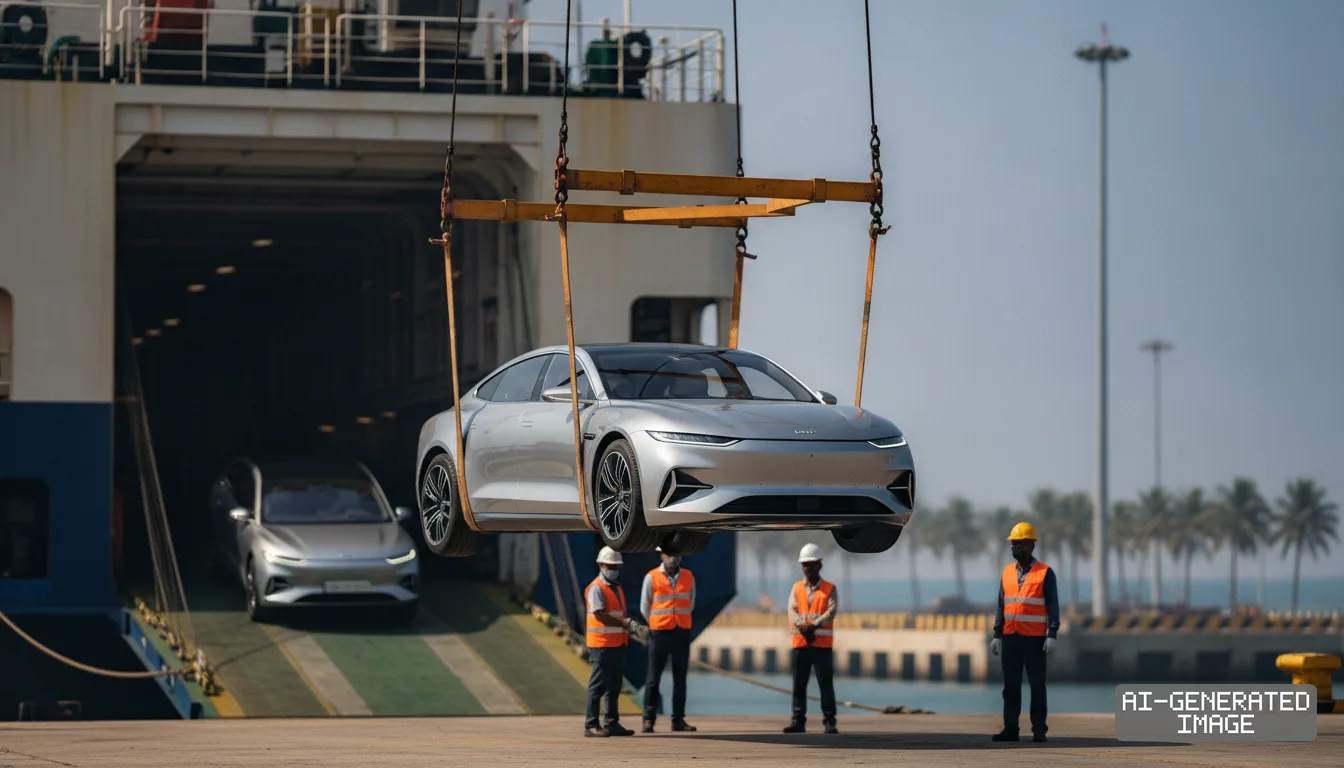
BYD confirmed Nov. 17, 2026, the Indian rollout of its luxury Denza sub-brand, introducing two fully imported battery electric models starting at ₹9,000,000 ($95,800) to contest the high-end vehicle market.
The move marks the formal Indian debut of Denza with two flagship nameplates, the D9 passenger van and the Z9 GT shooting brake. Both vehicles arrive as completely built-up units shipped directly from manufacturing facilities in China.
Federal customs rules impose a 100% tariff on imported passenger cars with an assessment value above $40,000. That duty lifts the ex-showroom price of the Z9 GT to ₹15,680,000 ($166,900), placing Denza in an elite band that forms barely 1% of India's annual 4.2 million passenger vehicle sales.
The seven-seat Denza D9 arrives in a single front-wheel-drive specification. It carries a 115.07-kilowatt-hour second-generation lithium iron phosphate Blade battery engineered by BYD, generating 340 kilowatts (462 metric horsepower) and 365 newton-meters of torque.
The vehicle delivers an operating range of 730 kilometers under the New European Driving Cycle standard, the company said. It accelerates from zero to 100 kilometers per hour in 8.5 seconds, using second-row captain chairs with ten-way power adjustments to draw executive buyers.
The Z9 GT shooting brake targets performance buyers with an all-wheel-drive layout powered by three electric motors. Built on BYD's proprietary e³ platform, the setup generates a combined output of 850 kilowatts (1,156 metric horsepower) and 1,210 newton-meters of torque.
That powertrain draws electricity from a 122.49-kilowatt-hour Blade battery pack, Denza said. It propels the five-seat wagon from zero to 100 kilometers per hour in 2.7 seconds, with an official top speed capped at 270 kilometers per hour and an NEDC range of 670 kilometers.
The luxury brand began taking customer reservations on Nov. 13 with an initial deposit of ₹1,000,000 ($10,640). Sales will flow through dedicated boutique showrooms in Gurugram, Mumbai, Ahmedabad, Bengaluru, Chennai and Hyderabad, operating separately from the established BYD dealer network.
The import approach sidesteps persistent regulatory blocks on Chinese capital in India. Under Press Note 3 rules implemented in April 2020, New Delhi mandates prior government clearance for any foreign direct investment originating from countries that share a land border with India.
Those restrictions halted BYD's earlier proposal to invest $1 billion alongside local partner Megha Engineering and Infrastructures to construct an electric passenger car assembly plant. Without local manufacturing permits, BYD cannot access the lower tariff bands applied to locally assembled kits.
By shifting its product focus to the ultra-luxury bracket, BYD seeks to absorb heavy border taxes through larger gross margins. Vehicles retailing above ₹9,000,000 carry sufficient price elasticity to cover customs overhead that would make mass-market electric vehicles non-viable.
The rollout places competitive pressure on German luxury manufacturers that dominate India's premium automotive volumes. Mercedes-Benz India sells roughly 18,000 luxury vehicles a year, controlling more than 40% of the country's high-end car registrations.
Denza holds historic links to the German manufacturer, having begun operations in 2010 as an equal joint venture between BYD and Mercedes-Benz. BYD raised its equity holding to 90% in 2021 before acquiring the remaining 10% German stake in September 2024 to take full operational control.
Mercedes-Benz sells its electric EQS SUV and combustion-powered V-Class passenger van in the exact price corridors contested by the incoming Denza models. Denza undercuts comparable imported European luxury electric vehicles on horsepower and battery capacity while matching their onboard technology suites.
BMW Group India and Audi also maintain pure-electric nameplates in the ₹10,000,000 to ₹20,000,000 range. Denza's tri-motor performance metrics surpass the baseline specifications offered on the BMW iX and Audi e-tron variants currently sold in Indian dealerships.
Indian domestic carmakers face minimal direct disruption from the launch. Tata Motors controls roughly 70% of the domestic mainstream electric vehicle volume through budget models like the Nexon EV, maintaining products priced well below ₹2,500,000 that do not cross paths with Denza.
Mahindra & Mahindra similarly operates its electric sport utility vehicle programs in entry-level and mid-tier segments. Both domestic manufacturers remain sheltered from Denza by the sheer price gap created by India's steep import tariff wall.
The parent company already markets the Atto 3 sport utility vehicle, the Seal sports sedan and the eMAX 7 electric passenger van in India. Those models run through 24 retail outlets, but their volume expansion remains constrained by foreign assembly caps and customs duties.
Denza plans to establish standalone retail and after-sales service lounges in the six selected metropolitan centers before expanding into secondary wealth hubs. The independent network aims to isolate the luxury marque from perceptions linked to mass-market commercial fleet vehicles.
The introductory retail prices include a complimentary 11-kilowatt alternating-current home wallbox charger, Denza said. The company provides a six-year or 150,000-kilometer general vehicle warranty, paired with an eight-year warranty on the high-voltage Blade battery assembly.
The launch filing does not state customer delivery dates for the initial vehicle batch. Denza has not published the total annual import quota allocated to its Indian retail network, leaving supply volume limits unconfirmed.
Authorized dealerships across the six metropolitan hubs will begin customer test drives in January 2027. State transport authorities in Maharashtra and Delhi are scheduled to complete local type-approval registration reviews for both variants before commercial handovers proceed.
Impact map
How this development propagates across the region and out to global buyers.
| Event | Korea | China | Japan | Global impact |
|---|---|---|---|---|
| Denza India CBU launch | No battery cell exposure as Denza uses proprietary BYD LFP Blade cells | BYD secures high-margin export outlet for premium EVs, absorbing 100% Indian duties | Japanese luxury imports face direct spec competition against D9 executive seating | Western luxury brands face margin pressure in India as Chinese EVs bypass FDI blocks via CBU niche |
| Denza India CBU launch | No battery cell exposure as Denza uses proprietary BYD LFP Blade cells | BYD secures high-margin export outlet for premium EVs, absorbing 100% Indian duties | Japanese luxury imports face direct spec competition against D9 executive seating | Western luxury brands face margin pressure in India as Chinese EVs bypass FDI blocks via CBU niche |
In this story
- Companies
- BYDDenza
- Tickers
- 002594.SZ1211.HK
- Exposed
- Mercedes-BenzBMWTata Motors
- Policy
- TariffsInvestment Screening
- Impact
- PricingSupply ChainOrder Book
Track every Tariffs development → Track every Investment Screening development →
Related briefings
- BYD secures Australian import approval for Ti 7 hybrid SUV Also on Tata Motors, BYD, Pricing
- BYD sets Denza N8 pre-orders to target luxury EV market in China Also on Denza, Mercedes-Benz, BMW
- BYD launches 130 kWh LFP pack in Denza SUV with 960 km range Also on Denza, BYD, Tariffs
- BYD Denza N8 debuts Nov. 12 with 1,003-kilometer battery range Also on Denza, BYD, Pricing
Sources
Reporting
Confidence: medium — how we grade this
The documents behind this briefing are linked above. East Asia Brief produces its English text with AI assistance under human editorial review, and does not translate or republish other outlets' articles. See our methodology and AI policy. Spotted an error? Tell us.
The Morning Brief
What changed in Korean, Chinese and Japanese industry overnight — and what it means for your supply chain. One email, weekday mornings, US time. Free.
The Morning Brief is in preparation. Leave your address and we will write to you once — when the first issue is ready. Nothing before that.