Hyundai tests used EV battery storage on South Korea's grid
A five-company consortium linking retired vehicle packs to industrial chargers targets electricity cost cuts and mineral reclamation across domestic assembly networks.
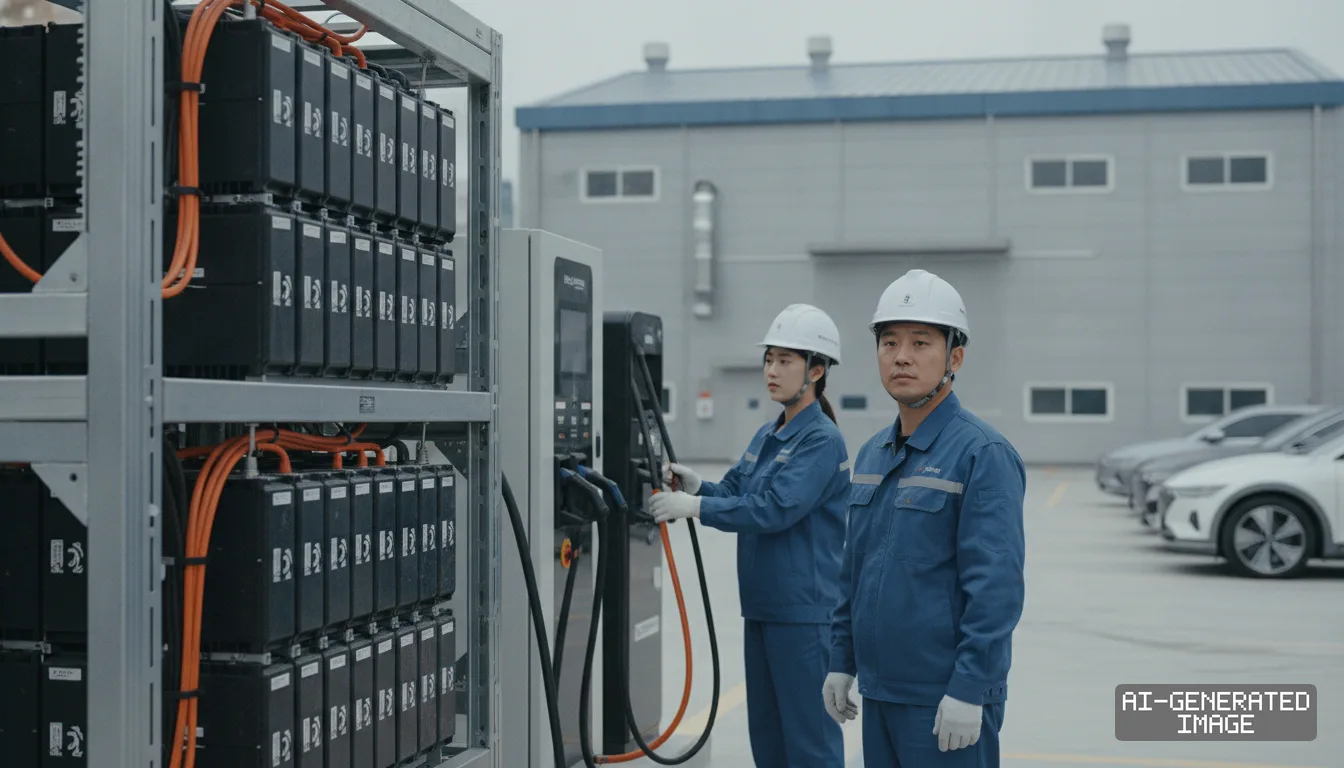
Hyundai Motor Group and LG Energy Solution initiated field demonstrations on Sept. 25 of a 200-kilowatt-hour energy storage system built from retired electric vehicle battery packs.
The project links used automotive packs directly to fast-charging infrastructure at an industrial facility in Hwaseong, South Korea. It marks the country's first live grid trial using standardized packs recovered from Hyundai's Electric-Global Modular Platform.
The 200-kilowatt-hour installation operates alongside commercial direct-current chargers. The unit draws power during off-peak hours when wholesale tariffs drop, storing electricity to supply fast chargers during expensive peak-demand periods.
Automotive lithium-ion batteries are typically retired from passenger vehicles when usable capacity declines to between 70% and 80%. While insufficient for driving range, the modules retain enough density for stationary storage applications.
Five companies share operational roles across the demonstration site. Hyundai Motor and affiliate Kia supply the retired E-GMP modules and oversee business model commercialization.
LG Energy Solution manufactures the storage hardware using the recovered packs. The cell producer also runs proprietary diagnostic and state-of-health management software to evaluate system safety and degradation rates.
Hyundai Engineering evaluates financial feasibility for wider deployment across public charging stations. On July 31, the engineering unit formally incorporated second-life battery systems into its long-term asset management strategy.
Wonik PNE hosts the equipment and runs daily site operations. The charging equipment manufacturer tests charging-control algorithms to balance thermal behavior and grid power draw under heavy utilization.
The trial expands on industrial energy storage pilots Hyundai launched under a regulatory exemption in Dec. 2020. Those earlier projects included a 2-megawatt-hour system at Hyundai's Ulsan assembly complex and a 300-kilowatt-hour solar-tied installation at OCI's chemical plant in Gongju.
Hyundai also built a 400-kilowatt-hour storage facility at the Busan Eco Delta Smart City demonstration district in April 2022. The new Hwaseong site shifts testing from isolated industrial microgrids to high-demand vehicle charging hubs.
Industrial power users in South Korea face steep peak-hour utility surcharges. By charging batteries during overnight surplus hours, fleet operators and charging hubs can reduce electricity procurement expenses while easing substation transformer strain.
Securing a commercial pathway for secondary battery use delays expensive material recycling. Extending pack life spans preserves embedded nickel, cobalt and lithium before chemical hydrometallurgical recycling becomes strictly necessary.
South Korean battery manufacturers face rising international mandates requiring closed-loop mineral tracking. European Union battery rules mandate minimum recycled content thresholds starting later this decade.
Secondary storage systems help automakers establish verifiable chain-of-custody data for retired packs. Tracking cell health through second-life deployment improves residual value appraisals before end-of-life smelting and mineral extraction.
Hardware standardization has historically limited the commercial viability of used vehicle batteries. Disassembling non-uniform packs into individual modules often cost more than purchasing brand-new grid-scale storage cells.
Hyundai's E-GMP platform eliminates structural variation across battery enclosures. Standardized module dimensions and busbar connections allow LG Energy Solution to assemble storage racks without redesigning external casing.
The demonstration tests whether standardized second-life battery manufacturing can undercut virgin cell costs. Lower pack-rebuilding expenses remain critical for private charging operators operating on thin margins.
Safety validation forms the central focus of the engineering tests. LG Energy Solution monitors internal cell impedance to catch thermal runaway risks before packs undergo rapid high-current cycling.
Operating algorithms adjust charge rates automatically when individual module temperatures deviate from baseline thresholds. This continuous monitoring prevents uneven aging across modules salvaged from different vehicle duty cycles.
Project partners have not published data on expected power cost savings or peak load reduction ratios. South Korean regulatory registries show no separate filing for the Sept. 25 operational demonstration beyond the Sept. 10 consortium launch.
The consortium plans to run operational stress tests through early 2027 to establish baseline longevity metrics. Regulators will review the performance and fire-safety findings before establishing formal national certification guidelines for secondary battery installations.
Impact map
How this development propagates across the region and out to global buyers.
| Event | Korea | China | Japan | Global impact |
|---|---|---|---|---|
| Used EV battery grid storage demonstration | Hyundai, LG Energy Solution and Wonik PNE validate 200-kWh peak-shaving unit at Hwaseong | Second-life battery export margins face pressure as Korean automakers build domestic reuse models | Japanese power equipment vendors face competing second-life battery grid architectures in Asia | Automakers extend cell life cycles to delay high-cost hydrometallurgical recycling and lower mineral exposure |
In this story
- Companies
- Hyundai MotorKiaLG Energy SolutionHyundai EngineeringWonik PNE
- Tickers
- 005380.KS000270.KS373220.KS131390.KS
- Exposed
- OCI Holdings
- Policy
- SubsidiesEconomic Security
- Impact
- Supply ChainCost StructureCapex
Track every Subsidies development → Track every Economic Security development →
Related briefings
- Hyundai, LG Energy launch used battery storage pilot for EVs Also on Hyundai Engineering, Wonik PNE, Kia
- Korea Links Commercial Electric Van Grants to Battery Recyclability Also on Kia, Hyundai Motor, LG Energy Solution
- Chinese EVs capture 35% Korea market share under 8% tariff Also on Hyundai Motor, LG Energy Solution, Cost Structure
- Chinese LiDAR makers sweep South Korea robotaxi trial fleets in 2026 Also on Hyundai Motor, Cost Structure
Sources
Reporting
Confidence: medium — how we grade this
The documents behind this briefing are linked above. East Asia Brief produces its English text with AI assistance under human editorial review, and does not translate or republish other outlets' articles. See our methodology and AI policy. Spotted an error? Tell us.
The Morning Brief
What changed in Korean, Chinese and Japanese industry overnight — and what it means for your supply chain. One email, weekday mornings, US time. Free.
The Morning Brief is in preparation. Leave your address and we will write to you once — when the first issue is ready. Nothing before that.