HD Hyundai Heavy union stages strike over 30% profit sharing
The four-hour walkout threatens delivery schedules at Ulsan docks running above 100% capacity with four years of orders as Seoul rules profit payouts non-negotiable.
The union at HD Hyundai Heavy Industries staged a four-hour partial strike on Sept. 11, 2026, demanding that the shipbuilder distribute 30% of its operating profit to employees.
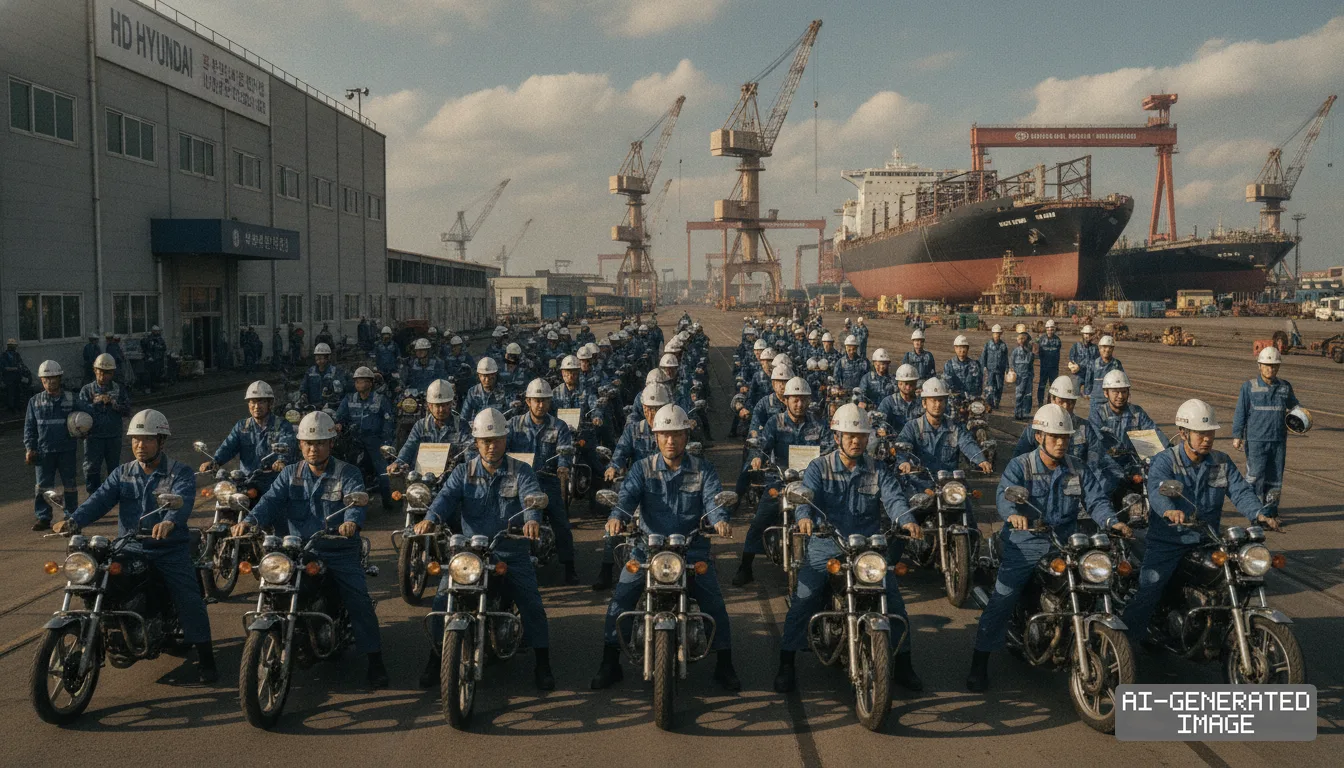
The walkout ran from 1:00 p.m. to 5:00 p.m. across all union members at the Ulsan yard. Workers gathered outside the union hall before staging a motorcycle rally across production roads.
The stoppage hit docks that operated above 100% capacity during the first half of 2026. South Korea's major shipbuilders hold order backlogs covering between three and four years of continuous construction.
Ship construction relies on sequential block assembly, where delays at early stages quickly cascade into dock bottlenecks. Unplanned work halts expose shipyards to heavy liquidated damages under standard vessel delivery contracts.
The action marked the first general membership strike at the shipbuilder during the 2026 wage round. Union leaders and shop stewards had staged narrower walkouts starting Sept. 2, union records showed.
Union delegates established the wage demands during an extraordinary congress on May 12, 2026. The platform called for a monthly base salary increase of 149,600 won ($112), excluding seniority pay increments.
The union demanded a 100% bonus increase alongside a 2 billion won ($1.5 million) corporate endowment. The funds would finance operating expenses for labor resort facilities, the union bargaining agenda stated.
The central dispute remains the union's insistence on claiming at least 30% of operating profit. Labor negotiators want that corporate income distributed directly to production workers as annual performance bonuses.
South Korea's Ministry of Employment and Labor issued an administrative directive on Sept. 4, 2026. The notice clarified legal boundaries for labor disputes over performance pay and managerial decisions.
Demands that bind performance bonuses to fixed percentages of corporate earnings do not qualify as mandatory collective bargaining subjects, the ministry ruled. Labor groups cannot legally strike over non-mandatory demands, the document stated.
The ministry stated that rigid profit formulas infringe on managerial autonomy and third-party property rights. Protection under collective bargaining law cannot extend to demands that restrict corporate investment discretion, the directive said.
Employment and Labor Minister Kim Young-hoon warned that walkouts organized around fixed profit distributions violate statutory limits. The ministry instructed local labor offices to handle disputes under those revised guidelines.
HD Hyundai Heavy Industries submitted its third wage counterproposal during the 20th formal bargaining round on Sept. 10, 2026. Company negotiators sought a settlement before the upcoming national autumn holidays.
Management offered a monthly base wage increase of 110,000 won ($82), which included a 47,000 won seniority increment. The offer also included a cash incentive bonus of 10 million won ($7,500).
The company package added performance pay equal to 200% of basic salary and 500,000 won in gift certificates. Union leaders rejected the proposal immediately, calling the terms inadequate for members.
The union had established its mandate after staging a strike authorization ballot from Aug. 25 to Aug. 27, 2026. Rank-and-file workers approved industrial action following the collapse of government-sponsored labor arbitration.
The National Labor Relations Commission halted mediation on Aug. 24, 2026, after two formal sessions failed to bridge differences. That procedural ruling granted the union legal authority to schedule strikes.
The labor dispute surfaces as South Korean yards benefit from high contract prices for liquefied natural gas carriers. Shipbuilders returned to operating profitability after a multi-year downturn that depleted shipyard labor pools.
High yard utilization leaves little schedule flexibility when work halts interrupt crane movements and hull assembly. Commercial ship contracts impose daily penalty fees on yards that fail to deliver vessels on agreed calendar dates.
Late-delivery damages accumulate rapidly once grace periods expire, cutting directly into shipyard operating margins. Chronic assembly delays also risk contract cancellations from shipowners operating under strict maritime charter commitments.
HD Hyundai Heavy Industries said essential operations continued without disruption during the four-hour action on Sept. 11. Supervisory staff and non-striking personnel maintained basic production lines throughout the afternoon, company representatives said.
The shipbuilder did not submit a production suspension filing to the Financial Supervisory Service following the strike. South Korean exchange regulations mandate immediate public disclosure only when labor stoppages bring operations to a complete standstill.
The shipbuilder has not disclosed the number of vessels delayed by the four-hour walkout, and no public filing on the electronic disclosure system details the financial impact of the lost operating hours.
The union announced a wider calendar of industrial action across the Ulsan yard for the coming week. Members will stage four-hour partial strikes on Sept. 14 and Sept. 15, union notices stated.
The stoppage will expand to seven hours each day from Sept. 16 through Sept. 18. Both sides scheduled further bargaining sessions to discuss the wage package before the holiday break.
Impact map
How this development propagates across the region and out to global buyers.
| Event | Korea | China | Japan | Global impact |
|---|---|---|---|---|
| HD Hyundai Heavy partial strike | HD Hyundai Heavy faces dock bottleneck, >100% utilization leaves no buffer | CSSC yards gain slot competitiveness on potential Korean delivery slips | Imabari and JMU maintain full order books with no direct cargo diversion | Shipowners face delivery delay risk, daily liquidated damages triggered if walkouts widen |
In this story
- Companies
- HD Hyundai Heavy Industries
- Tickers
- 329180.KS
- Exposed
- HD Korea Shipbuilding & Offshore EngineeringHanwha OceanSamsung Heavy Industries
- Policy
- Industrial Policy
- Impact
- Order BookSupply ChainCost Structure
Track every Industrial Policy development →
Related briefings
- HD Hyundai Heavy union launches partial strike as shipyard wage talks break down Also on HD Korea Shipbuilding & Offshore Engineering, Samsung Heavy Industries, Industrial Policy
- HD Hyundai and Hanwha Ocean Lock In LNG Carrier Berth Slots Through 2029 Also on HD Korea Shipbuilding & Offshore Engineering, Samsung Heavy Industries, HD Hyundai Heavy Industries
- KOGAS Plans LNG Carrier Tender to Test Domestic Tank Design Also on HD Korea Shipbuilding & Offshore Engineering, Samsung Heavy Industries, Hanwha Ocean
- Shipyard labor policies diverge as Korea, Japan, and China tackle yard manning gaps Also on HD Korea Shipbuilding & Offshore Engineering, Samsung Heavy Industries, Hanwha Ocean
Sources
Primary documents
Reporting
Confidence: high — how we grade this
The documents behind this briefing are linked above. East Asia Brief produces its English text with AI assistance under human editorial review, and does not translate or republish other outlets' articles. See our methodology and AI policy. Spotted an error? Tell us.
The Morning Brief
What changed in Korean, Chinese and Japanese industry overnight — and what it means for your supply chain. One email, weekday mornings, US time. Free.
The first issue goes out shortly. Sign up now and you will not miss it.