HD Hyundai and KR launch 3D ship design approval system in Ulsan
The initiative eliminates redundant two-dimensional drafting from vessel certification, linking digital models directly to classification checks to compress delivery lead times.
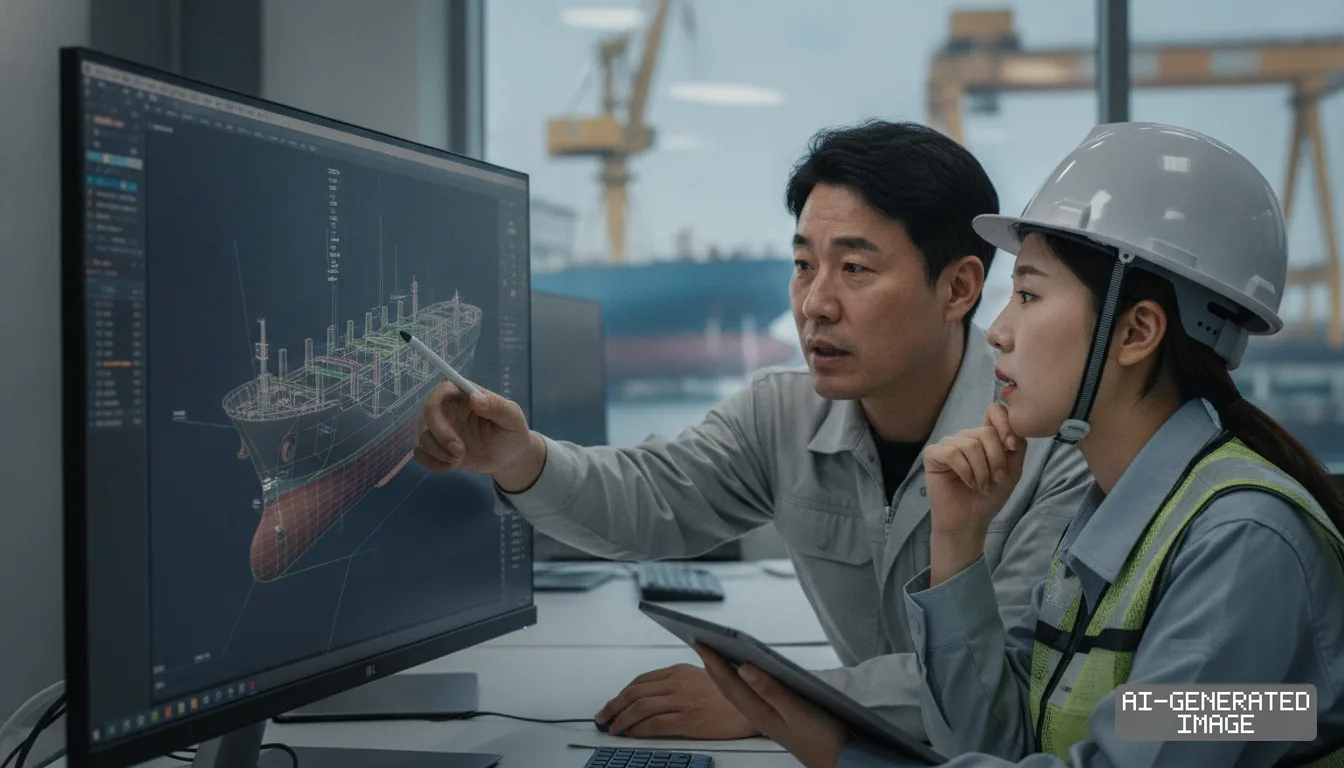
HD Hyundai Heavy Industries and classification society Korean Register began joint technical work Sept. 21 to establish a three-dimensional digital approval process for commercial ship structural design.
The project establishes a direct review system for ship classification. It allows marine surveyors to audit native 3D computer models rather than flattened paper blueprints.
Neither organization published a capital expenditure budget for the project. HD Hyundai Heavy Industries operates nine drydocks in Ulsan and accounts for roughly 15% of global shipbuilding output by volume.
Shipbuilders currently construct commercial vessels using advanced 3D computer-aided design software. Maritime safety regulations still require shipyards to convert those 3D structural datasets into 2D engineering sheets for plan approval.
That translation creates duplicate administrative labor for shipyard drafting departments. Converting complex curved hull forms into flat drawings introduces drafting backlogs and increases the probability of human transcription errors.
The joint initiative will replace paper submissions with direct digital model exchange. The partners call the technical framework 3D Model-Based Approval, or 3DMBA.
Under the agreement, HD Hyundai Heavy Industries will supply 3D structural design models and engineering datasets from active vessel construction projects. The shipbuilder will also host pilot verification exercises at its Ulsan yard.
Korean Register will define the technical scope, inspection items and structural criteria required for digital approval. The classification society will also develop a dedicated digital software environment to audit structural rule compliance.
The technical protocols will incorporate feedback from shipyard engineers throughout the live testing cycle. Both parties intend to refine the software workflow before applying it across broader commercial shipbuilding contracts.
Modern 3D models have already become the standard baseline across yard engineering units, Ryu Hong-ryeol, vice president of HD Hyundai Heavy Industries, said. The current regulatory framework still requires separate drawing generation, he said.
The joint development program marks the beginning of an environment where engineering data feeds directly into regulatory approvals, Ryu said. The change will remove duplicate drafting across active project teams, he said.
Transferring the baseline of structural plan approval from 2D blueprints to 3D digital models represents a major change for marine classification, Kim Dae-heon, executive vice president of Korean Register, said.
The classification society aims to build an approval process using actual production data to lift engineering efficiency across both shipyards and regulatory bodies, Kim said.
The technical collaboration originated from a memorandum of understanding signed Sept. 15 at the Gastech 2026 conference in Bangkok, Thailand. Korean Register formally released details of the pact Sept. 16 before joint development began.
Classification societies verify structural integrity by checking steel plate thickness, longitudinal framing and stress distribution against harmonized Common Structural Rules. That process traditionally requires dozens of distinct 2D structural arrangement drawings for every hull module.
Compressing drawing approval schedules has become critical as South Korean yards manage four-year order backlogs dominated by complex liquefied natural gas carriers and alternative-fuel container vessels.
HD Hyundai Heavy Industries has sought to shorten production cycles across its Ulsan facilities by expanding digital manufacturing under its shipyard modernization program.
Korean Register has previously developed direct data interfaces between commercial structural design programs such as NAPA Steel and its proprietary SeaTrust-HullScan engineering assessment tool.
The new system expands that technical capability by formalizing regulatory acceptance of native 3D geometry rather than using digital files solely as an internal calculating tool.
The companies agreed to begin pilot verification on active vessel projects immediately following the Bangkok signing. They plan to expand the workflow to gas carriers and container vessels after proving structural accuracy.
The announcement does not state the development budget, software integration platforms or the specific hull number assigned for the initial pilot run.
Impact map
How this development propagates across the region and out to global buyers.
| Event | Korea | China | Japan | Global impact |
|---|---|---|---|---|
| 3D Model-Based Approval process | HD Hyundai Heavy Industries eliminates 2D drawing conversions across active Ulsan commercial building slots | State shipbuilders under CSSC remain on dual 2D-3D submission protocols with local classification societies | ClassNK pilots independent 3D data exchange standards with domestic commercial shipbuilders | International shipowners face shortened engineering review windows on dual-fuel gas carrier deliveries |
In this story
- Companies
- HD Hyundai Heavy IndustriesKorean Register
- Tickers
- 329180.KS
- Policy
- Economic Security
- Impact
- Cost StructureCapexSupply Chain
Track every Economic Security development →
Related briefings
- HD Hyundai agrees to develop wind-assisted 174K LNG carrier Also on Korean Register, HD Hyundai Heavy Industries
- Korean shipyards pitch hybrid electric frigates across Southeast Asia Also on HD Hyundai Heavy Industries, Cost Structure
- Pentagon Inspects Hanwha Ocean Docks for US Frigate Programs Also on HD Hyundai Heavy Industries
- HD Hyundai wins DNV approval on 271,000 cbm LNG hull design Also on HD Hyundai Heavy Industries
Sources
Reporting
Confidence: medium — how we grade this
The documents behind this briefing are linked above. East Asia Brief produces its English text with AI assistance under human editorial review, and does not translate or republish other outlets' articles. See our methodology and AI policy. Spotted an error? Tell us.
The Morning Brief
What changed in Korean, Chinese and Japanese industry overnight — and what it means for your supply chain. One email, weekday mornings, US time. Free.
The Morning Brief is in preparation. Leave your address and we will write to you once — when the first issue is ready. Nothing before that.