HD Hyundai agrees to develop wind-assisted 174K LNG carrier
A four-party pact signed in Bangkok pairs rigid WindWings sails with a forward-deckhouse hull to cut fuel burn ahead of 2027 global maritime carbon rules.
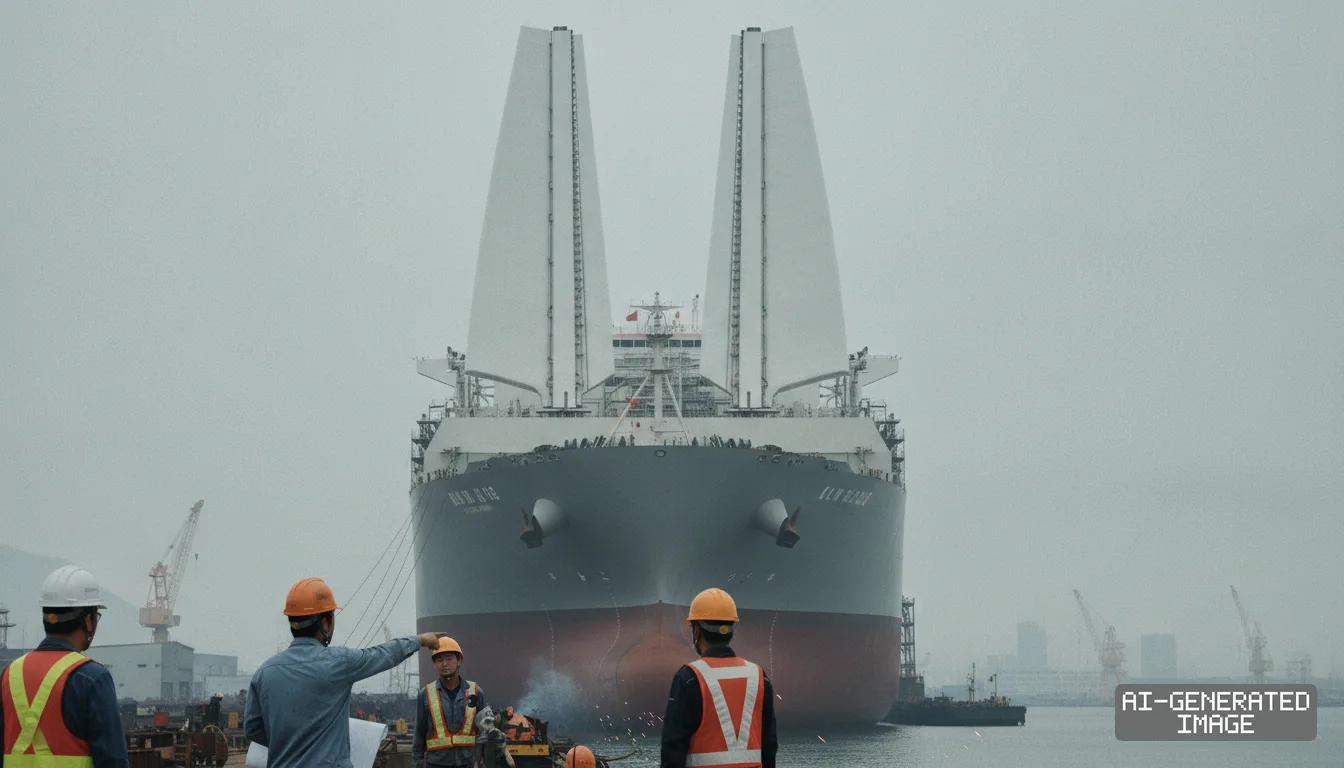
HD Hyundai Heavy Industries agreed Sept. 15, 2026 to develop a 174,000-cubic-meter liquefied natural gas carrier fitted with rigid wing sails alongside British engineering firm BAR Technologies.
The four-party memorandum of understanding, signed at the Gastech 2026 conference in Bangkok, includes the Korean Register and the Liberian International Ship & Corporate Registry. The partners aim to secure Approval in Principle for the vessel design.
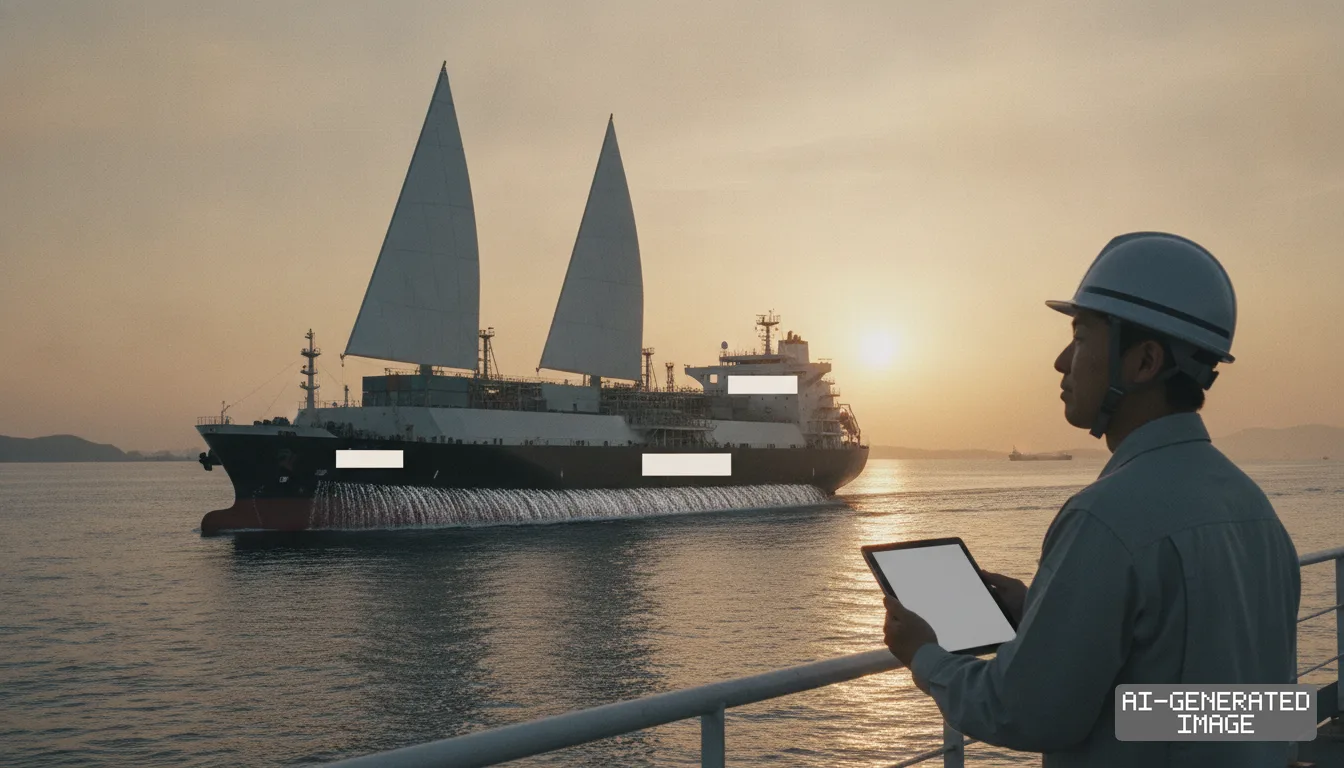
Under the project layout, the 174,000-cubic-meter vessel will use a forward accommodation arrangement. Placing crew quarters at the bow clears the upper deck, creating unobstructed space to install multiple mechanical wing sails above cargo tanks.
The system uses BAR Technologies' proprietary WindWings technology, which mounts large composite wing sails directly on the hull. The sails pivot automatically to generate aerodynamic lift from ocean crosswinds, providing supplementary forward thrust.
Auxiliary wind propulsion reduces mechanical drag on the main dual-fuel engines. That lower engine workload cuts bunker fuel consumption and trims greenhouse gas emissions without sacrificing scheduled operating speeds on long ocean passages.
BAR Technologies currently operates 23 WindWings units across 10 commercial bulk carriers and tankers. Those operational wings generate combined carbon dioxide savings of roughly 100 metric tons per day, Chief Executive John Cooper said.
HD Hyundai Heavy Industries leads naval architecture review and basic hull engineering under the agreement. The shipyard will determine structural deck reinforcements and examine how the sails interact aerodynamically with standard cargo containment systems.
BAR Technologies will provide technical data covering sail dimensions, structural loads, operational control concepts and anticipated fuel efficiency gains. The British engineering specialist developed the wing system after testing prototypes on transoceanic dry bulk routes.
The classification societies will evaluate vessel seaworthiness and fire safety under international maritime conventions. The Korean Register and the Liberian registry plan to review operational safety risks before granting formal technical design certification.
Shipowners face mounting pressure from the International Maritime Organization to eliminate fleet emissions by 2050. The United Nations maritime agency will enforce tighter carbon intensity benchmarks and evaluate mandatory economic measures on marine fuels starting in 2027.
Traditional gas carriers face compliance hurdles as Carbon Intensity Indicator rules tighten each year. While liquefied natural gas burns cleaner than heavy fuel oil, high transit speeds and auxiliary power demands can depress efficiency ratings on long-haul voyages.
Adding auxiliary wind thrust allows gas carriers to burn less cargo boil-off gas and marine diesel. For charterers and fleet operators, preserving higher efficiency grades helps avoid operational speed limits and contractual penalties under corporate climate mandates.
Hong-ryul Ryu, chief technology officer at HD Hyundai Heavy Industries, said the builder has steadily modified hull forms to strengthen the efficiency of its gas carriers. Developing forward-deckhouse layouts allows yards to deploy wind propulsion equipment cleanly.
The agreement deepens earlier commercial collaboration between the South Korean shipbuilder and the British wind engineering firm. The two companies signed an initial cooperation framework on June 2, 2026 to evaluate wind-assisted systems on merchant hulls.
South Korean shipbuilders are also testing domestic wing designs to avoid dependence on foreign suppliers. HD Korea Shipbuilding & Offshore Engineering installed its proprietary Hi-WING rigid sail on an HMM 50,000-deadweight-ton product tanker on Jan. 12, 2026.
That earlier trial, backed by a national research grant, evaluated mechanical deployment in commercial tanker operations. Combining foreign-licensed hardware with domestic wing programs gives the parent group parallel development tracks for varied vessel segments.
The Bangkok agreement moves the forward-deckhouse gas carrier concept closer to commercial yard availability. Lloyd's Register previously issued a drawing appraisal and basic approval for HD Hyundai's bow-accommodation gas carrier platform during industry talks in September 2025.
Integrating rigid sails on gas carriers requires solving distinct cryogenic operating challenges. Naval architects must ensure that aerofoils do not obstruct cargo loading manifolds, vent masts or mandatory bridge sightlines across open sea lanes.
The Korean Register said technical appraisals will focus on structural hull stresses caused by wind forces transferred through deck foundations. Classification inspectors must also assess automated wing feathering systems during sudden squalls and tropical storms.
The four parties did not disclose a commercial order volume, shipyard delivery schedule or financial contract value for the vessel. The pact remains an engineering joint development program rather than a firm shipbuilding contract from a carrier operator.
The Korean Register and Liberian maritime authorities will complete technical reviews over the coming months to verify compliance with safety codes. The partners expect to finalize the Approval in Principle appraisal before the 2027 regulatory revisions take effect.
Impact map
How this development propagates across the region and out to global buyers.
| Event | Korea | China | Japan | Global impact |
|---|---|---|---|---|
| Wind-assisted LNG carrier development | HD Hyundai Heavy Industries expands green propulsion options for 174K LNG hulls | Hudong-Zhonghua faces intensified eco-efficiency benchmarks in gas carrier export tenders | Imabari Shipbuilding and Mitsui O.S.K. accelerate mechanical sail trials on bulk and gas tonnage | Dual-fuel LNG carrier bunker burn reduced by auxiliary wind lift under 2027 IMO carbon rules |
In this story
- Companies
- HD Hyundai Heavy IndustriesKorean Register
- Tickers
- 329180.KS
- Exposed
- BAR TechnologiesLISCR
- Policy
- Economic Security
- Impact
- Supply ChainCapex
Track every Economic Security development →
Related briefings
- HD Hyundai wins ABS approval for 100MW floating power barge Also on HD Hyundai Heavy Industries
- Asyad Shipping orders two MR product tankers at HD Hyundai Also on HD Hyundai Heavy Industries
- HD Hyundai Heavy commits 1.07 trillion won to power engines Also on HD Hyundai Heavy Industries
- HMM confirms no new tanker order with HD Hyundai on Sept. 9 Also on HD Hyundai Heavy Industries
Sources
Reporting
Confidence: medium — how we grade this
The documents behind this briefing are linked above. East Asia Brief produces its English text with AI assistance under human editorial review, and does not translate or republish other outlets' articles. See our methodology and AI policy. Spotted an error? Tell us.
The Morning Brief
What changed in Korean, Chinese and Japanese industry overnight — and what it means for your supply chain. One email, weekday mornings, US time. Free.
The first issue goes out shortly. Sign up now and you will not miss it.