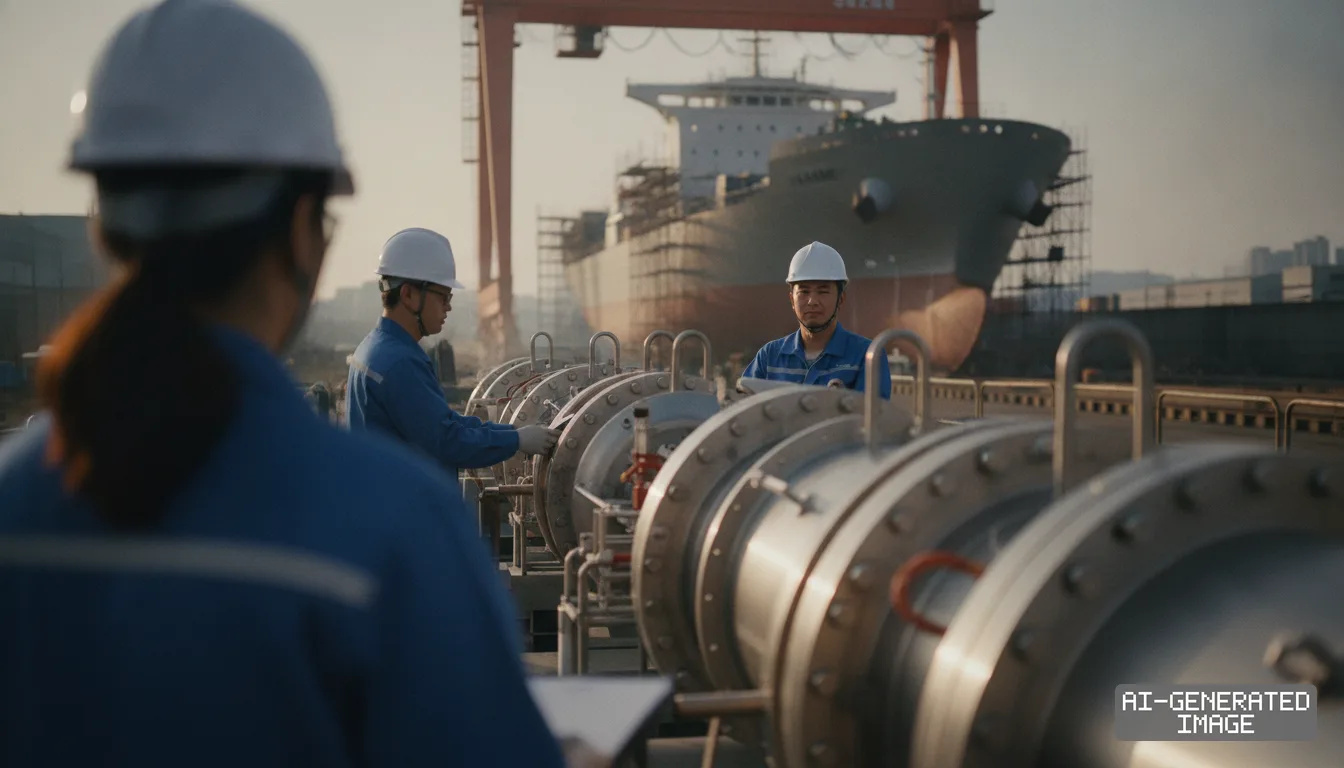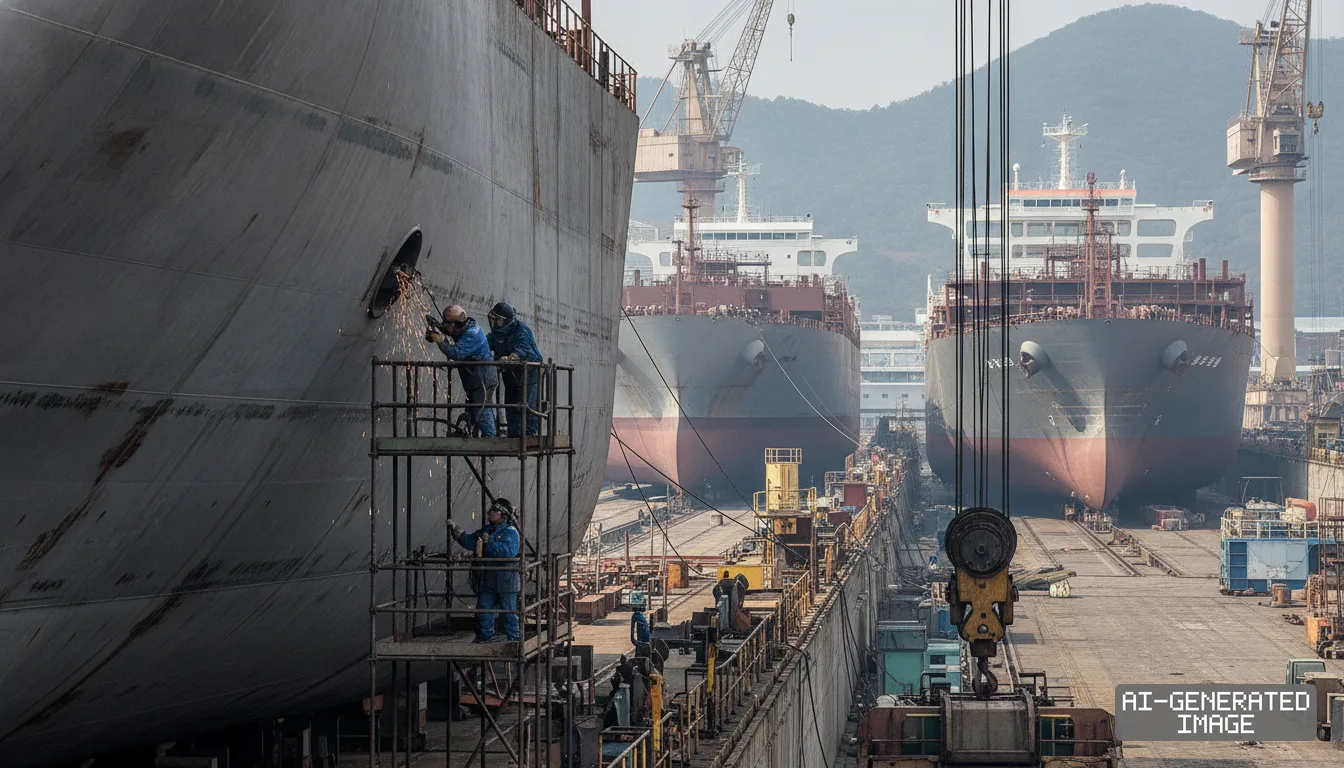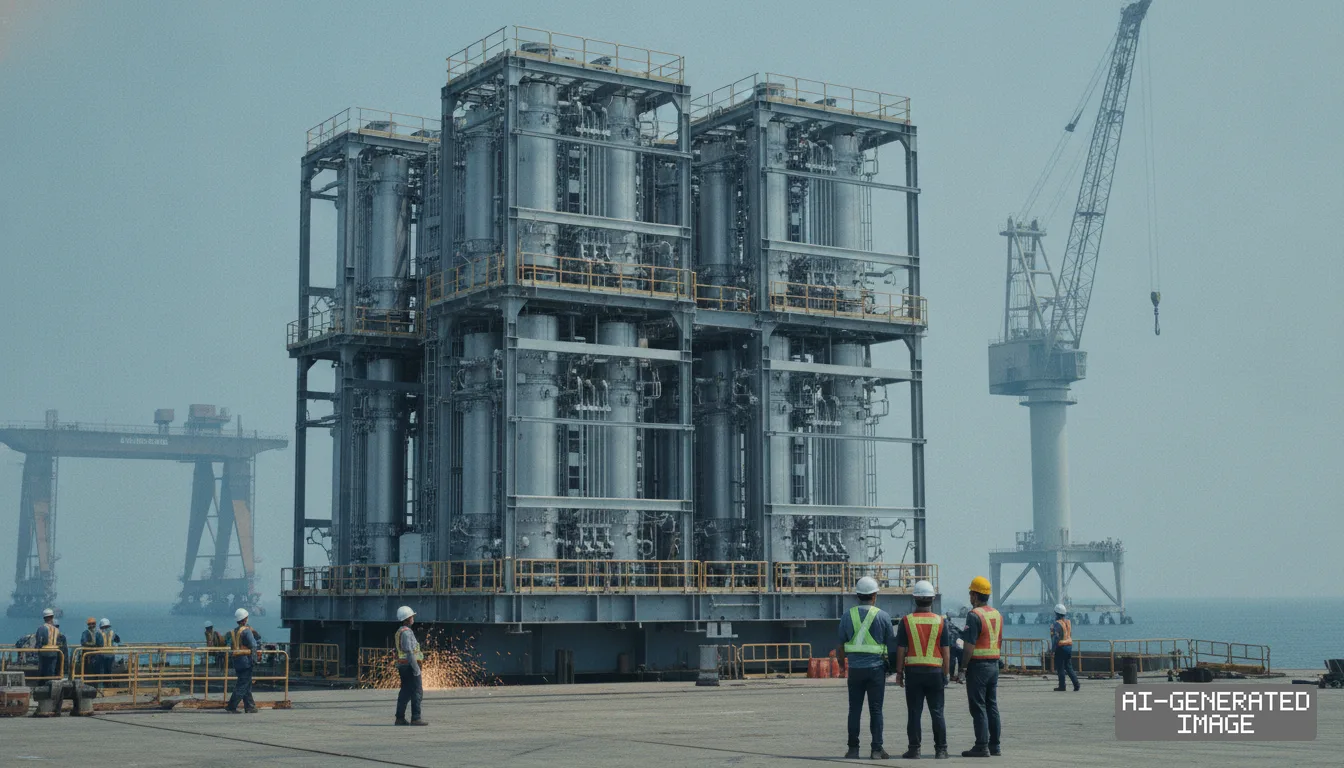
Hanwha Ocean wins $1.13 billion Yang Ming container order
The contract for six 13,000 TEU dual-fuel vessels represents 12.1% of the shipbuilder's 2025 revenue and locks in Geoje delivery slots through late 2029.
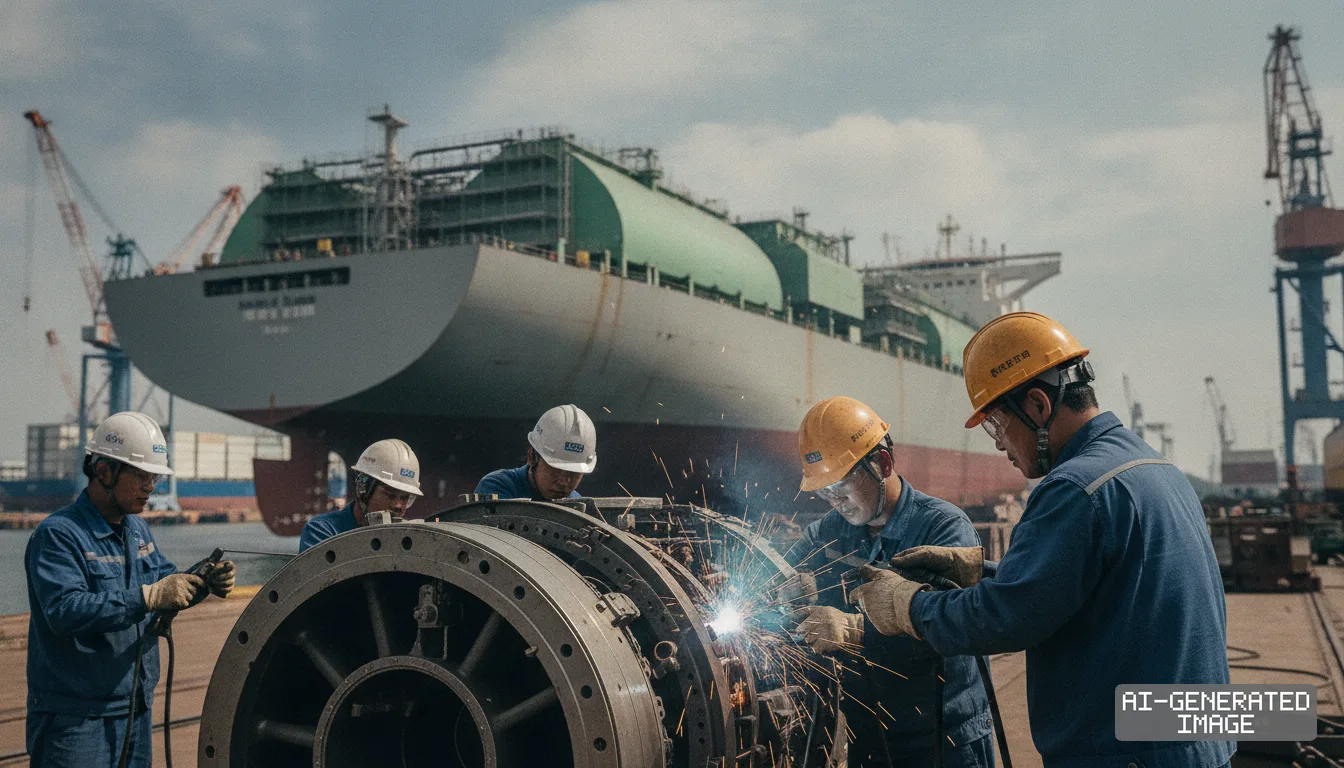
Yang Ming Marine Transport Corporation confirmed operational deployment details on October 7, 2026, for six 13,000 TEU liquefied natural gas dual-fuel container vessels ordered from South Korea's Hanwha Ocean.
The shipbuilding contract carries a total value of 1.5527 trillion won ($1.13 billion). That sum represents 12.1% of the 12.7835 trillion won in consolidated revenue that Hanwha Ocean reported for 2025.
Each container ship features a maximum loading capacity of 13,650 20-foot equivalent units (TEU). Hanwha Ocean will build the entire six-ship series at its primary Geoje shipyard in South Gyeongsang Province.
The vessels use liquefied natural gas (LNG) propulsion alongside conventional bunker fuel, which cuts greenhouse gas emissions by roughly 20%. The design also qualifies as ammonia fuel ready, allowing future conversion to zero-carbon propulsion.
Storage will rely on Type-B cargo tanks operating at a design pressure of 1.0 bar. Hanwha Ocean developed the tank design independently to improve fuel holding stability and safety during cryogenic bunkering.
The fuel tanks use high-manganese steel rather than expensive nickel-alloy steel or aluminum. South Korean steelmaker POSCO commercialized the alloy in 2013, providing mechanical strength and crack resistance at minus 163 degrees Celsius.
Using high-manganese steel lowers tank fabrication expenses while maintaining structural integrity. Hanwha Ocean applies the material across its large dual-fuel commercial vessels to defend production margins on long-cycle building programs.
Energy-saving hardware on the hulls includes aerodynamic wind shields, energy-recovery rudder bulbs and pre-swirl stators that smooth water flow into the propeller. The ships also incorporate high-voltage shore power systems to eliminate port emissions.
The contract marks an immediate follow-on order from the Taiwanese carrier. Yang Ming placed an initial contract with Hanwha Ocean in September 2025 for seven larger 15,880 TEU LNG dual-fuel container ships.
With this latest order, Yang Ming has awarded Hanwha Ocean contracts for 13 dual-fuel container vessels across two consecutive calendar years. The carrier previously sourced tonnage primarily from CSBC Corporation in Taiwan and Imabari Shipbuilding in Japan.
The six new ships form part of Yang Ming's fleet decarbonization program targeting 24 low-emission vessels by 2030. That program includes 18 LNG dual-fuel vessels and six 8,000 TEU ships built to accommodate methanol.
Yang Ming plans to assign the 13,000 TEU series to long-haul east-west liner lanes. Routes include transpacific voyages connecting East Asia to both coasts of North America, South America and the Mediterranean Sea.
The agreement formed part of a two-day order intake of 2.0305 trillion won for the shipbuilder in early September. Hanwha Ocean also booked three very large gas carriers worth 477.8 billion won from an Oceania shipowner.
Hanwha Ocean has focused dock capacity on high-margin gas carriers and dual-fuel vessels. Major South Korean shipyards have raised contract prices as available delivery slots through late 2028 become scarce across the region.
Commercial competition for delivery windows has intensified across Northeast Asia. Chinese shipbuilders hold large container backlogs, but Taiwanese and European liner operators continue to pay premiums for South Korean cryogenic fuel-containment technology.
Shipbuilders face strict emission thresholds established by the International Maritime Organization (IMO). Carriers must replace older conventional diesel vessels to maintain operating permits on major intercontinental freight corridors.
Hanwha Ocean scheduled sequential vessel deliveries to begin in 2028 and conclude by September 30, 2029. Yang Ming also expects to take initial delivery of five earlier 15,500 TEU dual-fuel ships beginning in 2026.
Neither Hanwha Ocean nor Yang Ming published new regulatory filings or amended disclosures on October 7, 2026, leaving contract terms identical to the regulatory filing submitted September 3, 2026.
Contract execution now shifts to engineering procurement and steel cutting at the Geoje facility. Official construction milestones will begin appearing in Hanwha Ocean's quarterly shipbuilding progress reports as dock schedules advance toward 2028.
Impact map
How this development propagates across the region and out to global buyers.
| Event | Korea | China | Japan | Global impact |
|---|---|---|---|---|
| Yang Ming six dual-fuel ship order | Hanwha Ocean books 1.5527T won, filling Geoje dock slots through Sept. 2029 | Chinese yards lose 13,000 TEU series despite lower berth pricing | Imabari Shipbuilding misses repeat business as Yang Ming expands Korean fleet | Global container liner emissions fall as 13,000 TEU dual-fuel ships replace diesel tonnage |
| Yang Ming six dual-fuel ship order | Hanwha Ocean books 1.5527T won, filling Geoje dock slots through Sept. 2029 | Chinese yards lose 13,000 TEU series despite lower berth pricing | Imabari Shipbuilding misses repeat business as Yang Ming expands Korean fleet | Global container liner emissions fall as 13,000 TEU dual-fuel ships replace diesel tonnage |
In this story
- Companies
- Hanwha OceanYang Ming Marine Transport
- Tickers
- 042660.KS2609.TW
- Exposed
- POSCO Holdings
- Policy
- Economic Security
- Impact
- Order BookCapexSupply Chain
Track every Economic Security development →
Related briefings
- Hanwha Ocean Wins $1.2B Yang Ming Order for Six LNG Container Ships Also on Yang Ming Marine Transport, Hanwha Ocean, Order Book
- Hanwha Ocean wins $500 million LNG carrier deal from Zodiac Also on Yang Ming Marine Transport, Hanwha Ocean, Order Book
- Hanwha Ocean faces $1.0 billion arbitration over Arctic LNG Also on Yang Ming Marine Transport, Hanwha Ocean, Order Book
- Asian Shipyard Heavy Plate Costs Diverge as Mills and Builders Clash Over Contract Pricing Also on POSCO Holdings, Hanwha Ocean
Sources
Reporting
Confidence: medium — how we grade this
The documents behind this briefing are linked above. East Asia Brief produces its English text with AI assistance under human editorial review, and does not translate or republish other outlets' articles. See our methodology and AI policy. Spotted an error? Tell us.
The Morning Brief
What changed in Korean, Chinese and Japanese industry overnight — and what it means for your supply chain. One email, weekday mornings, US time. Free.
The Morning Brief is in preparation. Leave your address and we will write to you once — when the first issue is ready. Nothing before that.