Samsung SDI wins Boston Dynamics deal to power electric Atlas robot
The supplier will deliver 70 cylindrical 2170-format cells per 1.3-kilowatt-hour pack, designed for three-minute autonomous battery swaps.
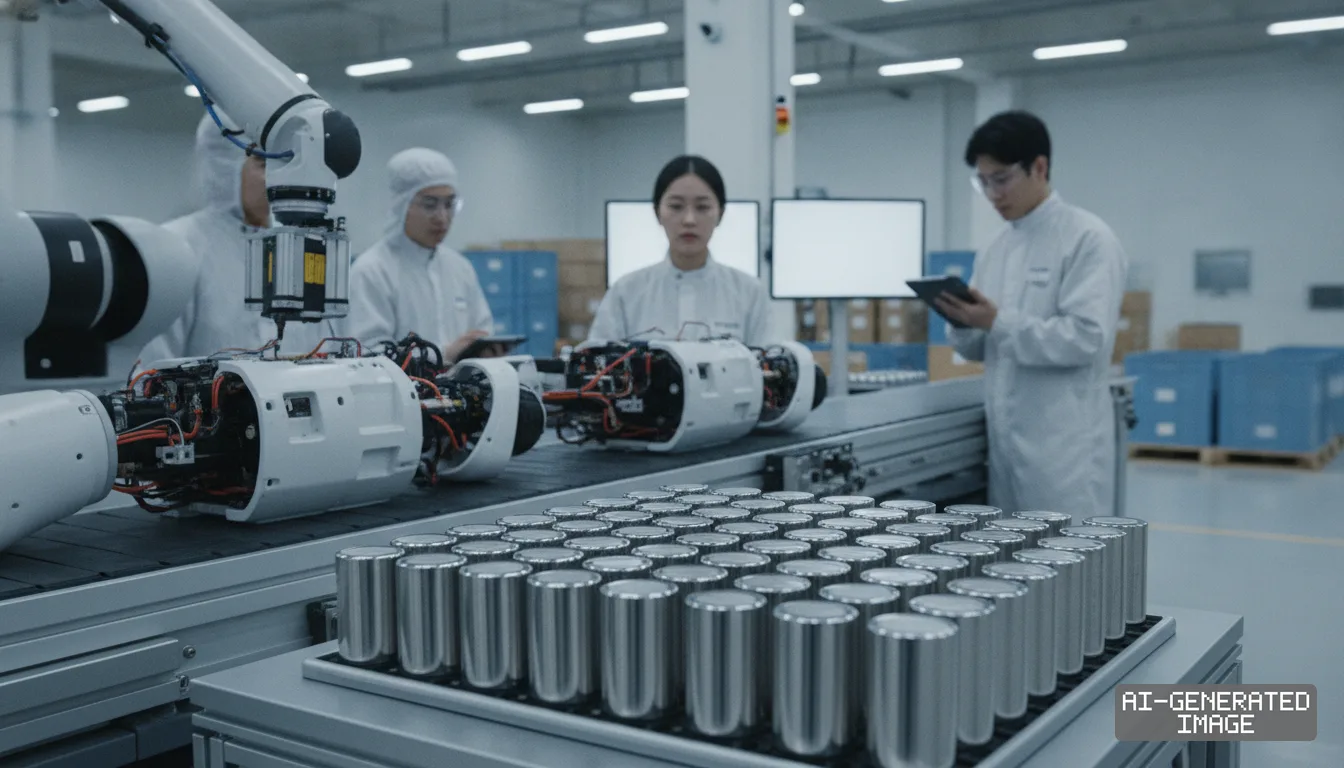
Hyundai Motor affiliate Boston Dynamics selected Samsung SDI on Nov. 7, 2026, to supply 70 cylindrical battery cells for each unit of its next-generation electric Atlas humanoid robot.
Each Atlas unit will carry an energy pack totaling roughly 1.3 kilowatt-hours, built from 2170-format cells. That storage capacity represents about 1.6% of an 84-kilowatt-hour Hyundai Ioniq 5 electric car battery pack.
The 1.3-kilowatt-hour pack provides between two and four hours of continuous operational runtime under typical factory workloads. The stored energy matches the daily power draw of a standard high-efficiency household refrigerator.
The system uses 2170 cylindrical cells — measuring 21 millimeters in diameter and 70 millimeters in height. Each individual cell carries a capacity rating of 5,000 milliampere-hours, engineering specifications showed.
Samsung SDI applies a tabless design to the cells, removing traditional foil tabs to lower internal resistance. The resulting structure enables the high electrical currents required when humanoid actuators make rapid, forceful movements.
Boston Dynamics engineered the humanoid for autonomous power management rather than prolonged tethering. The electric Atlas replaces its own battery pack in less than three minutes, while depleted packs recharge in 90 minutes.
Samsung SDI will supply virtually all initial cell volumes for Atlas development and pilot manufacturing. LG Energy Solution secured qualification as a secondary battery vendor, stepping in when production scales up, procurement records showed.
The battery award forms part of a broader consolidation of Atlas component sourcing across South Korean industrial suppliers. Boston Dynamics has requested domestic vendors to prepare component tooling for 10,000 humanoid robots.
Hyundai Mobis, the parts arm of Hyundai Motor Group, coordinates the hardware network. Hyundai Mobis manufactures all 31 electric joint actuators, which account for roughly 70% of the robot's hardware bill of materials.
Automotive component commonality guides the group's procurement strategy. Between 60% and 70% of the parts in an electric humanoid overlap directly with standard automobile subsystems, including motor controllers, wiring harnesses and optical sensors.
The vendor selections also exclude Chinese battery and motor manufacturers from the Atlas platform. Hyundai Motor prioritized intellectual property protection and export compliance for automated systems bound for North American industrial facilities.
Before deploying Atlas, Hyundai Motor will validate the 2170 cylindrical cells on Spot 2, Boston Dynamics' next-generation quadruped robot. The group already operates 500 first-generation Spot robots for factory inspections.
Pack integration for the Samsung SDI cells on quadruped platforms involves automotive tier-one supplier Valeo Kapec. Secondary battery supplier LG Energy Solution works alongside electronic components maker Powerlogics for modular pack assembly.
Samsung SDI reported the customer acquisition on Oct. 29, 2026, alongside third-quarter operating profit of 408 billion won ($296 million). Executive leadership confirmed securing global humanoid clients, while withholding customer names.
Shipments of specialized cylindrical cells for physical artificial intelligence will increase steadily from next year, the company said. Samsung SDI expects the category to generate over 10% of its cylindrical battery revenue by 2028.
The supply arrangement builds on a February 2025 development agreement between Samsung SDI and Hyundai Motor's Robotics Lab. Early cell iterations underwent mechanical testing on smaller robotic platforms, including the MobED eccentric mobility unit.
Humanoid chassis demand distinct electrical characteristics that differ from passenger electric cars. Real-time vision computing and dynamic balancing require instant current discharge spikes without causing voltage sag across internal computer processors.
Confined physical dimensions inside the humanoid chest cavity also restrict battery pack architecture. Cylindrical formats offer mechanical rigidity and thermal dissipation pathways that fit irregular internal cavities better than flat pouch or prismatic cells.
Boston Dynamics targets commercial mass production of the electric Atlas in 2028. Hyundai Motor Group plans annual production capacity of 30,000 humanoids, deploying initial fleets at its Metaplant America automotive factory in Georgia.
The companies have not published formal contract values, delivery schedules or regulatory exchange filings, citing supply chain non-disclosure agreements. Neither Hyundai Motor nor Samsung SDI has registered a material contract filing on the Korea Exchange.
Supplier purchase orders covering initial production tooling are scheduled to run through late 2027. Full component production lines will transition to active procurement ahead of the 2028 commercial manufacturing date.
Impact map
How this development propagates across the region and out to global buyers.
| Event | Korea | China | Japan | Global impact |
|---|---|---|---|---|
| Atlas humanoid battery supply chain | Samsung SDI secures initial cylindrical run, Hyundai Mobis builds 31 actuators | Chinese cell makers shut out of Hyundai robot platform over data security | Japanese actuator rivals bypassed as Hyundai insources motion systems | Humanoid battery standards converge on 2170 cylindrical form factor |
In this story
- Companies
- Samsung SDIBoston DynamicsHyundai Motor
- Tickers
- 006400.KS005380.KS
- Exposed
- LG Energy SolutionHyundai Mobis
- Policy
- Standards
- Impact
- Supply ChainOrder BookCost Structure
Track every Standards development →
Related briefings
- Boston Dynamics faces US supply curb on Chinese robot parts Also on Boston Dynamics, Hyundai Mobis, Hyundai Motor
- Hyundai Mobis scouts China robotics firms for joint hardware Also on Boston Dynamics, Hyundai Mobis, Cost Structure
- Hyundai accelerates Ulsan EV conversion to balance export lines with global demand Also on Hyundai Mobis, LG Energy Solution, Cost Structure
- UBS maps 87 humanoid robot suppliers across hardware tiers Also on Hyundai Mobis, LG Energy Solution, Cost Structure
Sources
Primary documents
Reporting
Confidence: high — how we grade this
The documents behind this briefing are linked above. East Asia Brief produces its English text with AI assistance under human editorial review, and does not translate or republish other outlets' articles. See our methodology and AI policy. Spotted an error? Tell us.
The Morning Brief
What changed in Korean, Chinese and Japanese industry overnight — and what it means for your supply chain. One email, weekday mornings, US time. Free.
The Morning Brief is in preparation. Leave your address and we will write to you once — when the first issue is ready. Nothing before that.