Keyence deploys edge vision sensors for battery inline inspection
The Osaka automation supplier integrates on-chip classification engines into machine vision hardware to eliminate processing bottlenecks across high-speed battery lines.
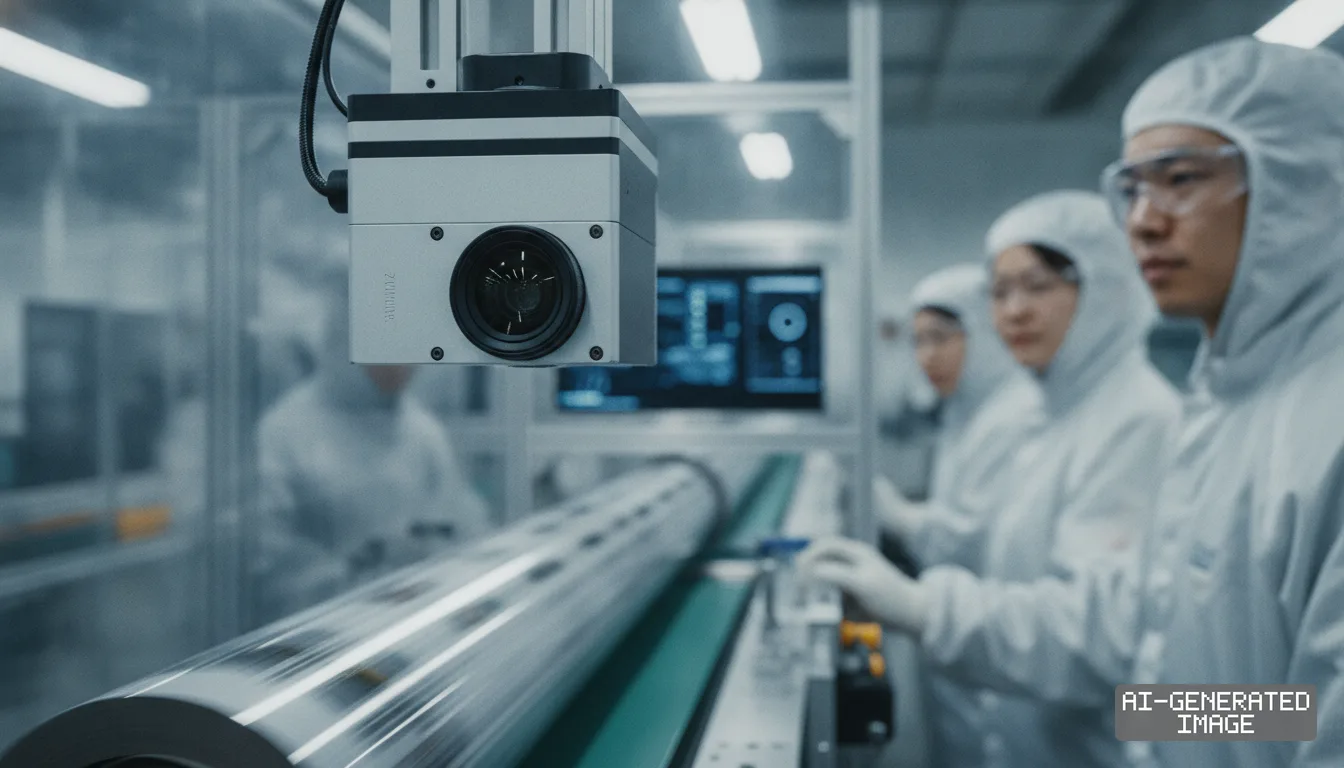
Keyence Corporation has begun commercial deliveries of high-speed machine vision sensors featuring integrated edge artificial intelligence processors designed specifically for automated battery cell and display assembly lines. The Osaka-based factory automation equipment manufacturer developed the hardware to execute real-time image classification directly on the sensor head, removing the network latency and processing bottlenecks associated with external industrial computers.
The system targets high-throughput roll-to-roll and cell assembly processes in lithium-ion battery gigafactories, where continuous web speeds often exceed 80 meters per minute. In conventional automated optical inspection configurations, high-resolution cameras stream uncompressed image data over gigabit Ethernet or proprietary frame-grabber links to centralized vision controllers. Those external processing units run defect-detection algorithms before transmitting pass-fail signals back to programmable logic controllers. Under high line velocities, the volume of high-resolution image data can exceed transmission bandwidth, forcing plant operators to reduce inspection resolution, drop frame rates, or deploy multiple parallel computing units.
By embedding dedicated neural processing cores directly adjacent to the complementary metal-oxide-semiconductor image sensor, Keyence executes image capture, filtering, feature extraction, and defect classification on a single physical unit. The edge processing architecture reduces total decision latency to single-digit milliseconds per frame. That processing speed allows battery manufacturers to perform 100 percent inline visual inspection at full production speed without buffering image queues or installing external computing cabinets alongside conveyor lines.
The primary manufacturing steps exposed to this inspection architecture include continuous electrode coating, foil slitting, separator winding, and cell pouch sealing. During electrode coating, the sensors scan moving copper and aluminum substrates for coating voids, edge misalignment, pinholes, and foreign metal particles as small as 10 micrometers. Undetected metallic contaminants on anode or cathode surfaces represent a primary root cause of internal short circuits and subsequent thermal runaway in finished battery packs. In the slitting and winding stages, the edge classification engine checks for foil burrs, edge curl, and tab weld positioning before components enter the final cell enclosure.
The hardware uses pre-trained classification models optimized for industrial surface inspection, distinguishing harmless process variations such as minor slurry color gradients or ambient light reflections from critical structural defects like foil tears and foreign particle inclusions. Plant engineers configure and calibrate detection thresholds directly through a localized teaching interface without writing custom deep learning code or managing cloud-hosted training pipelines. Defect classification metadata and bounding-box coordinates transmit over standard industrial protocols, including EtherNet/IP, PROFINET, and OPC UA, directly into the cell assembly line's master programmable logic controller.
The shift toward on-sensor inference reflects broader competitive pressures across the Japanese and global factory automation sectors. Japanese precision hardware manufacturers, including Omron Corporation and Sony Group, have accelerated the integration of embedded processing units into optical sensors to defend market share against dedicated software startups and low-cost vision camera producers. In North America and Europe, machine vision providers such as Cognex Corporation have similarly expanded edge-learning sensor portfolios to simplify integration for automotive tier-one suppliers and contract electronics manufacturers.
For battery cell manufacturers, the adoption of self-contained edge vision units alters the capital expenditure structure of cleanroom production lines. Installing standalone camera heads with localized inference eliminates the floor space, industrial rack cooling, and dedicated fiber cabling previously required for central vision servers. This reduction in ancillary hardware simplifies cleanroom layout planning and cuts power consumption across automated lines running continuous multi-shift operations.
Quality management standards across the electric vehicle supply chain increasingly require traceability records for every individual cell rather than statistical batch sampling. To support these audit requirements, the sensor hardware logs defect classifications, structural measurements, and operational run-time parameters to plant-level manufacturing execution systems while retaining localized pass-fail decision authority at the hardware edge.
Keyence has configured the vision series to support multi-angle optical illumination arrays, allowing synchronized dark-field, bright-field, and polarized surface scanning within a single inspection station. Initial deliveries are entering battery equipment integration lines across Japan, with expansion into production facilities in North America, Europe, and South Korea scheduled throughout the current fiscal year.
Impact map
How this development propagates across the region and out to global buyers.
| Event | Korea | China | Japan | Global impact |
|---|---|---|---|---|
| Edge AI vision rollout | battery makers adopt inline checks | inspection equipment competition | sensor component exports | gigafactory yield verification |
In this story
- Companies
- Keyence Corporation
- Tickers
- 6861.T
- Exposed
- Omron CorporationCognex Corporation
- Policy
- Economic Security
- Impact
- Supply ChainCapexCost Structure
Track every Economic Security development →
Related briefings
- IndexBox projects delta robot market will double by 2035 Also on Omron Corporation, Cost Structure
- Shinko buys Japan Display plant to build advanced packaging hub Also on Cost Structure
- Harmonic Drive pitches integrated actuators for robot joints in 2026 Also on Cost Structure
- CATL separates battery specs as 600 kW charging tests grids Also on Cost Structure
Sources
This briefing carries no sources block. It was written from our desks’ working knowledge of the sector rather than from documents retrieved for this piece. Read it as orientation and check any figure you intend to act on — how we source briefings.
This briefing carries no linked sources: it was written from our desks' working knowledge of the sector rather than from documents retrieved for this piece. East Asia Brief publishes no citation it cannot link. Our English text is produced with AI assistance under human editorial review. See our methodology and AI policy. Spotted an error? Tell us.
The Morning Brief
What changed in Korean, Chinese and Japanese industry overnight — and what it means for your supply chain. One email, weekday mornings, US time. Free.
The Morning Brief is in preparation. Leave your address and we will write to you once — when the first issue is ready. Nothing before that.