Fanuc tests robot order bottom as factory tooling steadies
Analysts questioned whether manufacturing capex reached a floor on Oct. 17, 2026, ahead of the company's fiscal second-quarter financial release scheduled for Oct. 23.
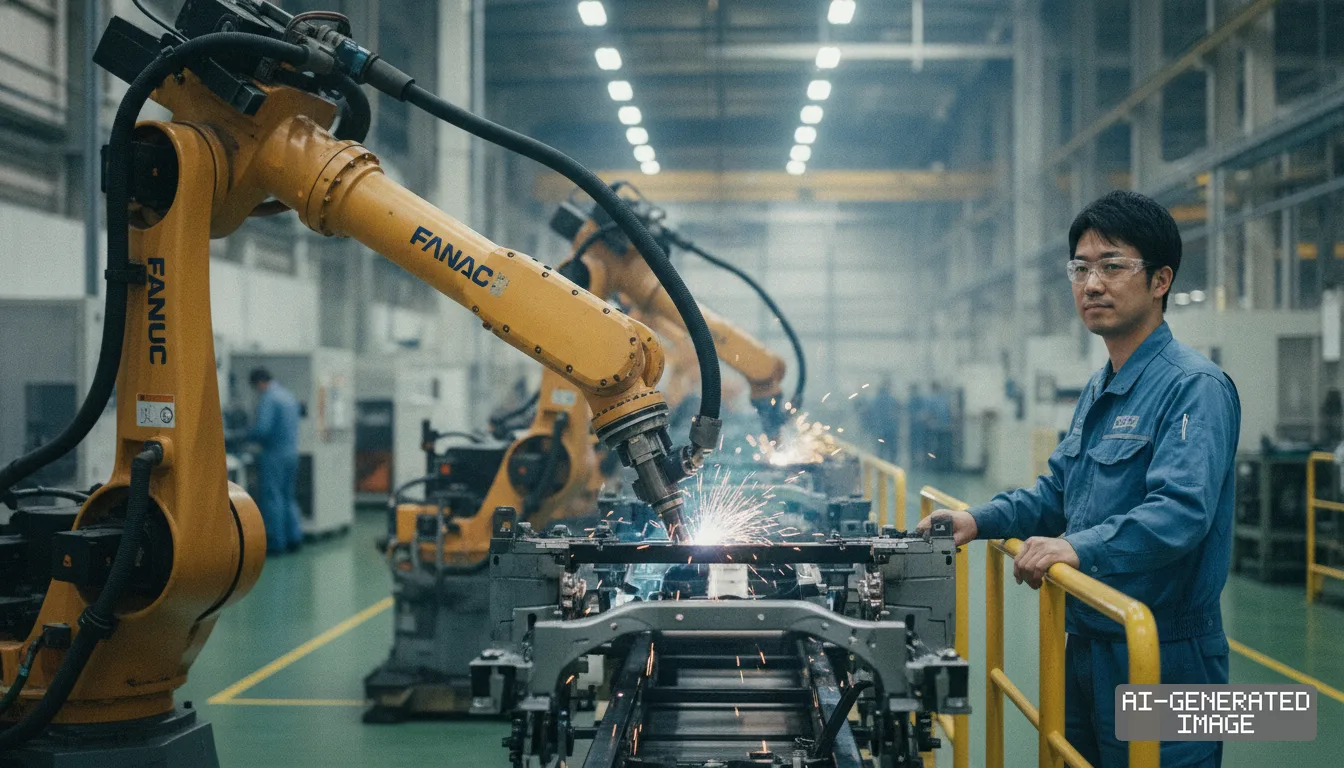
Fanuc faced heightened scrutiny from equity analysts on Oct. 17, 2026, as manufacturing forecasters tested whether demand for factory automation and industrial robots has passed its cyclical floor.
The Tokyo-listed company manufactures computer numerical control systems, multi-axis articulated robots and compact machining centers. Global machine builders rely on Fanuc control hardware to operate automated production lines.
Fanuc raised its full-year net sales guidance on July 31 to 948.1 billion yen ($6.3 billion), upgrading earlier projections. Management lifted full-year operating income guidance to 218.0 billion yen, establishing an operating margin target of 23.0%.
The upward forecast followed consolidated net sales of 231.0 billion yen for the fiscal first quarter ended June 30, 2026. That represented an increase of 34.7 billion yen over the corresponding period a year earlier.
First-quarter operating income expanded by 11.1 billion yen year-on-year to 53.5 billion yen. The quarterly performance yielded an operating margin of 23.2%, demonstrating pricing discipline during fluctuations in raw material expenses.
Demand recovery diverged between electronics manufacturing lines and automotive vehicle plants during the first half of the fiscal year. Consumer electronics assemblers in Asia resumed capital expenditures earlier than automotive manufacturers.
Smartphone and electronics contract factories in China drove early machine tool procurement during spring. Those facilities ordered compact machining centers to support retooling cycles for new mobile device chassis.
Fanuc exhibited its Robodrill and Robocut machine tool systems at the Taiwan International Machine Tool Show in March. Customer engagement at the exhibition reflected renewed interest from North American and Asian tooling buyers.
Automotive capital expenditure followed a more cautious pattern across global assembly plants. Major automakers slowed several planned electric vehicle battery line expansions while optimizing operational throughput across existing internal combustion and hybrid facilities.
European carmakers exercised strict spending restraint through late summer, deferring large-scale robotic cell installations. Factory operators chose to refurbish existing multi-axis welding robots rather than install entirely new automated assembly bays.
In North America, automakers reallocated automation budgets toward hybrid powertrain lines and flexible sheet-metal stamping cells. That strategic adjustment lengthened procurement evaluation cycles for high-payload articulated robots.
Despite selective automotive delays, Fanuc accelerated its long-term manufacturing presence in the Western Hemisphere. The company targeted expanding domestic automation demand driven by United States manufacturing reshoring initiatives.
Subsidiary FANUC America Corporation announced plans on March 24, 2026, to invest $90 million to build a production-ready facility in Michigan. The project represents a capital commitment of approximately 14.3 billion yen.
The new Michigan site covers 840,000 square feet and will provide dedicated floor capacity for industrial robots. Scheduled for operational completion in late 2027, the facility is designed to add 225 permanent production jobs.
FANUC America has manufactured paint application robots in Michigan for more than four decades. The new expansion marks its largest single addition of domestic robotic fabrication space.
The Michigan investment brings cumulative capital expenditures by FANUC America to nearly $300 million across United States sites since 2019. That spending expanded the subsidiary's operational footprint to 3 million square feet.
To support factory workforce integration, the subsidiary prepared to open an expanded training center in Auburn Hills, Michigan. The academy trains customer technicians in robot programming, digital-twin simulation and physical automation systems.
General industrial manufacturing provided steady underlying demand across Asian markets outside the automotive channel. Small and mid-sized enterprises procured articulated robots to mitigate structural labor shortages in warehouse logistics and metal fabrication.
Machine tending and automated palletizing applications accounted for consistent order intake across regional precision suppliers. Factory managers increasingly deploy collaborative and six-axis arms to execute repetitive packaging and loading tasks.
Industrial component supply chains stabilized over the summer, shortening lead times for specialized servo motors and precision reduction gears. The reduction in inventory backlogs helped machine tool fabricators resume baseline component replenishment.
Semiconductor backend packaging equipment makers also resumed measured intake of computer numerical control units. Precision handling robotics saw sustained inquiries from advanced chip packaging facilities operating in Japan and Taiwan.
Market participants anticipate that second-quarter financial results will clarify whether order bottoming in China has broadened into global industrial recovery. Consensus estimates compiled by equity analysts pegged quarterly revenue near 243 billion yen.
Fanuc will report its consolidated financial results for the six months ended Sept. 30, 2026, on Oct. 23. Management will host an investor briefing session that afternoon to review segment intake.
The company did not issue an IR release or official order book update on Oct. 17, and Fanuc has not published standalone order receipts for the July–September quarter.
Impact map
How this development propagates across the region and out to global buyers.
| Event | Korea | China | Japan | Global impact |
|---|---|---|---|---|
| Factory robot capex cycle test | robot component suppliers see delayed intake on slowed EV line orders | smartphone chassis lines lifted compact machining center orders in spring | FANUC maintains 23.0% operating margin guidance ahead of Oct. 23 release | automotive capex pivots from battery cells to flexible hybrid production |
In this story
- Companies
- FANUC Corporation
- Tickers
- 6954.T
- Impact
- CapexOrder BookCost Structure
Related briefings
- FANUC debuts welding and painting robots for FABTECH 2026 Also on FANUC CORPORATION, Cost Structure, Order Book
- FANUC America unveils packaging robotics for PACK EXPO 2026 Also on FANUC Corporation, Cost Structure
- IndexBox projects delta robot market will double by 2035 Also on Fanuc Corporation, Cost Structure
- Fanuc and Yaskawa Expand China Motion Control Plants to Meet Local Content Rules Also on Fanuc Corporation, Cost Structure
Sources
Reporting
Confidence: medium — how we grade this
The documents behind this briefing are linked above. East Asia Brief produces its English text with AI assistance under human editorial review, and does not translate or republish other outlets' articles. See our methodology and AI policy. Spotted an error? Tell us.
The Morning Brief
What changed in Korean, Chinese and Japanese industry overnight — and what it means for your supply chain. One email, weekday mornings, US time. Free.
The Morning Brief is in preparation. Leave your address and we will write to you once — when the first issue is ready. Nothing before that.