BYD and Tesla capture 38% of China passenger NEV exports in October
The two carmakers led an outbound surge of 582,000 units as total overseas deliveries of electric and plug-in hybrid vehicles rose 144.7%.
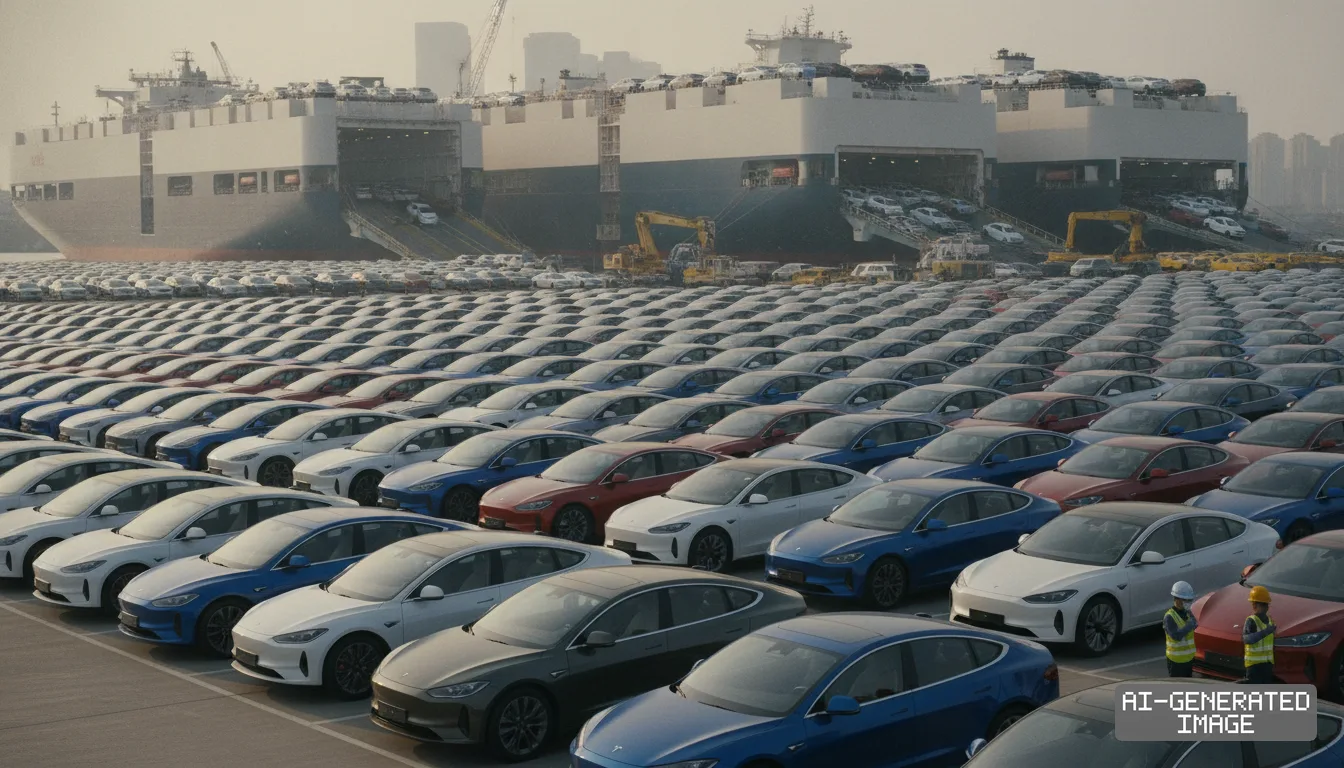
The China Passenger Car Association confirmed Nov. 10, 2026, that BYD and Tesla accounted for 38.4% of China's 582,000 passenger new energy vehicle exports in October.
Total overseas shipments of electric and plug-in hybrid cars rose 144.7% from a year earlier. Those deliveries generated 62.8% of all passenger car exports leaving Chinese ports during the month.
BYD held the largest share of outbound volume, exporting 164,679 passenger new energy vehicles. The total gave the Shenzhen automaker 28.3% of the segment's outbound trade, despite a 2.8 percentage point drop from September.
Tesla shipped 59,012 electric vehicles from its Shanghai assembly plant to overseas destinations. That volume raised the company's export market share to 10.1%, up 4.7 percentage points from 5.4% in September.
Exports absorbed 87% of the 67,829 cars built at the Shanghai plant during October. The factory directed only 8,817 vehicles to domestic buyers, down 66.1% from October 2025.
The domestic drop reflects weaker household demand across Chinese cities. Automakers faced declining showroom foot traffic after Beijing began tapering national vehicle purchase incentives and halved the new energy vehicle purchase tax exemption.
Domestic retail sales across China's broader passenger car market fell 27.1% year on year to 1.64 million units. In contrast, total passenger vehicle exports climbed 68.5% to 928,000 units.
Carmakers redirected manufacturing capacity toward foreign buyers to clear factory inventory. Assembly lines in China sent 35% of their total passenger car production overseas last month, the association said.
Chery Automobile ranked second in new energy exports behind BYD, shipping 83,843 passenger vehicles. The volume gave the state-owned manufacturer 14.4% of China's outbound new energy car volume.
Geely Automobile held third place, delivering 80,119 electrified vehicles abroad for a 13.8% market share. Geely and Chery rely heavily on emerging markets across Southeast Asia, Russia and the Middle East.
BYD's overseas volume expanded 105.6% compared with October 2025. Across the first 10 months of 2026, BYD exported 1,465,753 passenger electrified cars, securing 32.8% of total outbound shipments.
The company has expanded its chartered carrier fleet to bypass ocean freight bottlenecks. Dedicated roll-on, roll-off vessels move vehicles directly from Shenzhen and Taicang to European and Latin American distribution hubs.
Tesla adjusted Shanghai's assembly schedule to prioritize export orders early in the fourth quarter. The factory cleared 420,984 export vehicles between January and October, more than double its year-earlier pace.
Intensifying domestic price wars eroded Tesla's margins inside China, prompting the company to offload output abroad. Tesla's domestic deliveries plunged 86.4% in October compared with September, trade records showed.
Both automakers face commercial resistance in primary destination markets. The European Commission introduced definitive countervailing duties on Chinese-made electric vehicles, raising landed prices across European dealerships.
BYD faces an additional 17% countervailing duty on top of the standard 10% European Union import tariff. Tesla secured an individual duty rate of 7.8% for vehicles built at its Shanghai assembly plant.
Automakers compensated for European trade barriers by routing more deliveries into non-aligned economies. Brazil, Mexico, Thailand and the United Arab Emirates absorbed larger shares of Chinese-built battery electric models.
Pure battery electric vehicles made up 61.7% of all new energy passenger car exports during October. Narrow-sense plug-in hybrids accounted for 33.7%, while range-extended vehicles represented the remaining 4.6%.
Entry-level models drove the pure electric export category. Compact and subcompact battery electric vehicles represented 56.4% of all pure electric passenger cars shipped abroad, up from 42.1% a year earlier.
Chinese manufacturers also expanded shipments of completely knocked-down vehicle kits for final assembly abroad. Assembling vehicle kits in overseas hubs allows carmakers to comply with local content rules and bypass import tariffs.
Kits accounted for 41.9% of exports for SAIC-GM-Wuling and 31.1% for Great Wall Motor. SAIC Passenger Vehicle assembled 27.6% of its foreign shipments as kits, the association reported.
SAIC Passenger Vehicle shipped 42,030 new energy cars abroad in October, capturing a 7.2% export share. Changan Automobile followed in sixth place with 30,343 units, while Leapmotor exported 21,132 vehicles.
Leapmotor assembles vehicles in Malaysia through its manufacturing partnership with Stellantis. The venture plans to begin customer deliveries of the A10 hatchback in additional Southeast Asian markets before year-end.
Exporters must navigate shifting domestic tax policy alongside foreign tariff barriers. China will lower its value-added tax export rebate on electric vehicles from 13% to 9% on April 1, 2027.
The rebate reduction will raise effective export operating costs by four percentage points for vehicle manufacturers. Exporters are pulling overseas production forward before the revised tax schedule takes effect.
The association does not state the country-by-country delivery breakdown of Tesla's Shanghai shipments, and Tesla has not published destination port data in its regulatory filings.
The Ministry of Commerce will conduct its next quarterly export compliance review in Beijing on Dec. 18, 2026.
Impact map
How this development propagates across the region and out to global buyers.
| Event | Korea | China | Japan | Global impact |
|---|---|---|---|---|
| China NEV export expansion | Hyundai and Kia face direct pricing pressure in Southeast Asia and Middle East | BYD and Tesla absorb 38.4% of NEV exports, offsetting 27.1% home retail drop | Toyota and Honda hybrid share erodes in non-EU markets against Chinese PHEVs | Pure EV exports rise 144.7% as carmakers route around EU tariffs via emerging markets |
In this story
- Companies
- BYD CompanyTesla
- Tickers
- 002594.SZTSLA
- Exposed
- Chery AutomobileGeely AutomobileSAIC MotorLeapmotorGreat Wall Motor
- Policy
- Tariffs
- Impact
- Supply ChainOrder BookPricing
Track every Tariffs development →
Related briefings
- BYD and Geely expand Southeast Asian assembly lines to build regional export hubs Also on Great Wall Motor, SAIC Motor, BYD Company
- Stellantis pushes Leapmotor European parts past 40% in Spain Also on Leapmotor, Chery Automobile, Tariffs
- BYD expands luxury SUV and hybrid pickup lineups in China Also on Great Wall Motor, Pricing, Order Book
- Li Auto and EV rivals drop CATL to build in-house batteries Also on Leapmotor, Pricing
Sources
Primary documents
Reporting
Confidence: high — how we grade this
The documents behind this briefing are linked above. East Asia Brief produces its English text with AI assistance under human editorial review, and does not translate or republish other outlets' articles. See our methodology and AI policy. Spotted an error? Tell us.
The Morning Brief
What changed in Korean, Chinese and Japanese industry overnight — and what it means for your supply chain. One email, weekday mornings, US time. Free.
The Morning Brief is in preparation. Leave your address and we will write to you once — when the first issue is ready. Nothing before that.