
Hanwha Ocean signs $345m Dorian LPG order to lock 2030 slots
The three dual-fuel Panamax gas carriers extend the South Korean yard's commercial backlog through late 2030 as fleet renewal accelerates under tighter global emissions rules.
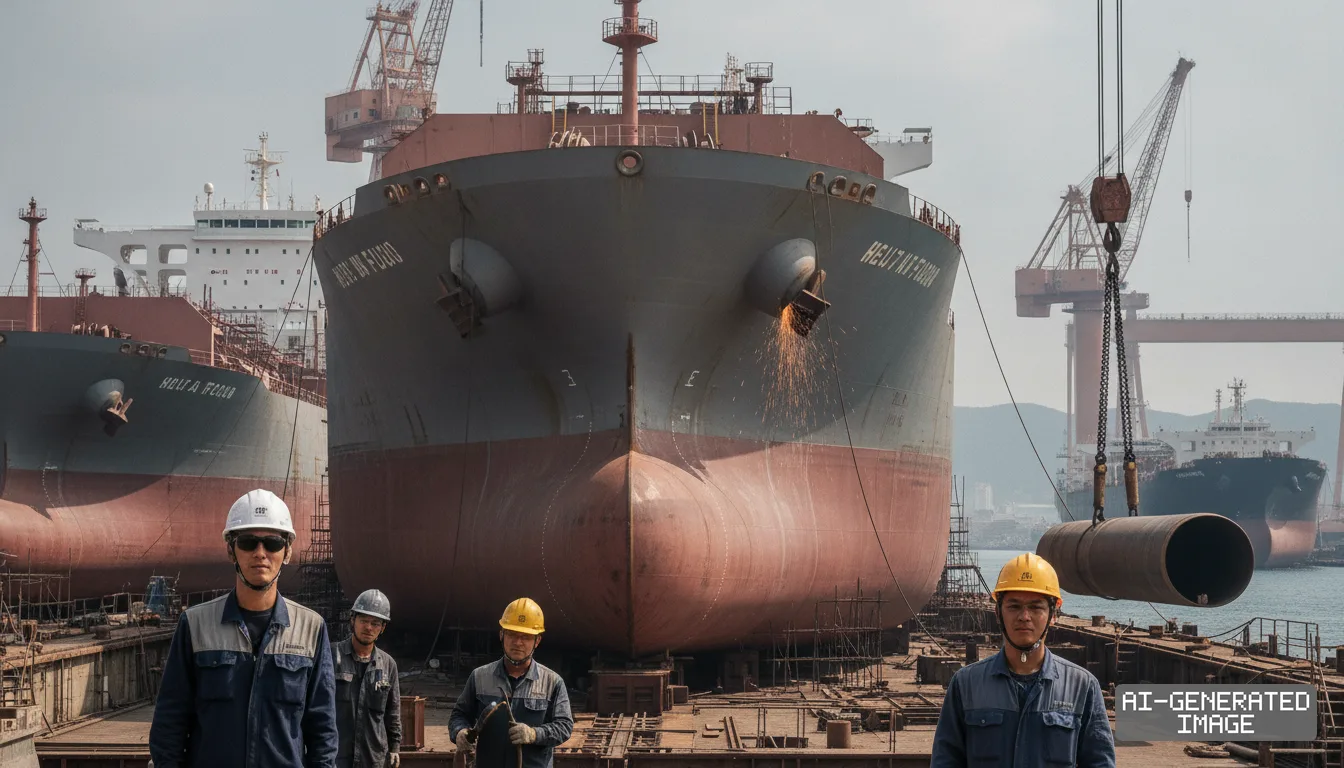
Dorian LPG confirmed technical parameters on Sept. 11, 2026, for three dual-fuel very large gas carriers contracted at South Korea's Hanwha Ocean under a 477.8 billion won deal.
The contract carries a total value of 477.8 billion won ($345 million). That sum represents 3.7% of Hanwha Ocean's 2025 revenue of 12.78 trillion won ($9.25 billion), according to a regulatory filing.
The agreement reserves building berths at the Geoje yard through the fourth quarter of 2030. Hanwha Ocean scheduled the three vessels for staggered completion across that year.
Each vessel will have a cargo capacity of 90,000 cubic meters. The design uses Panamax hull dimensions to preserve operational transit options across global waterways.
The Panamax beam enables the gas carriers to navigate the original locks of the Panama Canal. That feature offers charterers lower transit tolls and shorter waiting queues than the expanded Neopanamax locks.
Main propulsion units will operate on liquefied petroleum gas or conventional low-sulfur heavy fuel oil. The dual-fuel setup lets the vessels burn part of their cargo during long voyages.
Fuel flexibility shields fleet operators from price spikes in refined bunker products. Burning LPG cuts carbon dioxide emissions by roughly 20% compared to standard marine fuel oil.
Hanwha Ocean will install shaft generator systems on all three newbuildings. The systems draw mechanical energy from the main shaft to generate electric power while sailing.
Onboard shaft generation reduces the operating hours of auxiliary diesel engines. That configuration trims fuel burn and cuts auxiliary generator maintenance costs on long-haul legs.
The shipyard also modified the hull form and stern arrangements to accommodate larger-diameter propellers. Pre-swirl energy-saving devices around the propellers optimize wake flow into the blades.
The order brings Hanwha Ocean's intake this year to 32 vessels valued at $5.94 billion. The haul includes 17 crude oil carriers, six liquefied natural gas carriers and three ammonia carriers.
Hanwha Ocean has filled its building berths for more than three years. The healthy backlog allows the shipbuilder to select high-margin gas carrier contracts over commoditized commercial vessels.
The transaction extends an established commercial relationship between the two companies. Hanwha Ocean delivered the 93,000-cubic-meter dual-fuel carrier Areion to Dorian LPG in March 2026.
The Areion operates inside the Helios LPG Pool, a joint commercial venture run by Dorian LPG and MOL Energia. The vessel was built with ammonia-loading capability alongside its LPG systems.
Dorian LPG manages an operating fleet of 25 very large gas carriers. Six units in that fleet run on dual-fuel LPG machinery.
The owner is using high secondhand asset prices to pay for its fleet replacement campaign. Dorian LPG raised more than $340 million by selling four older carriers built between 2014 and 2015.
The disposals covered the vessels Corsair, Cobra, Constellation and Clermont. Proceeds from those sales match almost the entire contract price of the three Hanwha Ocean newbuildings.
The asset churn creates a cash-neutral replacement cycle for the shipping line. Dorian LPG trades older tonnage for high-efficiency hulls without adding net leverage to its balance sheet.
Dorian LPG also secured a seven-year $368.4 million credit facility on Sept. 2, 2026. The credit package consolidates four older bank facilities at a margin of 140 basis points over SOFR.
The shipping line reported high spot exposure in its third-quarter trading update. It fixed 99% of its available calendar days through September at rates above $88,000 per day.
Freight rates climbed on strong exports of liquefied petroleum gas from the United States to Asia. Canal congestion and longer sailing distances around the Cape of Good Hope lifted ton-mile demand.
Stricter emission rules from the International Maritime Organization are forcing gas fleet modernization. Older carriers face operational penalties and slow-steaming mandates under carbon-intensity standards.
The regulatory filings and company releases do not show an additional shipbuilding contract signed on Sept. 11 beyond the three-hull order booked on Aug. 31. Technical summaries distributed on Sept. 11 re-indexed disclosures from earlier in the month.
Hanwha Ocean is scheduled to deliver the three gas carriers in June, September and December 2030, with contract close dated Dec. 6, 2030.
Impact map
How this development propagates across the region and out to global buyers.
| Event | Korea | China | Japan | Global impact |
|---|---|---|---|---|
| Dorian LPG three-VLGC order | Hanwha Ocean extends high-margin gas carrier dock coverage to December 2030 | Jiangnan Shipyard misses export berth allocation as buyer stays with Korean builder | MOL Energia gains three modern dual-fuel hulls for Helios LPG Pool by 2030 | US-to-Asia LPG routes gain three Panamax-capable dual-fuel hulls cutting bunker burn |
In this story
- Companies
- Hanwha OceanDorian LPG
- Tickers
- 042660.KSLPG
- Exposed
- Mitsui O.S.K. LinesHD Hyundai Heavy Industries
- Policy
- Economic Security
- Impact
- Order BookCapexFleet Renewal
Track every Economic Security development →
Related briefings
- MOL names world's first LNG carrier fitted with rigid sails Also on Mitsui O.S.K. Lines, Hanwha Ocean, Order Book
- Japanese shipbuilders standardize electric coastal feeder designs to cut renewal costs Also on Mitsui O.S.K. Lines, Order Book
- Imabari and JMU consolidate dry bulk engineering to standardize ammonia dual-fuel vessels Also on Mitsui O.S.K. Lines, Order Book
- Japan shipyards agree long-term thick plate supply terms with Nippon Steel Also on Mitsui O.S.K. Lines
Sources
Reporting
Confidence: medium — how we grade this
The documents behind this briefing are linked above. East Asia Brief produces its English text with AI assistance under human editorial review, and does not translate or republish other outlets' articles. See our methodology and AI policy. Spotted an error? Tell us.
The Morning Brief
What changed in Korean, Chinese and Japanese industry overnight — and what it means for your supply chain. One email, weekday mornings, US time. Free.
The first issue goes out shortly. Sign up now and you will not miss it.


