Pakistan asks China for zero-tariff terms to reach $25B in exports
Planning Minister Ahsan Iqbal presented the Nov. 28 plan in Beijing to narrow a bilateral trade deficit that reached $19.6 billion in fiscal 2026.
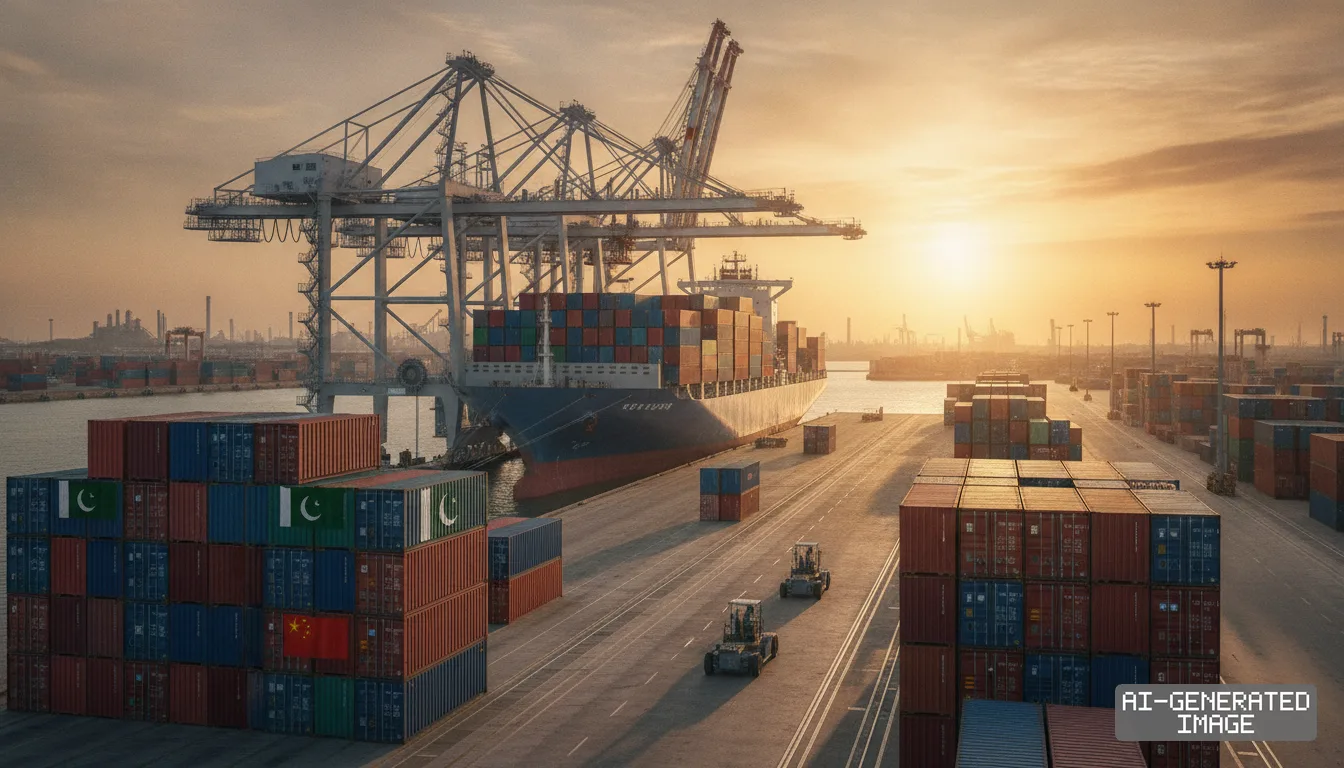
Pakistan's Ministry of Planning, Development and Special Initiatives requested non-reciprocal, zero-tariff market access from China on Nov. 28, 2026, seeking to lift annual exports to $25 billion.
Planning Minister Ahsan Iqbal presented the initiative in Beijing to Zhou Haibing, vice chairman of China's National Development and Reform Commission. The plan aims to narrow a bilateral deficit that reached $19.6 billion in fiscal 2025–2026.
The trade gap stems from severe structural imbalances. Pakistan imported $22.34 billion in Chinese goods during the fiscal year, while shipping just $2.71 billion in return, planning ministry records show.
The proposal asks Beijing to replicate the duty exemptions it granted to African nations. Pakistan wants complete tariff relief across all export categories outside the existing China-Pakistan Free Trade Agreement framework.
Iqbal also met Liu Haixing, head of the International Department of the Communist Party of China, to align political backing for technical discussions. The talks follow preliminary discussions held on Nov. 3.
The trade mechanism forms the commercial anchor of the China-Pakistan Economic Corridor (CPEC). Islamabad plans to use duty-free concessions to integrate light manufacturing, agricultural processing and mining into Chinese industrial supply chains.
Under the initial phase of CPEC, Chinese entities committed $25 billion in direct investments. Those outlays added more than 8,000 megawatts of power generation capacity and 888 kilometers of intercity highways.
The planned tariff regime targets intermediate inputs. Pakistan aims to position its northwestern export zones as low-cost processing hubs that supply Chinese state manufacturers facing Western import tariffs and supply-chain scrutiny.
Transport bottlenecks remain the main obstacle to bilateral shipments. Iqbal urged China to finalize the financing agreement for the 102-kilometer Thor Nullah–Raikot section of the Karakoram Highway.
The road segment is the priority stage of the Rs576 billion ($2.07 billion) Thakot–Raikot realignment. The bypass is required because new hydropower reservoirs along the Indus River will submerge parts of the existing arterial road.
Rail modernization is also moving forward through mixed financing. While Pakistan negotiates Asian Development Bank funding for the Karachi–Rohri rail tract, Islamabad asked Chinese state rail contractors to build the remaining sections of Main Line-1.
Maritime logistics require immediate restructuring. Iqbal called for Chinese state assistance to restore scheduled container calls at Gwadar Port, asking for dedicated berthing commitments from China COSCO Shipping.
Gwadar handles negligible container traffic despite receiving deepwater dredging and a newly built international airport. Iqbal proposed a joint technical study to establish commercial strategic petroleum reserves inside the port compound.
Mineral extraction represents the largest industrial volume exposure. The ministry outlined a dedicated transit route connecting copper and gold reserves in Balochistan's Chagai district directly to the Gwadar Free Zone for smelting.
Chinese refining groups would gain duty-free access to unrefined concentrates under the plan. In exchange, Chinese processing ventures must build local beneficiation facilities rather than trucking raw ores across border checkpoints.
Agricultural goods provide the immediate volume target. Pakistan shipped $420 million worth of rice, sesame seeds and seafood to China last year, capturing less than 1% of Chinese agricultural import demand.
Pakistani textile spinners also expect margin relief from duty exemptions. Local mills operate at 65% capacity due to high domestic power tariffs and seek tariff-free cotton yarn quotas into southern Chinese weaving plants.
The ministry notice does not state whether China's National Development and Reform Commission has formally accepted the zero-tariff proposal, and Beijing has not published an agreed tariff-line schedule.
Bilateral working groups will convene before the next Joint Cooperation Committee session in early 2027 to draft product eligibility lists, rules of origin and bonded customs protocols.
Impact map
How this development propagates across the region and out to global buyers.
| Event | Korea | China | Japan | Global impact |
|---|---|---|---|---|
| Pakistan-China duty-free market access request | domestic synthetic fiber exporters face price competition in low-count yarn exports to China | secures diversified overland minerals and agricultural supply through Gwadar corridor | freight logistics firms face route realignment as Gwadar aims for Indian Ocean shipping share | South-South trade corridor expands bypass routes around Western supply chain restrictions |
| Pakistan-China duty-free market access request | domestic synthetic fiber exporters face price competition in low-count yarn exports to China | secures diversified overland minerals and agricultural supply through Gwadar corridor | freight logistics firms face route realignment as Gwadar aims for Indian Ocean shipping share | South-South trade corridor expands bypass routes around Western supply chain restrictions |
In this story
- Companies
- China COSCO Shipping
- Tickers
- 601919.SS
- Policy
- Tariffs
- Impact
- Supply ChainOrder BookCost Structure
Track every Tariffs development →
Related briefings
- BYD lifts overseas EV battery volume 66.5% to take 11% share Also on Tariffs, Cost Structure, Order Book
- China widens offshore wind turbine cost lead over Europe Also on Tariffs, Cost Structure, Order Book
- U.S.-China Board of Trade sets tariff cuts on corn and beef as raw soybeans stay excluded Also on Tariffs, Cost Structure, Order Book
- POSCO Future M signs $776M LFP cathode supply deal with SK On Also on Tariffs, Cost Structure, Order Book
Sources
Reporting
Confidence: medium — how we grade this
The documents behind this briefing are linked above. East Asia Brief produces its English text with AI assistance under human editorial review, and does not translate or republish other outlets' articles. See our methodology and AI policy. Spotted an error? Tell us.
The Morning Brief
What changed in Korean, Chinese and Japanese industry overnight — and what it means for your supply chain. One email, weekday mornings, US time. Free.
The Morning Brief is in preparation. Leave your address and we will write to you once — when the first issue is ready. Nothing before that.