# Trump Threatens Korea With Tariffs Over $54B Alaska LNG Deal
*Washington demands full funding for the Arctic energy corridor while Seoul insists a bilateral agreement covers only preliminary feasibility reviews.*
**Published:** October 4, 2026
**By:** Dae-hyun Kim
**Section:** Trade & Industrial Policy — South Korea
**Format:** Breaking
**Confidence:** medium
**Source:** https://eastasiabrief.com/trade-policy/trump-threatens-korea-tariffs-54b-alaska-lng-deal-525
**Publisher:** East Asia Brief (https://eastasiabrief.com/)
---
## What to know
- Trump threatened to double import tariffs on Oct. 2, 2026, if Seoul skips the $54 billion Alaska LNG project
- The project requires $44.5 billion to $54.5 billion to build an 800-mile pipeline and 20 mtpa export terminal
- Delegations meet Oct. 24 in Washington; no tariff proclamation or executive order has been filed
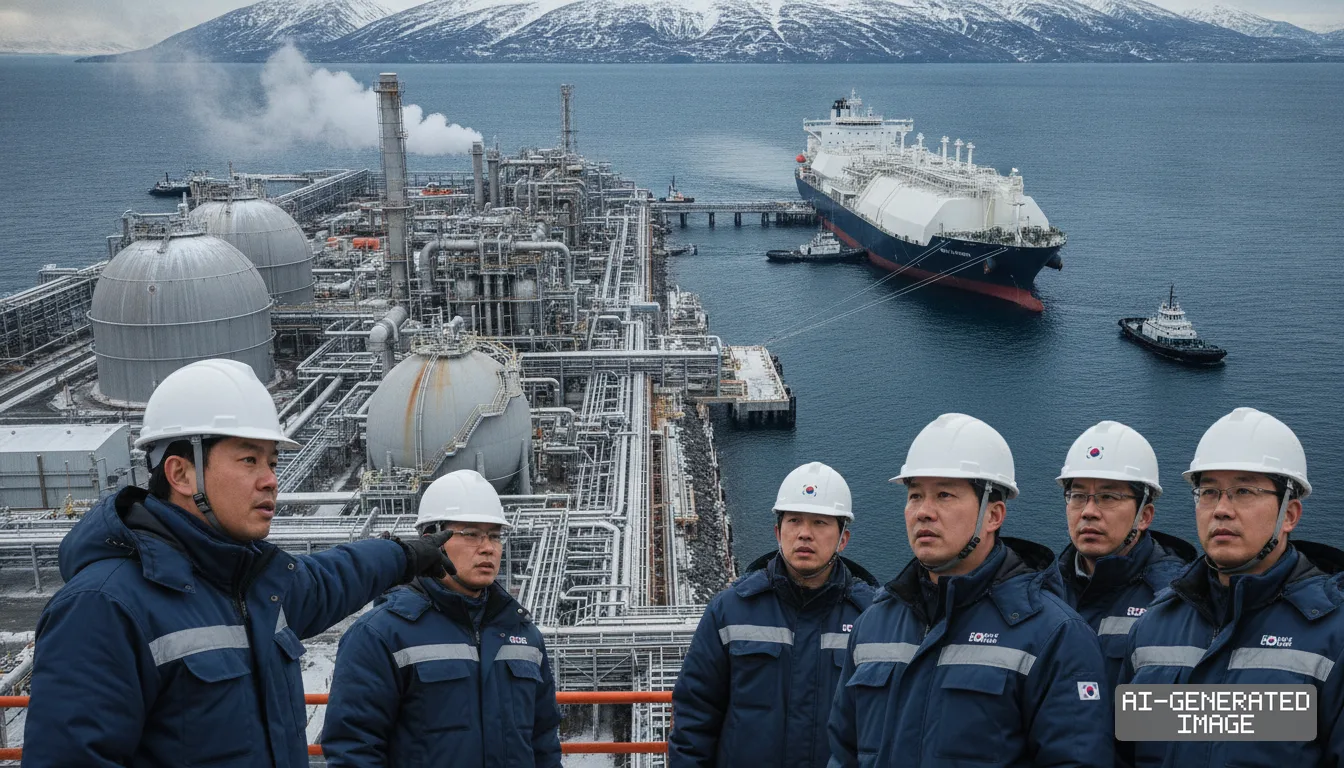
*South Korean personnel inspect a coastal liquefied natural gas export terminal as a large LNG tanker rests at the dock. (AI-generated image)*
Donald Trump warned South Korea on Oct. 2, 2026, that he would raise tariffs if Seoul refused to fund the $54 billion Alaska liquefied natural gas pipeline.
The verbal warning came two days after South Korean trade officials disputed White House assertions that Seoul had formally committed to financing the Arctic export project.
Trump told reporters during a White House press exchange that his earlier announcement of the multi-billion-dollar deal had not been premature, defending the commercial agreement.
"If they don't want it, I'll just charge them more," Trump told reporters, adding that he would double import duties if both sides failed to reach a deal soon.
The verbal threat targets an earlier bilateral trade package that lowered average tariffs on South Korean shipments from 25% down to 15%.
Doubling that rate would push border duties on South Korean manufactured goods up to 30%, unwinding duty reductions secured during months of trade negotiations.
On the same day, Trump wrote on the Truth Social platform that South Korea had also agreed to provide $8.4 billion for domestic enhanced oil recovery projects.
The dispute began on Sept. 30, when Trump and Commerce Secretary Howard Lutnick announced in Washington that South Korea would invest $54 billion in the Alaska venture.
The White House framed the commitment as a cornerstone of a broader bilateral investment program that included commercial power generation and civil nuclear power ventures.
Glenfarne Group Chief Executive Brendan Duval attended the Oval Office event alongside Alaska Governor Mike Dunleavy, endorsing the commercial scale of the proposed capital injection.
Glenfarne acts as the lead commercial developer for the Alaska liquefied natural gas pipeline and liquefaction project, holding a 75% equity stake in operating company 8 Star Alaska LLC.
The state-backed Alaska Gasline Development Corporation retains the remaining 25% interest in the development vehicle, which holds the underlying federal pipeline permits.
Official documentation released by the two governments described a much more restricted scope than the financial commitment presented during the Oval Office ceremony.
The bilateral joint fact sheet released Sept. 30 stated only that both governments agreed to commence formal reviews of the Alaska pipeline under a strategic memorandum.
That review clause remains conditional on commercial viability and domestic statutory requirements, according to the official text published by the two governments.
The signed bilateral document contained no capital expenditure target, no mandatory fuel off-take volume and no binding $54 billion financing allocation.
Trade Minister Kim Jung-kwan rejected the White House claims during a press conference in Sejong on Oct. 1, clarifying the official position of the South Korean government.
Kim said Seoul had agreed only to evaluate the project's commercial viability, stressing that no investment decision or capital sum had been finalized.
Kim said he had conveyed formal regret to Lutnick regarding the characterization of the energy investment during the White House event.
South Korean state utility planners have scrutinized the Alaska gas development because of the exceptional capital expenditure required to extract and transport the fuel.
Glenfarne estimates total construction costs for Alaska LNG at $44.5 billion to $54.5 billion, representing one of the largest planned infrastructure assets in North America.
The design calls for an 800-mile pipeline across mountainous sub-Arctic terrain, linking natural gas fields on the North Slope to a coastal terminal at Nikiski.
The liquefaction complex at Nikiski is engineered to export 20 million metric tons of fuel per year to Asian power utilities.
Those pipeline requirements elevate the project's capital intensity to roughly $2.5 billion per million tons of annual capacity, more than double equivalent Gulf Coast export terminals.
Liquefaction terminals built along the Gulf of Mexico access existing interstate gathering networks, keeping construction outlays below $1 billion per million tons of annual capacity.
Glenfarne has secured non-binding commercial agreements representing 13 million metric tons per year, but needs 16 million tons of definitive commitments to reach a final investment decision.
South Korean utilities have avoided long-term take-or-pay purchase contracts for Arctic volumes because pipeline tariff surcharges would inflate delivered fuel prices above prevailing Asian spot levels.
Using energy purchases as commercial leverage introduces regulatory exposure for South Korean industrial exporters, particularly automotive assembly plants and battery cell makers serving North American supply chains.
The White House has not published an executive order, presidential proclamation or Federal Register notice imposing higher tariffs or mandating the investment.
Working-level trade delegations from the two countries are scheduled to meet in Washington on Oct. 24 to review procedural guidelines for the joint economic framework.
## Impact map
| Event | Korea | China | Japan | Global impact |
| --- | --- | --- | --- | --- |
| Alaska LNG tariff warning | Trade ministry rejects $54 billion pledge; export goods face potential duty rise to 30% | no exposure, pipeline volumes exclude Chinese state energy buyers | JERA holds non-binding LOI for Alaska LNG offtake, insulating supply pacts | LNG project development costs benchmark at $2.5 billion per mtpa, double Gulf Coast levels |
## In this story
- **Companies:** Glenfarne Group, Alaska Gasline Development Corporation
- **Tickers:** 036460.KS
- **Exposed:** Korea Gas Corporation
- **Policy:** Tariffs, Energy Security, Trade Agreements
- **Impact:** Pricing, Capex, Compliance
## Primary sources
1. chosun.com
2. sedaily.com
3. yonhapnewstv.co.kr
4. edaily.co.kr
5. ogj.com
---
Cite as: East Asia Brief, "Trump Threatens Korea With Tariffs Over $54B Alaska LNG Deal," October 4, 2026. https://eastasiabrief.com/trade-policy/trump-threatens-korea-tariffs-54b-alaska-lng-deal-525