# Korean yards ratify annual wages to protect 3-year LNG backlogs
*Labor pacts across HD Hyundai, Hanwha Ocean and Samsung Heavy clear delivery risks where high-margin vessels take 70% of dock space.*
**Published:** November 7, 2026
**By:** Hyun-jung Lee
**Section:** Shipbuilding & Defense — South Korea
**Format:** Breaking
**Confidence:** medium
**Source:** https://eastasiabrief.com/shipbuilding/korean-yards-ratify-annual-wages-protect-3-year-lng-1225
**Publisher:** East Asia Brief (https://eastasiabrief.com/)
---
## What to know
- Korean shipbuilders hold three years of orders with gas carriers filling over 70% of dock slots
- HD Hyundai settlements average 41.36 million won per worker as Hanwha Ocean clears pact by 29 votes
- Hanwha Ocean bonus criteria task force concludes Dec. 31, 2026
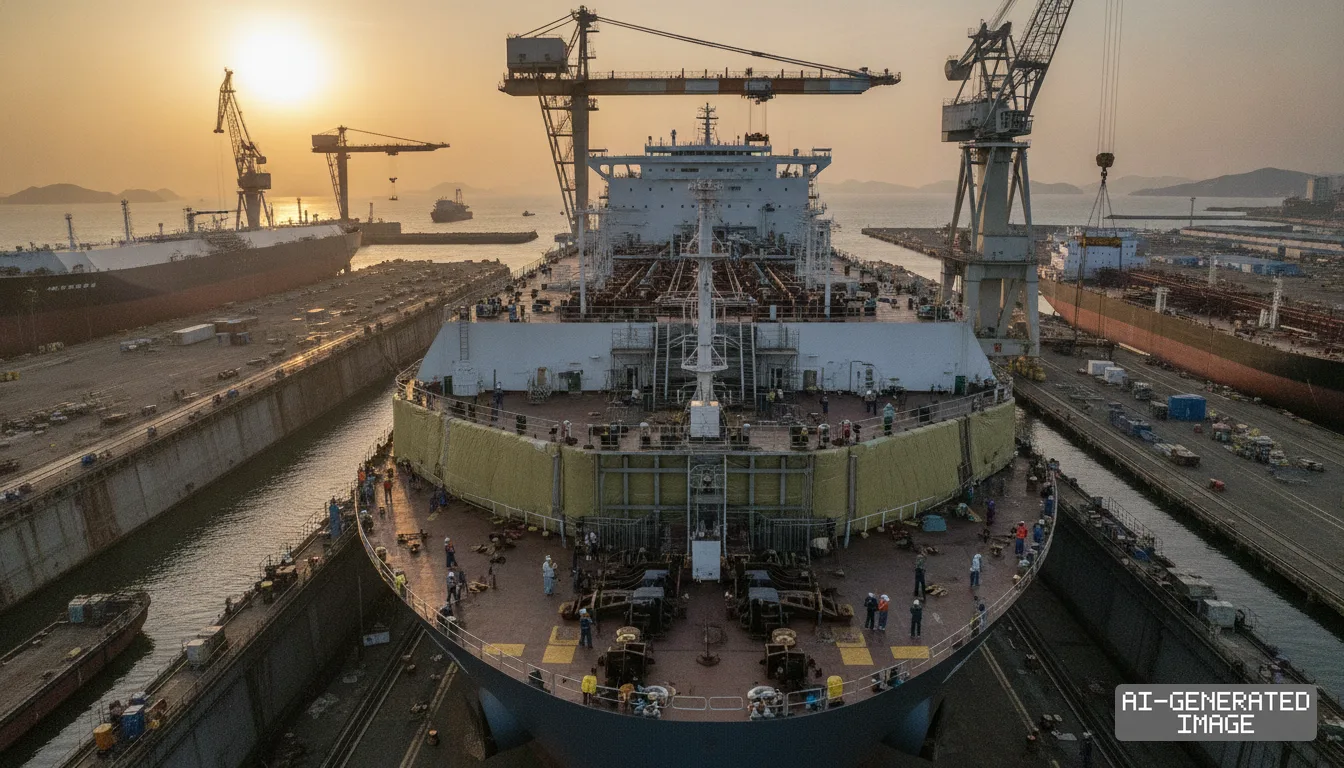
*Workers stand on the deck of a commercial vessel under construction in a South Korean shipyard dry dock as cranes tower overhead. (AI-generated image)*
HD Hyundai Heavy Industries, Hanwha Ocean and Samsung Heavy Industries secured drydock delivery schedules across South Korea on Nov. 7, 2026, after ratifying annual labor pacts across all three major shipbuilders.
The three yards hold more than three years of commercial order backlog, where high-margin liquefied natural gas carriers and dual-fuel vessels account for over 70% of scheduled dock slots.
Dock space remains at capacity across Ulsan and Geoje, making any labor stoppage an immediate threat to construction milestones and contract delivery penalties.
The wage agreements eliminate immediate strike exposure across the Korean shipbuilding sector as global carriers demand strict compliance with contractual delivery dates.
South Korean yards compete directly with Chinese state-backed shipbuilders for next-generation dual-fuel container vessels and premium gas carriers.
Yard managers had warned that prolonged walkouts would disrupt berth rotations, delaying the float-out of hulls and pushing subsequent deliveries into financial penalty windows.
Hanwha Ocean finalized its collective bargaining agreement on Oct. 29 after union members approved a revised contract by a margin of 29 votes.
The ballot approved the agreement with 50.02% support among 4,422 voting members, ending five months of bargaining that began on June 4.
Hanwha Ocean agreed to raise basic monthly wages by 140,000 won ($102) and pay 8.5 million won ($6,200) in lump-sum cash incentives.
The package included 1 million won in annual employee welfare credits and expanded pre-school educational subsidies for shipyard workers.
Union branch leader Kim Yu-cheol concluded a 21-day sit-in protest on a 25-meter goliath crane at the Geoje shipyard once the vote passed.
Hanwha Ocean operates five drydocks at its Geoje complex, where commercial gas carriers generate roughly 55% of total shipbuilding revenue.
HD Hyundai Heavy Industries ratified its own labor pact on Oct. 27 following 147 days of bilateral talks and 11 partial walkouts.
The second tentative agreement secured 55.06% approval among 7,724 union members who cast ballots at the Ulsan yard.
HD Hyundai Heavy Industries lifted monthly base salaries by 120,000 won ($88), including 55,000 won in regular seniority increases.
The company also distributed 11.5 million won in cash bonuses, two months of agreed wages and 300,000 won in welfare points.
HD Hyundai Heavy Industries estimated the total financial effect at an average of 41.36 million won ($30,300) per union member, up roughly 38% from the prior year.
The company unified working terms and employment regulations following its corporate integration with HD Hyundai Mipo.
Union branch chief Kim Dong-ha ended a five-day crane sit-in in Ulsan after negotiators reached the revised package.
HD Hyundai Heavy Industries accounts for approximately 65% of commercial shipbuilding revenue within parent group HD Korea Shipbuilding & Offshore Engineering.
The Ulsan shipyard operates nine drydocks, with specialized gas carriers and large container vessels filling berth space through 2028.
Samsung Heavy Industries concluded its wage negotiations earliest, ratifying a pact on Sept. 23 without a single labor stoppage.
The Samsung Heavy agreement passed with 58.78% member approval, lifting base monthly salaries by 131,786 won, or 5.2%.
Samsung Heavy Industries paid 7 million won in one-time performance and operational bonuses to its workforce.
The yard also restructured its annual profit-sharing mechanism, switching the funding formula from 20% of economic value added to 10% of operating profit.
Samsung Heavy Industries runs eight docks at its Geoje shipyard, where liquefied gas carriers and floating production units represent more than 60% of outstanding order value.
European container lines and Middle Eastern energy exporters have booked delivery slots through late 2028, leaving yards zero leeway for fabrication halts.
Berth turnaround times dictate shipyard margins, because erecting hull blocks in dock represents the tightest bottleneck in naval architecture.
A one-week stoppage at a central dock forces shipbuilders to reschedule subsequent engine installations, sea trials and vessel handovers.
Delaying a contracted vessel handover triggers liquidated damages, which typically accumulate as daily cash deductions under standard shipbuilding contracts.
The labor settlements remove operational uncertainty, allowing South Korean shipyards to maintain dock efficiency across specialized gas carrier series.
Higher payroll expenses will raise labor costs, requiring yards to offset overhead through automated steel cutting and robotic block assembly.
Subcontracted labor remains a friction point, as vendor unions at Hanwha Ocean and HD Hyundai Heavy Industries seek direct collective bargaining rights.
The shipbuilders have not disclosed the specific liquidated damage figures or daily penalty rates stipulated in their private vessel delivery contracts.
Hanwha Ocean and its union plan to conclude a joint task force on bonus criteria by Dec. 31, 2026, while Samsung Heavy Industries distributes its profit-linked compensation in early 2027.
## Impact map
| Event | Korea | China | Japan | Global impact |
| --- | --- | --- | --- | --- |
| Shipyard labor settlement | HD Hyundai, Hanwha Ocean and Samsung Heavy protect three-year dock rotations across Ulsan and Geoje | CSSC and Yangzijiang face tighter delivery competition on dual-fuel berths | Imabari and Nihon Shipyard retain niche gas carrier delivery slots without disruption | Commercial shipowners secure scheduled handovers for LNG and eco-friendly container fleets |
## In this story
- **Companies:** HD Hyundai Heavy Industries, Hanwha Ocean, Samsung Heavy Industries
- **Tickers:** 329180.KS, 042660.KS, 010140.KS
- **Exposed:** HD Korea Shipbuilding & Offshore Engineering
- **Impact:** Supply Chain, Cost Structure, Compliance
## Primary sources
1. chosun.com
2. ddaily.co.kr
3. imarinenews.com
4. zdnet.co.kr
5. hd-hhi.com
---
Cite as: East Asia Brief, "Korean yards ratify annual wages to protect 3-year LNG backlogs," November 7, 2026. https://eastasiabrief.com/shipbuilding/korean-yards-ratify-annual-wages-protect-3-year-lng-1225