# Senator Cotton demands US blacklist on CXMT as DRAM share hits 10%
*A letter to Howard Lutnick urges the Bureau of Industry and Security to revoke tool licenses after the Chinese memory maker reached fourth place globally.*
**Published:** November 13, 2026
**By:** Wei Zhang
**Section:** Semiconductors & AI Hardware — China
**Format:** Policy Tracker
**Confidence:** high
**Source:** https://eastasiabrief.com/semiconductors/senator-cotton-demands-us-blacklist-cxmt-dram-share-hits-1386
**Publisher:** East Asia Brief (https://eastasiabrief.com/)
---
## What to know
- Senator Tom Cotton asks Commerce to blacklist CXMT on the Entity List
- CXMT global DRAM revenue share rose from 4% to 10% in the second quarter
- Commerce faces congressional committee oversight hearings in early December
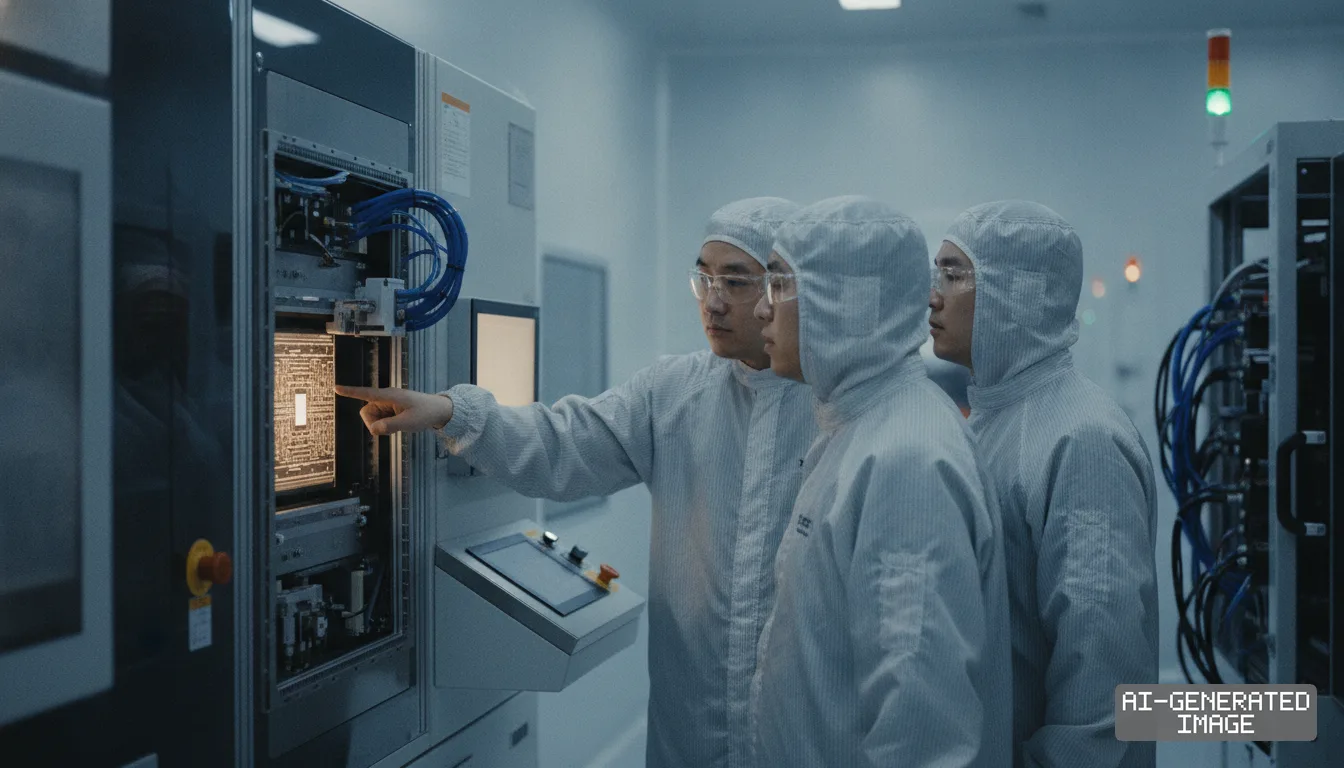
*Technicians wearing protective cleanroom suits inspect semiconductor manufacturing equipment inside a fabrication facility. (AI-generated image)*
Senator Tom Cotton demanded Nov. 13 that the Commerce Department place ChangXin Memory Technologies on the Entity List, seeking a full ban on American tool shipments to China's largest DRAM manufacturer.
The letter to Commerce Secretary Howard Lutnick urges the Bureau of Industry and Security to revoke export licenses and strip CXMT of access to American semiconductor equipment, components and technical maintenance.
CXMT expanded its share of global dynamic random-access memory revenue from 4% in the second quarter of 2025 to 10% in the second quarter of 2026, according to data from Counterpoint Research.
That rapid ascent established CXMT as the fourth-largest DRAM producer worldwide, trailing only Samsung Electronics, SK hynix and Micron Technology, which together still account for more than 80% of global memory output.
Cotton also asked Lutnick to invoke authorities under the Information and Communications Technology and Services office to explore prohibiting sales of CXMT memory products inside the United States.
The Department of Defense already lists CXMT under Section 1260H as a Chinese military company, but that designation does not impose the binding trade restrictions enforced under Commerce export controls.
The letter singled out CXMT's push into high-bandwidth memory, an advanced architecture that stacks multiple DRAM dies vertically to feed the processors driving artificial intelligence clusters and high-performance computing systems.
CXMT has accelerated trial production of HBM3E despite manufacturing yields hovering near 20%, an aggressive gamble that underscores Beijing's urgency to establish domestic alternatives without cutting-edge foreign machinery, Cotton said.
The push builds on earlier congressional efforts to cut off Chinese memory firms from Western capital goods and intermediate materials before domestic fabs master sub-18-nanometer fabrication processes.
House Select Committee Chairman John Moolenaar sent a formal request to Lutnick in July, arguing that unlisted Chinese memory producers continue to acquire advanced lithography, etching and deposition systems.
Lawmakers have also pressured electronics brands to purge Chinese silicon from commercial supply chains, with Senator Chuck Schumer urging Apple in July to drop plans to test memory chips sourced from CXMT.
Samsung Electronics, which accounts for roughly 40% of the world's DRAM market, has faced downward pricing pressure in standard memory lines as CXMT aggressively flooded domestic channels with legacy DDR4 and LPDDR4 chips.
SK hynix commands approximately 30% of global DRAM supply and leads the premium HBM3E market, leaving its core server-grade margins protected even as Chinese capacity pushes into consumer electronics and automotive modules.
Micron Technology, holding roughly 20% of global DRAM revenue, has navigated Chinese regulatory restrictions since 2023, making any strict export curbs on CXMT an immediate competitive shield across open third-country markets.
Placing CXMT on the Entity List would halt shipments of critical components and technical support from American tool vendors, directly threatening wafer yields at its primary fabrication clusters in Hefei and Beijing.
American semiconductor equipment manufacturers Applied Materials, Lam Research and KLA provide precision etching, chemical vapor deposition and process diagnostics that Chinese toolmakers cannot yet replicate at volume production standards.
Without routine preventive maintenance, proprietary replacement parts and software calibration from foreign field engineers, advanced DRAM lines suffer rapid defect escalation and precipitous drops in wafer throughput.
Commodity DRAM spot pricing dropped by an estimated 8% during late summer procurement cycles as CXMT expanded operational capacity beyond 150,000 wafer starts per month across its domestic fabrication network.
Korean manufacturers responded to the Chinese volume influx by accelerating conversions of older production lines toward high-density DDR5 and high-bandwidth memory stacks tailored for cloud infrastructure clients.
If the Commerce Department revokes CXMT's access to foreign tooling, the Chinese firm would likely see its capacity additions frozen at trailing nodes, preventing meaningful volume output of sub-18-nanometer DRAM.
Such a disruption would force Chinese smartphone and personal computer assemblers to rely more heavily on imported memory chips from Samsung Electronics, SK hynix and Micron Technology to meet domestic production targets.
Washington has simultaneously engaged Tokyo and The Hague to harmonize export control standards, aiming to prevent Chinese fabs from substituting American equipment with tools manufactured by Japanese or European suppliers.
The Commerce Department has not issued a formal administrative decision, and the Bureau of Industry and Security has not published a Federal Register notice adding CXMT to the Entity List.
Congressional committees plan oversight hearings in early December to examine export control enforcement on Chinese semiconductor makers, establishing a key timeline before the end of the legislative year.
For now, shipments of American manufacturing tools to unlisted CXMT facilities continue under existing facility-specific restrictions rather than a comprehensive, company-wide trade embargo.
## Impact map
| Event | Korea | China | Japan | Global impact |
| --- | --- | --- | --- | --- |
| CXMT Entity List demand | Samsung and SK hynix sustain ~70% DRAM share, legacy price erosion slows | CXMT risks tool cutoffs across Hefei fabs, stalling HBM3E yields near 20% | Tokyo Electron and tool suppliers face licensing barriers for China DRAM lines | Server and smartphone memory supply tightens if Chinese wafer output is curbed |
## In this story
- **Companies:** ChangXin Memory Technologies
- **Exposed:** Samsung Electronics, SK hynix, Micron Technology, Apple, Applied Materials, Lam Research, KLA
- **Policy:** Export Controls
- **Impact:** Supply Chain, Capex, Compliance
## Primary sources
1. senate.gov
2. house.gov
3. legistorm.com
4. wabx.net
5. businesskorea.co.kr
---
Cite as: East Asia Brief, "Senator Cotton demands US blacklist on CXMT as DRAM share hits 10%," November 13, 2026. https://eastasiabrief.com/semiconductors/senator-cotton-demands-us-blacklist-cxmt-dram-share-hits-1386