# Nippon Shokubai Buys GOO Chemical to Secure Packaging Resins
*The 20 billion yen transaction brings photosensitive polymer synthesis in-house as Japanese chemical suppliers build integrated chains for advanced chip packaging.*
**Published:** November 4, 2026
**By:** Kenji Sato
**Section:** Semiconductors & AI Hardware — Japan
**Format:** Company Watch
**Confidence:** medium
**Source:** https://eastasiabrief.com/semiconductors/nippon-shokubai-buys-goo-chemical-secure-packaging-resins-1135
**Publisher:** East Asia Brief (https://eastasiabrief.com/)
---
## What to know
- Nippon Shokubai completed 20 billion yen acquisition of GOO Chemical on Nov. 3
- Deal values target at 2.9 times FY2026 sales to secure chip packaging resins
- Joint packaging dielectric products scheduled for rollout in first half of FY2027
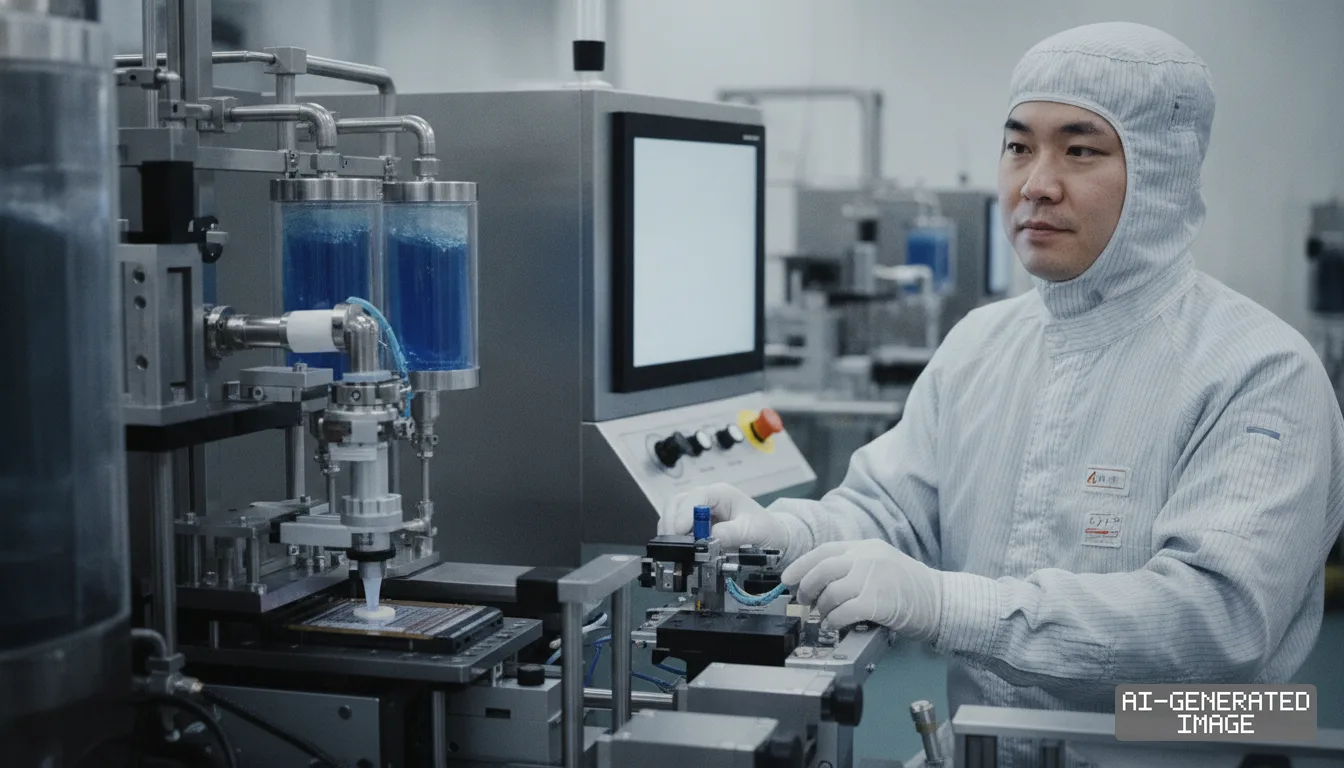
*A technician in cleanroom attire operates automated chemical dispensing machinery inside a semiconductor packaging facility. (AI-generated image)*
Nippon Shokubai completed its 20 billion yen ($127 million) buyout of GOO Chemical on Nov. 3, 2026, bringing specialized photosensitive polymers in-house to supply advanced chip packaging lines.
The transaction gives the Osaka-based chemical manufacturer full ownership of the Kyoto specialty polymer producer, absorbing 3,520,000 common shares. The sellers included private equity vehicle MCP V, LPS and individual shareholders.
The 20 billion yen purchase price values GOO Chemical at roughly 2.9 times its annual sales. GOO Chemical generated 6.925 billion yen ($43.8 million) in revenue and 846 million yen ($5.4 million) in operating profit for the fiscal year ended March 2026.
The transaction executes a core mandate of Nippon Shokubai's Medium-term Business Plan 2027. The company wants its Solutions Business segment to generate more than 50% of group operating profit by the fiscal year ending March 2028.
Nippon Shokubai built its corporate base on bulk petrochemicals, supplying acrylic acid and superabsorbent polymers that account for roughly a quarter of global disposable diaper production. Commoditization and regional capacity additions have squeezed petrochemical margins, forcing a structural pivot toward electronic materials.
GOO Chemical manufactures functional resin formulations, photoresist materials and insulating coatings for electronic components at its facilities in Uji, Kyoto Prefecture. The firm operated as a listed company on the Tokyo Stock Exchange Standard Market before a management buyout took it private in 2022.
Advanced chip packaging has emerged as the critical bottleneck in high-performance computing. Modern artificial intelligence processors rely on multi-die architectures, connecting graphic processing units and high-bandwidth memory through silicon interposers and redistribution layers.
These dense packaging architectures demand insulating dielectric films and photosensitive binder resins with strict performance tolerances. Materials must provide low dielectric loss at high frequencies, withstand repeated thermal cycles, and maintain structural adhesion under operational stress.
Nippon Shokubai already produces upstream inputs for the electronics sector, including acrylic resins for optical films, functional monomers and crosslinked polymer fine particles used as spacers and additives in photoresists. The company lacked the downstream compounding and photosensitive resin synthesis capabilities required to deliver finished electronic packaging materials.
GOO Chemical fills that processing gap through proprietary emulsion polymerization, resin synthesis and photosensitive compounding technologies. The Kyoto firm formulates liquid resists and protective insulating materials tailored directly to circuit board fabricators and packaging contractors.
By integrating GOO Chemical, Nippon Shokubai establishes a direct vertical supply chain from raw acrylic monomers to formulated dielectric and resist systems. Controlling resin synthesis allows the combined entity to customize the molecular architecture of binders, adjusting thermal expansion coefficients to match copper redistribution traces and silicon dies.
The acquisition places Nippon Shokubai in competition with established Japanese electronic materials suppliers, including Resonac, Sumitomo Bakelite and Nagase & Co. Japanese formulators supply more than 80% of global semiconductor packaging resins and photosensitive permanent dielectrics, giving domestic players significant leverage across backend supply chains.
The transaction reshapes Nippon Shokubai's internal asset allocation. The group deployed 20 billion yen from its balance sheet to acquire net assets of 8.03 billion yen reported by GOO Chemical at the close of March 2026.
The board approved the transaction on Sept. 9, 2026, and signed the definitive share transfer contract on Oct. 16, 2026. The share transfer took legal effect Nov. 2, 2026, with post-closing governance structures taking effect the following day.
GOO Chemical's 6.925 billion yen revenue base will be consolidated into Nippon Shokubai's Solutions Business starting in the third quarter of the fiscal year ending March 2027. The acquired operation adds immediate positive operating earnings, backed by GOO Chemical's 12.2% operating profit margin.
Integration teams will combine Nippon Shokubai's synthetic chemistry research centers in Suita and Himeji with GOO Chemical's compounding laboratories in Kyoto. The companies will coordinate direct sales accounts across Taiwan, South Korea and mainland China, where outsourced assembly and test contractors expand advanced packaging capacity.
Specialty chemical consolidations in Japan reflect broader supply chain realignments driven by semiconductor packaging complexity. As front-end transistor scaling slows, chip performance gains depend heavily on substrate metallurgy and dielectric resin performance.
Foundries and packaging houses demand proprietary resin formulations that do not degrade under intense thermal loads. Upstream chemical synthesizers without custom compounding arms risk marginalization as commoditized raw material suppliers.
Nippon Shokubai plans to introduce its first jointly engineered packaging dielectric resins during the first half of the fiscal year starting April 1, 2027.
The voluntary filing did not disclose the financial advisory fees or the specific enterprise value multiple applied during contract negotiations, citing confidentiality obligations with the private equity sellers.
## Impact map
| Event | Korea | China | Japan | Global impact |
| --- | --- | --- | --- | --- |
| Packaging resin vertical integration | Memory makers secure alternate Japanese supplier for backend dielectric resins | Packaging lines face concentrated Japanese supply in photosensitive binder polymers | Nippon Shokubai integrates 6.925 billion yen specialty formulator into Solutions unit | AI packaging supply chain tightens link between basic monomer synthesis and formulated resists |
## In this story
- **Companies:** Nippon Shokubai, GOO Chemical
- **Tickers:** 4114.T
- **Exposed:** Resonac, Sumitomo Bakelite
- **Impact:** Supply Chain, Capex, Cost Structure
## Primary sources
1. shokubai.co.jp
2. minkabu.jp
3. assetsalon.online
4. kabutan.jp
5. yahoo.co.jp
---
Cite as: East Asia Brief, "Nippon Shokubai Buys GOO Chemical to Secure Packaging Resins," November 4, 2026. https://eastasiabrief.com/semiconductors/nippon-shokubai-buys-goo-chemical-secure-packaging-resins-1135